talk-data.com talk-data.com

Topic

Flink

Apache Flink

stream_processing batch_processing big_data

74

tagged

Activity Trend

7 peak/qtr
2020-Q1 2026-Q2

Activities

74 activities · Newest first

Summary

Real-time capabilities have quickly become an expectation for consumers. The complexity of providing those capabilities is still high, however, making it more difficult for small teams to compete. Meroxa was created to enable teams of all sizes to deliver real-time data applications. In this episode DeVaris Brown discusses the types of applications that are possible when teams don't have to manage the complex infrastructure necessary to support continuous data flows.

Announcements

Hello and welcome to the Data Engineering Podcast, the show about modern data management RudderStack helps you build a customer data platform on your warehouse or data lake. Instead of trapping data in a black box, they enable you to easily collect customer data from the entire stack and build an identity graph on your warehouse, giving you full visibility and control. Their SDKs make event streaming from any app or website easy, and their extensive library of integrations enable you to automatically send data to hundreds of downstream tools. Sign up free at dataengineeringpodcast.com/rudderstack Your host is Tobias Macey and today I'm interviewing DeVaris Brown about the impact of real-time data on business opportunities and risk profiles

Interview

Introduction How did you get involved in the area of data management? Can you describe what Meroxa is and the story behind it?

How have the focus and goals of the platform and company evolved over the past 2 years?

Who are the target customers for Meroxa?

What problems are they trying to solve when they come to your platform?

Applications powered by real-time data were the exclusive domain of large and/or sophisticated tech companies for several years due to the inherent complexities involved. What are the shifts that have made them more accessible to a wider variety of teams?

What are some of the remaining blockers for teams who want to start using real-time data?

With the democratization of real-time data, what are the new categories of products and applications that are being unlocked?

How are organizations thinking about the potential value that those types of apps/services can provide?

With data flowing constantly, there are new challenges around oversight and accuracy. How does real-time data change the risk profile for applications that are consuming it?

What are some of the technical controls that are available for organizations that are risk-averse?

What skills do developers need to be able to effectively design, develop, and deploy real-time data applications?

How does this differ when talking about internal vs. consumer/end-user facing applications?

What are the most interesting, innovative, or unexpected ways that you have seen Meroxa used? What are the most interesting, unexpected, or challenging lessons that you have learned while working on Meroxa? When is Meroxa the wrong choice? What do you have planned for the future of Meroxa?

Contact Info

LinkedIn @devarispbrown on Twitter

Parting Question

From your perspective, what is the biggest gap in the tooling or technology for data management today?

Closing Announcements

Thank you for listening! Don't forget to check out our other shows. Podcast.init covers the Python language, its community, and the innovative ways it is being used. The Machine Learning Podcast helps you go from idea to production with machine learning. Visit the site to subscribe to the show, sign up for the mailing list, and read the show notes. If you've learned something or tried out a project from the show then tell us about it! Email [email protected]) with your story. To help other people find the show please leave a review on Apple Podcasts and tell your friends and co-workers

Links

Meroxa

Podcast Episode

Kafka Kafka Connect Conduit - golang Kafka connect replacement Pulsar Redpanda Flink Beam Clickhouse Druid Pinot

The intro and outro music is from The Hug by The Freak Fandango Orchestra / CC
Serving Near Real-Time Features at Scale

This presentation will first introduce the use case, which generates the price adjustments based on the network effect, and the corresponding model relies on the 108 near real-time features computed by Flink pipelines with the raw demand and supply events. Here is the simplified computation logic:

-The pipelines need to process the raw real-time events at the rate of 300k/s including both demand and supply -Each event needs to be computed on the geospatial, temporal and other dimensions -Each event contributes to the computation on the original hexagon and the 1K+ neighbours due to the fan-out effect of Kring smooth -Each event contributions to the aggregation on multiple window sizes up to 32 minutes, sliding by 1 minute, or 63 windows in total

Next the presentation will briefly go through the DAG of the Flink pipeline before optimization and the issues we faced: the pipeline could not run stably due to OOM and backpressure. The presentation will discuss how to optimize a streaming pipeline with the generic performance tuning framework, which focuses on three areas: Network, CPU and Memory, and five domains: Parallelism, Partition, Remote Call, Algorithm and Garbage Collector. The presentation will also show some example techniques being applied onto the pipelines by following the performance tuning framework.

Then the presentation will discuss one particular optimization technique: Customized Sliding Window.

Powering machine learning models with near real-time features can be quite challenging, due to computation logic complexity, write throughput, serving SLA, etc. In this talk, we have introduced some of the problems that we faced and our solutions to them, in the hope of aiding our peers in similar use cases.

Connect with us: Website: https://databricks.com Facebook: https://www.facebook.com/databricksinc Twitter: https://twitter.com/databricks LinkedIn: https://www.linkedin.com/company/data... Instagram: https://www.instagram.com/databricksinc/

Backfill Streaming Data Pipelines in Kappa Architecture

Streaming data pipelines can fail due to various reasons. Since the source data, such as Kafka topics, often have limited retention, prolonged job failures can lead to data loss. Thus, streaming jobs need to be backfillable at all times to prevent data loss in case of failures. One solution is to increase the source's retention so that backfilling is simply replaying source streams, but extending Kafka retention is very costly for Netflix's data sizes. Another solution is to utilize source data stored in DWH, commonly known as the Lambda architecture. However, this method introduces significant code duplication, as it requires engineers to maintain a separate equivalent batch job. At Netflix, we have created the Iceberg Source Connector to provide backfilling capabilities to Flink streaming applications. It allows Flink to stream data stored in Apache Iceberg while mirroring Kafka's ordering semantics, enabling us to backfill large-scale stateful Flink pipelines at low retention cost.

Connect with us: Website: https://databricks.com Facebook: https://www.facebook.com/databricksinc Twitter: https://twitter.com/databricks LinkedIn: https://www.linkedin.com/company/data... Instagram: https://www.instagram.com/databricksinc/

Beyond Daily Batch Processing: Operational Trade-Offs of Microbatch, Incremental, and Real-Time

Are you considering converting some batch daily pipelines to a realtime system? Perhaps restating multiple days of batch data is becoming unscalable for your pipelines. Maybe a short SLA is music to your stakeholders' ears. If you're flink-curious or possibly just sick of pondering your late arriving data, this discussion is for you.

On the Streaming Data Science and Engineering team at Netflix we support business-critical daily batch, hourly batch, incremental, and realtime pipelines with a rotating on-call system. In this presentation I'll discuss tradeoffs we experience between these systems with an emphasis on operational support when things go sideways. I'll also share some learnings about "goodness of fit" per processing type amongst various workloads with an eye for keeping your data timely and your colleagues sane.

Connect with us: Website: https://databricks.com Facebook: https://www.facebook.com/databricksinc Twitter: https://twitter.com/databricks LinkedIn: https://www.linkedin.com/company/data... Instagram: https://www.instagram.com/databricksinc/

Diving into Delta Lake 2.0

The Delta ecosystem rapidly expanded with the release of Delta Lake 1.2 which included integrations with Apache Spark™, Apache Flink, Presto, Trino, features such as OPTIMIZE, data skipping using column statistics, restore APIs, S3 multi-cluster writes, and more.

Join this session to learn about how the wider Delta community collaborated together to bring these features and integrations together; as well as the current roadmap. This will be an interactive session so come prepared with your questions—we should have answers!

Connect with us: Website: https://databricks.com Facebook: https://www.facebook.com/databricksinc Twitter: https://twitter.com/databricks LinkedIn: https://www.linkedin.com/company/data... Instagram: https://www.instagram.com/databricksinc/

Delta Lake 2.0 Overview

After three years of hard work by the Delta community, we are proud to announce the release of Delta Lake 2.0. Completing the work to open-source all of Delta Lake while tens of thousands of organizations were running in production was no small feat and we have the ever-expanding Delta community to thank! Join this session to learn about how the wider Delta community collaborated together to bring these features and integrations together.

Join this session to learn about how the wider Delta community collaborated together to bring these features and integrations together. This includes the Integrations with Apache Spark™, Apache Flink, Apache Pulsar, Presto, Trino, and more.

Features such as OPTIMIZE ZORDER, data skipping using column stats, S3 multi-cluster writes, Change Data Feed, and more.

Language APIs including Rust, Python, Ruby, GoLang, Scala, and Java.

Connect with us: Website: https://databricks.com Facebook: https://www.facebook.com/databricksinc Twitter: https://twitter.com/databricks LinkedIn: https://www.linkedin.com/company/data... Instagram: https://www.instagram.com/databricksinc/

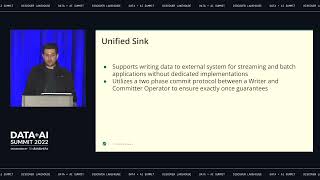
Sink Framework Evolution in Apache Flink

Apache Flink is one of the most popular frameworks for unified stream and batch processing. Like every other big data framework, Apache Flink offers connectors to different external systems to read from and write to. We refer to connectors for writing to external systems as sinks. Over the years, multiple frameworks existed inside Apache Flink for building sinks. The Apache Flink community also noticed the latest trend of ingesting real-time data directly into data lakes for further usage. Therefore with Apache Flink 1.15, we released the next iteration of our sink framework. We designed it to accommodate the needs of modern data lake connectors i.e. lazy file compaction, user-defined shuffling.

In this talk, we first give a brief historical glimpse of the evolution of the frameworks that started as a kind of a simple map operation until a custom operator model that simplified two-phase commit semantics. Secondly, we do a deep dive into Apache Flink’s fault tolerance model to explain how the last iteration of the sink framework supports exactly-once processing and complex operations important for delta lakes. In summary, this talk introduces the principles behind the sink framework in Apache Flink and gives a starting point for developers building a new connector for Apache Flink.

Connect with us: Website: https://databricks.com Facebook: https://www.facebook.com/databricksinc Twitter: https://twitter.com/databricks LinkedIn: https://www.linkedin.com/company/data... Instagram: https://www.instagram.com/databricksinc/

Airflow is the almost de-facto standard job orchestration tool that is used in the production stage. But moving your job from the development stage in other tools to the production stage in Airflow is usually a big pain for lots of users. A major reason is due to the environment inconsistency between the development environment and the production environment. Apache Zeppelin is a web-based notebook that is integrated seamlessly with lots of popular big data engines, such as Spark, Flink, Hive, Presto and etc. So it is very suitable for the development stage. In this talk, I will talk about the seamless integration between Airflow & Zeppelin, so that you can develop your big data job in Zeppelin efficiently and move to Airflow easily without caring too much about issues caused by the environment inconsistency.

Get your ticket for this workshop Tensorflow Extended (TFX) can run machine learning pipelines on Airflow, but all the steps are run by default in the same workers where the Airflow DAG is running. This can lead to an excessive usage of resources, and breaks the assumption that Airflow is a scheduler; it becomes also the data processing platform. In this session, we will see how to use TFX with third party services, on top of Google Cloud Platform. The data processing steps can be run in Dataflow, Spark, Flink and other runners (parallelizing the processing of data and scaling up to petabytes), and the training steps can be run in Vertex or other external services. After this workshop, you will have learnt how to externalize any TFX heavyweight computing outside Airflow, while maintaining Airflow as the orchestrator for your machine learning pipelines.

Mastering Apache Pulsar

Every enterprise application creates data, including log messages, metrics, user activity, and outgoing messages. Learning how to move these items is almost as important as the data itself. If you're an application architect, developer, or production engineer new to Apache Pulsar, this practical guide shows you how to use this open source event streaming platform to handle real-time data feeds. Jowanza Joseph, staff software engineer at Finicity, explains how to deploy production Pulsar clusters, write reliable event streaming applications, and build scalable real-time data pipelines with this platform. Through detailed examples, you'll learn Pulsar's design principles, reliability guarantees, key APIs, and architecture details, including the replication protocol, the load manager, and the storage layer. This book helps you: Understand how event streaming fits in the big data ecosystem Explore Pulsar producers, consumers, and readers for writing and reading events Build scalable data pipelines by connecting Pulsar with external systems Simplify event-streaming application building with Pulsar Functions Manage Pulsar to perform monitoring, tuning, and maintenance tasks Use Pulsar's operational measurements to secure a production cluster Process event streams using Flink and query event streams using Presto

Summary Data lake architectures have largely been biased toward batch processing workflows due to the volume of data that they are designed for. With more real-time requirements and the increasing use of streaming data there has been a struggle to merge fast, incremental updates with large, historical analysis. Vinoth Chandar helped to create the Hudi project while at Uber to address this challenge. By adding support for small, incremental inserts into large table structures, and building support for arbitrary update and delete operations the Hudi project brings the best of both worlds together. In this episode Vinoth shares the history of the project, how its architecture allows for building more frequently updated analytical queries, and the work being done to add a more polished experience to the data lake paradigm.

Announcements

Hello and welcome to the Data Engineering Podcast, the show about modern data management You listen to this show to learn about all of the latest tools, patterns, and practices that power data engineering projects across every domain. Now there’s a book that captures the foundational lessons and principles that underly everything that you hear about here. I’m happy to announce I collected wisdom from the community to help you in your journey as a data engineer and worked with O’Reilly to publish it as 97 Things Every Data Engineer Should Know. Go to dataengineeringpodcast.com/97things today to get your copy! When you’re ready to build your next pipeline, or want to test out the projects you hear about on the show, you’ll need somewhere to deploy it, so check out our friends at Linode. With their managed Kubernetes platform it’s now even easier to deploy and scale your workflows, or try out the latest Helm charts from tools like Pulsar and Pachyderm. With simple pricing, fast networking, object storage, and worldwide data centers, you’ve got everything you need to run a bulletproof data platform. Go to dataengineeringpodcast.com/linode today and get a $100 credit to try out a Kubernetes cluster of your own. And don’t forget to thank them for their continued support of this show! RudderStack’s smart customer data pipeline is warehouse-first. It builds your customer data warehouse and your identity graph on your data warehouse, with support for Snowflake, Google BigQuery, Amazon Redshift, and more. Their SDKs and plugins make event streaming easy, and their integrations with cloud applications like Salesforce and ZenDesk help you go beyond event streaming. With RudderStack you can use all of your customer data to answer more difficult questions and then send those insights to your whole customer data stack. Sign up free at dataengineeringpodcast.com/rudder today. We’ve all been asked to help with an ad-hoc request for data by the sales and marketing team. Then it becomes a critical report that they need updated every week or every day. Then what do you do? Send a CSV via email? Write some Python scripts to automate it? But what about incremental sync, API quotas, error handling, and all of the other details that eat up your time? Today, there is a better way. With Census, just write SQL or plug in your dbt models and start syncing your cloud warehouse to SaaS applications like Salesforce, Marketo, Hubspot, and many more. Go to dataengineeringpodcast.com/census today to get a free 14-day trial. Your host is Tobias Macey and today I’m interviewing Vinoth Chandar about Apache Hudi, a data lake management layer for supporting fast and incremental updates to your tables.

Interview

Introduction How did you get involved in the area of data management? Can you describe what Hudi is and the story behind it? What are the use cases that it is focused on supporting? There have been a number of alternative table formats introduced for data lakes recently. How does Hudi compare to projects like Iceberg, Delta Lake, Hive, etc.? Can you describe how Hudi is architected?

How have the goals and design of Hudi changed or evolved since you first began working on it? If you were to start the whole project over today, what would you do differently?

Can you talk through the lifecycle of a data record as it is ingested, compacted, and queried in a Hudi deployment? One of the capabilities that is interesting to explore is support for arbitrary record deletion. Can you talk through why this is a challenging operation in data lake architectures?

How does Hudi make that a tractable problem?

What are the data platform components that are needed to support an installation of Hudi? What is involved in migrating an existing data lake to use Hudi?

How would someone approach supporting heterogeneous table formats in their lake?

As someone who has invested a lot of time in technologies for supporting data lakes, what are your thoughts on the tradeoffs of data lake vs data warehouse and the current trajectory of the ecosystem? What are the most interesting, innovative, or unexpected ways that you have seen Hudi used? What are the most interesting, unexpected, or challenging lessons that you have learned while working on Hudi? When is Hudi the wrong choice? What do you have planned for the future of Hudi?

Contact Info

Linkedin Twitter

Parting Question

From your perspective, what is the biggest gap in the tooling or technology for data management today?

Closing Announcements

Thank you for listening! Don’t forget to check out our other show, Podcast.init to learn about the Python language, its community, and the innovative ways it is being used. Visit the site to subscribe to the show, sign up for the mailing list, and read the show notes. If you’ve learned something or tried out a project from the show then tell us about it! Email [email protected]) with your story. To help other people find the show please leave a review on iTunes and tell your friends and co-workers Join the community in the new Zulip chat workspace at dataengineeringpodcast.com/chat

Links

Hudi Docs Hudi Design & Architecture Incremental Processing CDC == Change Data Capture

Podcast Episodes

Oracle GoldenGate Voldemort Kafka Hadoop Spark HBase Parquet Iceberg Table Format

Data Engineering Episode

Hive ACID Apache Kudu

Podcast Episode

Vertica Delta Lake

Podcast Episode

Optimistic Concurrency Control MVCC == Multi-Version Concurrency Control Presto Flink

Podcast Episode

Trino

Podcast Episode

Gobblin LakeFS

Podcast Episode

Nessie

The intro and outro music is from The Hug by The Freak Fandango Orchestra / CC BY-SA
Support Data Engineering Podcast

Summary In memory computing provides significant performance benefits, but brings along challenges for managing failures and scaling up. Hazelcast is a platform for managing stateful in-memory storage and computation across a distributed cluster of commodity hardware. On top of this foundation, the Hazelcast team has also built a streaming platform for reliable high throughput data transmission. In this episode Dale Kim shares how Hazelcast is implemented, the use cases that it enables, and how it complements on-disk data management systems.

Announcements

Hello and welcome to the Data Engineering Podcast, the show about modern data management What are the pieces of advice that you wish you had received early in your career of data engineering? If you hand a book to a new data engineer, what wisdom would you add to it? I’m working with O’Reilly on a project to collect the 97 things that every data engineer should know, and I need your help. Go to dataengineeringpodcast.com/97things to add your voice and share your hard-earned expertise. When you’re ready to build your next pipeline, or want to test out the projects you hear about on the show, you’ll need somewhere to deploy it, so check out our friends at Linode. With their managed Kubernetes platform it’s now even easier to deploy and scale your workflows, or try out the latest Helm charts from tools like Pulsar and Pachyderm. With simple pricing, fast networking, object storage, and worldwide data centers, you’ve got everything you need to run a bulletproof data platform. Go to dataengineeringpodcast.com/linode today and get a $60 credit to try out a Kubernetes cluster of your own. And don’t forget to thank them for their continued support of this show! Tree Schema is a data catalog that is making metadata management accessible to everyone. With Tree Schema you can create your data catalog and have it fully populated in under five minutes when using one of the many automated adapters that can connect directly to your data stores. Tree Schema includes essential cataloging features such as first class support for both tabular and unstructured data, data lineage, rich text documentation, asset tagging and more. Built from the ground up with a focus on the intersection of people and data, your entire team will find it easier to foster collaboration around your data. With the most transparent pricing in the industry – $99/mo for your entire company – and a money-back guarantee for excellent service, you’ll love Tree Schema as much as you love your data. Go to dataengineeringpodcast.com/treeschema today to get your first month free, and mention this podcast to get %50 off your first three months after the trial. You listen to this show to learn and stay up to date with what’s happening in databases, streaming platforms, big data, and everything else you need to know about modern data platforms. For more opportunities to stay up to date, gain new skills, and learn from your peers there are a growing number of virtual events that you can attend from the comfort and safety of your home. Go to dataengineeringpodcast.com/conferences to check out the upcoming events being offered by our partners and get registered today! Your host is Tobias Macey and today I’m interviewing Dale Kim about Hazelcast, a distributed in-memory computing platform for data intensive applications

Interview

Introduction How did you get involved in the area of data management? Can you start by describing what Hazelcast is and its origins? What are the benefits and tradeoffs of in-memory computation for data-intensive workloads? What are some of the common use cases for the Hazelcast in memory grid? How is Hazelcast implemented?

How has the architecture evolved since it was first created?

How is the Jet streaming framework architected?

What was the motivation for building it? How do the capabilities of Jet compare to systems such as Flink or Spark Streaming?

How has the introduction of hardware capabilities such as NVMe drives influenced the market for in-memory systems? How is the governance of the open source grid and Jet projects handled?

What is the guiding heuristic for which capabilities or features to include in the open source projects vs. the commercial offerings?

What is involved in building an application or workflow on top of Hazelcast? What are the common patterns for engineers who are building on top of Hazelcast? What is involved in deploying and maintaining an installation of the Hazelcast grid or Jet streaming? What are the scaling factors for Hazelcast?

What are the edge cases that users should be aware of?

What are some of the most interesting, innovative, or unexpected ways that you have seen Hazelcast used? When is Hazelcast Grid or Jet the wrong choice? What is in store for the future of Hazelcast?

Contact Info

LinkedIn

Parting Question

From your perspective, what is the biggest gap in the tooling or technology for data management today?

Closing Announcements

Thank you for listening! Don’t forget to check out our other show, Podcast.init to learn about the Python language, its community, and the innovative ways it is being used. Visit the site to subscribe to the show, sign up for the mailing list, and read the show notes. If you’ve learned something or tried out a project from the show then tell us about it! Email [email protected]) with your story. To help other people find the show please leave a review on iTunes and tell your friends and co-workers Join the community in the new Zulip chat workspace at dataengineeringpodcast.com/chat

Links

HazelCast Istanbul Apache Spark OrientDB CAP Theorem NVMe Memristors Intel Optane Persistent Memory Hazelcast Jet Kappa Architecture IBM Cloud Paks Digital Integration Hub (Gartner)

The intro and outro music is from The Hug by The Freak Fandango Orchestra / CC BY-SA
Support Data Engineering Podcast

Summary The landscape of data management and processing is rapidly changing and evolving. There are certain foundational elements that have remained steady, but as the industry matures new trends emerge and gain prominence. In this episode Astasia Myers of Redpoint Ventures shares her perspective as an investor on which categories she is paying particular attention to for the near to medium term. She discusses the work being done to address challenges in the areas of data quality, observability, discovery, and streaming. This is a useful conversation to gain a macro perspective on where businesses are looking to improve their capabilities to work with data.

Announcements

Hello and welcome to the Data Engineering Podcast, the show about modern data management What are the pieces of advice that you wish you had received early in your career of data engineering? If you hand a book to a new data engineer, what wisdom would you add to it? I’m working with O’Reilly on a project to collect the 97 things that every data engineer should know, and I need your help. Go to dataengineeringpodcast.com/97things to add your voice and share your hard-earned expertise. When you’re ready to build your next pipeline, or want to test out the projects you hear about on the show, you’ll need somewhere to deploy it, so check out our friends at Linode. With their managed Kubernetes platform it’s now even easier to deploy and scale your workflows, or try out the latest Helm charts from tools like Pulsar to get you up and running in no time. With simple pricing, fast networking, S3 compatible object storage, and worldwide data centers, you’ve got everything you need to run a bulletproof data platform. Go to dataengineeringpodcast.com/linode today and get a $60 credit to try out a Kubernetes cluster of your own. And don’t forget to thank them for their continued support of this show! You listen to this show because you love working with data and want to keep your skills up to date. Machine learning is finding its way into every aspect of the data landscape. Springboard has partnered with us to help you take the next step in your career by offering a scholarship to their Machine Learning Engineering career track program. In this online, project-based course every student is paired with a Machine Learning expert who provides unlimited 1:1 mentorship support throughout the program via video conferences. You’ll build up your portfolio of machine learning projects and gain hands-on experience in writing machine learning algorithms, deploying models into production, and managing the lifecycle of a deep learning prototype. Springboard offers a job guarantee, meaning that you don’t have to pay for the program until you get a job in the space. The Data Engineering Podcast is exclusively offering listeners 20 scholarships of $500 to eligible applicants. It only takes 10 minutes and there’s no obligation. Go to dataengineeringpodcast.com/springboard and apply today! Make sure to use the code AISPRINGBOARD when you enroll. Your host is Tobias Macey and today I’m interviewing Astasia Myers about the trends in the data industry that she sees as an investor at Redpoint Ventures

Interview

Introduction How did you get involved in the area of data management? Can you start by giving an overview of Redpoint Ventures and your role there? From an investor perspective, what is most appealing about the category of data-oriented businesses? What are the main sources of information that you rely on to keep up to date with what is happening in the data industry?

What is your personal heuristic for determining the relevance of any given piece of information to decide whether it is worthy of further investigation?

As someone who works closely with a variety of companies across different industry verticals and different areas of focus, what are some of the common trends that you have identified in the data ecosystem? In your article that covers the trends you are keeping an eye on for 2020 you call out 4 in particular, data quality, data catalogs, observability of what influences critical business indicators, and streaming data. Taking those in turn:

What are the driving factors that influence data quality, and what elements of that problem space are being addressed by the companies you are watching?

What are the unsolved areas that you see as being viable for newcomers?

What are the challenges faced by businesses in establishing and maintaining data catalogs?

What approaches are being taken by the companies who are trying to solve this problem?

What shortcomings do you see in the available products?

For gaining visibility into the forces that impact the key performance indicators (KPI) of businesses, what is lacking in the current approaches?

What additional information needs to be tracked to provide the needed context for making informed decisions about what actions to take to improve KPIs? What challenges do businesses in this observability space face to provide useful access and analysis to this collected data?

Streaming is an area that has been growing rapidly over the past few years, with many open source and commercial options. What are the major business opportunities that you see to make streaming more accessible and effective?

What are the main factors that you see as driving this growth in the need for access to streaming data?

With your focus on these trends, how does that influence your investment decisions and where you spend your time? What are the unaddressed markets or product categories that you see which would be lucrative for new businesses? In most areas of technology now there is a mix of open source and commercial solutions to any given problem, with varying levels of maturity and polish between them. What are your views on the balance of this relationship in the data ecosystem?

For data in particular, there is a strong potential for vendor lock-in which can cause potential customers to avoid adoption of commercial solutions. What has been your experience in that regard with the companies that you work with?

Contact Info

@AstasiaMyers on Twitter @astasia on Medium LinkedIn

Parting Question

From your perspective, what is the biggest gap in the tooling or technology for data management today?

Closing Announcements

Thank you for listening! Don’t forget to check out our other show, Podcast.init to learn about the Python language, its community, and the innovative ways it is being used. Visit the site to subscribe to the show, sign up for the mailing list, and read the show notes. If you’ve learned something or tried out a project from the show then tell us about it! Email [email protected]) with your story. To help other people find the show please leave a review on iTunes and tell your friends and co-workers Join the community in the new Zulip chat workspace at dataengineeringpodcast.com/chat

Links

Redpoint Ventures 4 Data Trends To Watch in 2020 Seagate Western Digital Pure Storage Cisco Cohesity Looker

Podcast Episode

DGraph

Podcast Episode

Dremio

Podcast Episode

SnowflakeDB

Podcast Episode

Thoughspot Tibco Elastic Splunk Informatica Data Council DataCoral Mattermost Bitwarden Snowplow

Podcast Interview Interview About Snowplow Infrastructure

CHAOSSEARCH

Podcast Episode

Kafka Streams Pulsar

Podcast Interview Followup Podcast Interview

Soda Toro Great Expectations Alation Collibra Amundsen DataHub Netflix Metacat Marquez

Podcast Episode

LDAP == Lightweight Directory Access Protocol Anodot Databricks Flink

a…

Summary Data lakes offer a great deal of flexibility and the potential for reduced cost for your analytics, but they also introduce a great deal of complexity. What used to be entirely managed by the database engine is now a composition of multiple systems that need to be properly configured to work in concert. In order to bring the DBA into the new era of data management the team at Upsolver added a SQL interface to their data lake platform. In this episode Upsolver CEO Ori Rafael and CTO Yoni Iny describe how they have grown their platform deliberately to allow for layering SQL on top of a robust foundation for creating and operating a data lake, how to bring more people on board to work with the data being collected, and the unique benefits that a data lake provides. This was an interesting look at the impact that the interface to your data can have on who is empowered to work with it.

Announcements

Hello and welcome to the Data Engineering Podcast, the show about modern data management What are the pieces of advice that you wish you had received early in your career of data engineering? If you hand a book to a new data engineer, what wisdom would you add to it? I’m working with O’Reilly on a project to collect the 97 things that every data engineer should know, and I need your help. Go to dataengineeringpodcast.com/97things to add your voice and share your hard-earned expertise. When you’re ready to build your next pipeline, or want to test out the projects you hear about on the show, you’ll need somewhere to deploy it, so check out our friends at Linode. With their managed Kubernetes platform it’s now even easier to deploy and scale your workflows, or try out the latest Helm charts from tools like Pulsar and Pachyderm. With simple pricing, fast networking, object storage, and worldwide data centers, you’ve got everything you need to run a bulletproof data platform. Go to dataengineeringpodcast.com/linode today and get a $60 credit to try out a Kubernetes cluster of your own. And don’t forget to thank them for their continued support of this show! You listen to this show because you love working with data and want to keep your skills up to date. Machine learning is finding its way into every aspect of the data landscape. Springboard has partnered with us to help you take the next step in your career by offering a scholarship to their Machine Learning Engineering career track program. In this online, project-based course every student is paired with a Machine Learning expert who provides unlimited 1:1 mentorship support throughout the program via video conferences. You’ll build up your portfolio of machine learning projects and gain hands-on experience in writing machine learning algorithms, deploying models into production, and managing the lifecycle of a deep learning prototype. Springboard offers a job guarantee, meaning that you don’t have to pay for the program until you get a job in the space. The Data Engineering Podcast is exclusively offering listeners 20 scholarships of $500 to eligible applicants. It only takes 10 minutes and there’s no obligation. Go to dataengineeringpodcast.com/springboard and apply today! Make sure to use the code AISPRINGBOARD when you enroll. Your host is Tobias Macey and today I’m interviewing Ori Rafael and Yoni Iny about building a data lake for the DBA at Upsolver

Interview

Introduction How did you get involved in the area of data management? Can you start by sharing your definition of what a data lake is and what it is comprised of? We talked last in November of 2018. How has the landscape of data lake technologies and adoption changed in that time?

How has Upsolver changed or evolved since we last spoke?

How has the evolution of the underlying technologies impacted your implementation and overall product strategy?

What are some of the common challenges that accompany a data lake implementation? How do those challenges influence the adoption or viability of a data lake? How does the introduction of a universal SQL layer change the staffing requirements for building and maintaining a data lake?

What are the advantages of a data lake over a data warehouse if everything is being managed via SQL anyway?

What are some of the underlying realities of the data systems that power the lake which will eventually need to be understood by the operators of the platform? How is the SQL layer in Upsolver implemented?

What are the most challenging or complex aspects of managing the underlying technologies to provide automated partitioning, indexing, etc.?

What are the main concepts that you need to educate your customers on? What are some of the pitfalls that users should be aware of? What features of your platform are often overlooked or underutilized which you think should be more widely adopted? What have you found to be the most interesting, unexpected, or challenging lessons learned while building the technical and business elements of Upsolver? What do you have planned for the future?

Contact Info

Ori

LinkedIn

Yoni

yoniiny on GitHub LinkedIn

Parting Question

From your perspective, what is the biggest gap in the tooling or technology for data management today?

Links

Upsolver

Podcast Episode

DBA == Database Administrator IDF == Israel Defense Forces Data Lake Eventual Consistency Apache Spark Redshift Spectrum Azure Synapse Analytics SnowflakeDB

Podcast Episode

BigQuery Presto

Podcast Episode

Apache Kafka Cartesian Product kSQLDB

Podcast Episode

Eventador

Podcast Episode

Materialize

Podcast Episode

Common Table Expressions Lambda Architecture Kappa Architecture Apache Flink

Podcast Episode

Reinforcement Learning Cloudformation GDPR

The intro and outro music is from The Hug by The Freak Fandango Orchestra / CC BY-SA
Support Data Engineering Podcast

Summary Modern applications frequently require access to real-time data, but building and maintaining the systems that make that possible is a complex and time consuming endeavor. Eventador is a managed platform designed to let you focus on using the data that you collect, without worrying about how to make it reliable. In this episode Eventador Founder and CEO Kenny Gorman describes how the platform is architected, the challenges inherent to managing reliable streams of data, the simplicity offered by a SQL interface, and the interesting projects that his customers have built on top of it. This was an interesting inside look at building a business on top of open source stream processing frameworks and how to reduce the burden on end users.

Announcements

Hello and welcome to the Data Engineering Podcast, the show about modern data management When you’re ready to build your next pipeline, or want to test out the projects you hear about on the show, you’ll need somewhere to deploy it, so check out our friends at Linode. With 200Gbit private networking, scalable shared block storage, a 40Gbit public network, fast object storage, and a brand new managed Kubernetes platform, you’ve got everything you need to run a fast, reliable, and bullet-proof data platform. And for your machine learning workloads, they’ve got dedicated CPU and GPU instances. Go to dataengineeringpodcast.com/linode today to get a $20 credit and launch a new server in under a minute. And don’t forget to thank them for their continued support of this show! Your host is Tobias Macey and today I’m interviewing Kenny Gorman about the Eventador streaming SQL platform

Interview

Introduction How did you get involved in the area of data management? Can you start by describing what the Eventador platform is and the story behind it?

How has your experience at ObjectRocket influenced your approach to streaming SQL? How do the capabilities and developer experience of Eventador compare to other streaming SQL engines such as ksqlDB, Pulsar SQL, or Materialize?

What are the main use cases that you are seeing people use for streaming SQL?

How does it fit into an application architecture? What are some of the design changes in the different layers that are necessary to take advantage of the real time capabilities?

Can you describe how the Eventador platform is architected?

How has the system design evolved since you first began working on it? How has the overall landscape of streaming systems changed since you first began working on Eventador? If you were to start over today what would you do differently?

What are some of the most interesting and challenging operational aspects of running your platform? What are some of the ways that you have modified or augmented the SQL dialect that you support?

What is the tipping point for when SQL is insufficient for a given task and a user might want to leverage Flink?

What is the workflow for developing and deploying different SQL jobs?

How do you handle versioning of the queries and integration with the software development lifecycle?

What are some data modeling considerations that users should be aware of?

What are some of the sharp edges or design pitfalls that users should be aware of?

What are some of the most interesting, innovative, or unexpected ways that you have seen your customers use your platform? What are some of the most interesting, unexpected, or challenging lessons that you have learned in the process of building and scaling Eventador? What do you have planned for the future of the platform?

Contact Info

LinkedIn Blog @kennygorman on Twitter kgorman on Twitter

Parting Question

From your perspective, what is the biggest gap in the tooling or technology for data management today?

Closing Announcements

Thank you for listening! Don’t forget to check out our other show, Podcast.init to learn about the Python language, its community, and the innovative ways it is being used. Visit t

Stream Processing with Apache Spark

Before you can build analytics tools to gain quick insights, you first need to know how to process data in real time. With this practical guide, developers familiar with Apache Spark will learn how to put this in-memory framework to use for streaming data. You’ll discover how Spark enables you to write streaming jobs in almost the same way you write batch jobs. Authors Gerard Maas and François Garillot help you explore the theoretical underpinnings of Apache Spark. This comprehensive guide features two sections that compare and contrast the streaming APIs Spark now supports: the original Spark Streaming library and the newer Structured Streaming API. Learn fundamental stream processing concepts and examine different streaming architectures Explore Structured Streaming through practical examples; learn different aspects of stream processing in detail Create and operate streaming jobs and applications with Spark Streaming; integrate Spark Streaming with other Spark APIs Learn advanced Spark Streaming techniques, including approximation algorithms and machine learning algorithms Compare Apache Spark to other stream processing projects, including Apache Storm, Apache Flink, and Apache Kafka Streams

Stream Processing with Apache Flink

Get started with Apache Flink, the open source framework that powers some of the world’s largest stream processing applications. With this practical book, you’ll explore the fundamental concepts of parallel stream processing and discover how this technology differs from traditional batch data processing. Longtime Apache Flink committers Fabian Hueske and Vasia Kalavri show you how to implement scalable streaming applications with Flink’s DataStream API and continuously run and maintain these applications in operational environments. Stream processing is ideal for many use cases, including low-latency ETL, streaming analytics, and real-time dashboards as well as fraud detection, anomaly detection, and alerting. You can process continuous data of any kind, including user interactions, financial transactions, and IoT data, as soon as you generate them. Learn concepts and challenges of distributed stateful stream processing Explore Flink’s system architecture, including its event-time processing mode and fault-tolerance model Understand the fundamentals and building blocks of the DataStream API, including its time-based and statefuloperators Read data from and write data to external systems with exactly-once consistency Deploy and configure Flink clusters Operate continuously running streaming applications

Mastering Hadoop 3

"Mastering Hadoop 3" is your in-depth guide to understanding and mastering the advanced features of the Hadoop ecosystem. With a focus on distributed computing and data processing, this book covers essential tools such as YARN, MapReduce, and Apache Spark to help you build scalable, efficient data pipelines. What this Book will help me do Gain a comprehensive understanding of Hadoop Distributed File System (HDFS) and YARN for effective resource management. Master data processing with MapReduce and learn to integrate with real-time processing engines like Spark and Flink. Develop and secure enterprise-grade Hadoop-based data pipelines by implementing robust security and governance measures. Explore techniques for batch data processing, data modeling, and designing applications tailored for Hadoop environments. Understand best practices for optimizing and troubleshooting Hadoop clusters for enhanced performance and reliability. Author(s) The authors, including None Wong, None Singh, and None Kumar, bring together years of experience in big data engineering, distributed systems, and enterprise application development. They aim to provide a clear pathway to mastering Hadoop ecosystem tools. Who is it for? This book is ideal for budding big data professionals who have some familiarity with Java and basic Hadoop concepts and wish to elevate their expertise. If you're a Hadoop career practitioner keen to expand your understanding of the ecosystem's advanced capabilities or a professional looking to implement Hadoop in organizational workflows, this book is well-suited for you.

Summary

The past year has been an active one for the timeseries market. New products have been launched, more businesses have moved to streaming analytics, and the team at Timescale has been keeping busy. In this episode the TimescaleDB CEO Ajay Kulkarni and CTO Michael Freedman stop by to talk about their 1.0 release, how the use cases for timeseries data have proliferated, and how they are continuing to simplify the task of processing your time oriented events.

Introduction

Hello and welcome to the Data Engineering Podcast, the show about modern data management When you’re ready to build your next pipeline, or want to test out the projects you hear about on the show, you’ll need somewhere to deploy it, so check out Linode. With 200Gbit private networking, scalable shared block storage, and a 40Gbit public network, you’ve got everything you need to run a fast, reliable, and bullet-proof data platform. If you need global distribution, they’ve got that covered too with world-wide datacenters including new ones in Toronto and Mumbai. Go to dataengineeringpodcast.com/linode today to get a $20 credit and launch a new server in under a minute. Go to dataengineeringpodcast.com to subscribe to the show, sign up for the mailing list, read the show notes, and get in touch. To help other people find the show please leave a review on iTunes, or Google Play Music, tell your friends and co-workers, and share it on social media. Join the community in the new Zulip chat workspace at dataengineeringpodcast.com/chat Your host is Tobias Macey and today I’m welcoming Ajay Kulkarni and Mike Freedman back to talk about how TimescaleDB has grown and changed over the past year

Interview

Introduction How did you get involved in the area of data management? Can you refresh our memory about what TimescaleDB is? How has the market for timeseries databases changed since we last spoke? What has changed in the focus and features of the TimescaleDB project and company? Toward the end of 2018 you launched the 1.0 release of Timescale. What were your criteria for establishing that milestone?

What were the most challenging aspects of reaching that goal?

In terms of timeseries workloads, what are some of the factors that differ across varying use cases?

How do those differences impact the ways in which Timescale is used by the end user, and built by your team?

What are some of the initial assumptions that you made while first launching Timescale that have held true, and which have been disproven? How have the improvements and new features in the recent releases of PostgreSQL impacted the Timescale product?

Have you been able to leverage some of the native improvements to simplify your implementation? Are there any use cases for Timescale that would have been previously impractical in vanilla Postgres that would now be reasonable without the help of Timescale?

What is in store for the future of the Timescale product and organization?

Contact Info

Ajay

@acoustik on Twitter LinkedIn

Mike

LinkedIn Website @michaelfreedman on Twitter

Timescale

Website Documentation Careers timescaledb on GitHub @timescaledb on Twitter

Parting Question

From your perspective, what is the biggest gap in the tooling or technology for data management today?

Links

TimescaleDB Original Appearance on the Data Engineering Podcast 1.0 Release Blog Post PostgreSQL

Podcast Interview

RDS DB-Engines MongoDB IOT (Internet Of Things) AWS Timestream Kafka Pulsar

Podcast Episode

Spark

Podcast Episode

Flink

Podcast Episode

Hadoop DevOps PipelineDB

Podcast Interview

Grafana Tableau Prometheus OLTP (Online Transaction Processing) Oracle DB Data Lake

The intro and outro music is from The Hug by The Freak Fandango Orchestra / CC BY-SA Support Data Engineering Podcast
Summary

As more companies and organizations are working to gain a real-time view of their business, they are increasingly turning to stream processing technologies to fullfill that need. However, the storage requirements for continuous, unbounded streams of data are markedly different than that of batch oriented workloads. To address this shortcoming the team at Dell EMC has created the open source Pravega project. In this episode Tom Kaitchuk explains how Pravega simplifies storage and processing of data streams, how it integrates with processing engines such as Flink, and the unique capabilities that it provides in the area of exactly once processing and transactions. And if you listen at approximately the half-way mark, you can hear as the hosts mind is blown by the possibilities of treating everything, including schema information, as a stream.

Preamble

Hello and welcome to the Data Engineering Podcast, the show about modern data management When you’re ready to build your next pipeline, or want to test out the projects you hear about on the show, you’ll need somewhere to deploy it, so check out Linode. With 200Gbit private networking, scalable shared block storage, and a 40Gbit public network, you’ve got everything you need to run a fast, reliable, and bullet-proof data platform. If you need global distribution, they’ve got that covered too with world-wide datacenters including new ones in Toronto and Mumbai. Go to dataengineeringpodcast.com/linode today to get a $20 credit and launch a new server in under a minute. Go to dataengineeringpodcast.com to subscribe to the show, sign up for the mailing list, read the show notes, and get in touch. To help other people find the show please leave a review on iTunes, or Google Play Music, tell your friends and co-workers, and share it on social media. Join the community in the new Zulip chat workspace at dataengineeringpodcast.com/chat Your host is Tobias Macey and today I’m interviewing Tom Kaitchuck about Pravega, an open source data storage platform optimized for persistent streams

Interview

Introduction How did you get involved in the area of data management? Can you start by explaining what Pravega is and the story behind it? What are the use cases for Pravega and how does it fit into the data ecosystem?

How does it compare with systems such as Kafka and Pulsar for ingesting and persisting unbounded data?

How do you represent a stream on-disk?

What are the benefits of using this format for persisted streams?

One of the compelling aspects of Pravega is the automatic sharding and resource allocation for variations in data patterns. Can you describe how that operates and the benefits that it provides? I am also intrigued by the automatic tiering of the persisted storage. How does that work and what options exist for managing the lifecycle of the data in the cluster? For someone who wants to build an application on top of Pravega, what interfaces does it provide and what architectural patterns does it lend itself toward? What are some of the unique system design patterns that are made possible by Pravega? How is Pravega architected internally? What is involved in integrating engines such as Spark, Flink, or Storm with Pravega? A common challenge for streaming systems is exactly once semantics. How does Pravega approach that problem?

Does it have any special capabilities for simplifying processing of out-of-order events?

For someone planning a deployment of Pravega, what is involved in building and scaling a cluster?

What are some of the operational edge cases that users should be aware of?

What are some of the most interesting, useful, or challenging experiences that you have had while building Pravega? What are some cases where you would recommend against using Pravega? What is in store for the future of Pravega?

Contact Info

tkaitchuk on GitHub LinkedIn

Parting Question

From your perspective, what is the biggest gap in the tooli