talk-data.com talk-data.com

Topic

AWS

Amazon Web Services (AWS)

cloud cloud provider infrastructure services

837

tagged

Activity Trend

190 peak/qtr
2020-Q1 2026-Q1

Activities

837 activities · Newest first

Summary Data is useless if it isn’t being used, and you can’t use it if you don’t know where it is. Data catalogs were the first solution to this problem, but they are only helpful if you know what you are looking for. In this episode Shinji Kim discusses the challenges of data discovery and how to collect and preserve additional context about each piece of information so that you can find what you need when you don’t even know what you’re looking for yet.

Announcements

Hello and welcome to the Data Engineering Podcast, the show about modern data management When you’re ready to build your next pipeline, or want to test out the projects you hear about on the show, you’ll need somewhere to deploy it, so check out our friends at Linode. With their new managed database service you can launch a production ready MySQL, Postgres, or MongoDB cluster in minutes, with automated backups, 40 Gbps connections from your application hosts, and high throughput SSDs. Go to dataengineeringpodcast.com/linode today and get a $100 credit to launch a database, create a Kubernetes cluster, or take advantage of all of their other services. And don’t forget to thank them for their continued support of this show! Data stacks are becoming more and more complex. This brings infinite possibilities for data pipelines to break and a host of other issues, severely deteriorating the quality of the data and causing teams to lose trust. Sifflet solves this problem by acting as an overseeing layer to the data stack – observing data and ensuring it’s reliable from ingestion all the way to consumption. Whether the data is in transit or at rest, Sifflet can detect data quality anomalies, assess business impact, identify the root cause, and alert data teams’ on their preferred channels. All thanks to 50+ quality checks, extensive column-level lineage, and 20+ connectors across the Data Stack. In addition, data discovery is made easy through Sifflet’s information-rich data catalog with a powerful search engine and real-time health statuses. Listeners of the podcast will get $2000 to use as platform credits when signing up to use Sifflet. Sifflet also offers a 2-week free trial. Find out more at dataengineeringpodcast.com/sifflet today! The biggest challenge with modern data systems is understanding what data you have, where it is located, and who is using it. Select Star’s data discovery platform solves that out of the box, with an automated catalog that includes lineage from where the data originated, all the way to which dashboards rely on it and who is viewing them every day. Just connect it to your database/data warehouse/data lakehouse/whatever you’re using and let them do the rest. Go to dataengineeringpodcast.com/selectstar today to double the length of your free trial and get a swag package when you convert to a paid plan. Data teams are increasingly under pressure to deliver. According to a recent survey by Ascend.io, 95% in fact reported being at or over capacity. With 72% of data experts reporting demands on their team going up faster than they can hire, it’s no surprise they are increasingly turning to automation. In fact, while only 3.5% report having current investments in automation, 85% of data teams plan on investing in automation in the next 12 months. 85%!!! That’s where our friends at Ascend.io come in. The Ascend Data Automation Cloud provides a unified platform for data ingestion, transformation, orchestration, and observability. Ascend users love its declarative pipelines, powerful SDK, elegant UI, and extensible plug-in architecture, as well as its support for Python, SQL, Scala, and Java. Ascend automates workloads on Snowflake, Databricks, BigQuery, and open source Spark, and can be deployed in AWS, Azure, or GCP. Go to dataengineeringpodcast.com/ascend and sign up for a free trial. If you’re a data engineering podcast listener, you get credits worth $5,000 when you become a customer. Your host is Tobias M
In this episode, we’re talking to Brook Lovatt, Chief Executive Officer at Cloudentity. Cloudentity is a company that provides application and security teams with a better way to automate and control how information is shared over APIs.   We talk about the problems Cloudentity solves and how it came to be, along with the options available to today’s SaaS companies when it comes to building a security authorization layer. Brook shares some of the positive impacts of facilitating data sharing.   We discuss the differences between data and API, how SaaS has changed over time, the shift towards more product-oriented CEOs (and the advantages of this as a company scales), and the trend of selling software directly to developers.   Finally, we look at the growing importance of being a product specialist, and what the future holds for SaaS and developers.   This episode is brought to you by Qrvey The tools you need to take action with your data, on a platform built for maximum scalability, security, and cost efficiencies. If you’re ready to reduce complexity and dramatically lower costs, contact us today at qrvey.com. Qrvey, the modern no-code analytics solution for SaaS companies on AWS. 

Effective Data Science Infrastructure

Simplify data science infrastructure to give data scientists an efficient path from prototype to production. In Effective Data Science Infrastructure you will learn how to: Design data science infrastructure that boosts productivity Handle compute and orchestration in the cloud Deploy machine learning to production Monitor and manage performance and results Combine cloud-based tools into a cohesive data science environment Develop reproducible data science projects using Metaflow, Conda, and Docker Architect complex applications for multiple teams and large datasets Customize and grow data science infrastructure Effective Data Science Infrastructure: How to make data scientists more productive is a hands-on guide to assembling infrastructure for data science and machine learning applications. It reveals the processes used at Netflix and other data-driven companies to manage their cutting edge data infrastructure. In it, you’ll master scalable techniques for data storage, computation, experiment tracking, and orchestration that are relevant to companies of all shapes and sizes. You’ll learn how you can make data scientists more productive with your existing cloud infrastructure, a stack of open source software, and idiomatic Python. The author is donating proceeds from this book to charities that support women and underrepresented groups in data science. About the Technology Growing data science projects from prototype to production requires reliable infrastructure. Using the powerful new techniques and tooling in this book, you can stand up an infrastructure stack that will scale with any organization, from startups to the largest enterprises. About the Book Effective Data Science Infrastructure teaches you to build data pipelines and project workflows that will supercharge data scientists and their projects. Based on state-of-the-art tools and concepts that power data operations of Netflix, this book introduces a customizable cloud-based approach to model development and MLOps that you can easily adapt to your company’s specific needs. As you roll out these practical processes, your teams will produce better and faster results when applying data science and machine learning to a wide array of business problems. What's Inside Handle compute and orchestration in the cloud Combine cloud-based tools into a cohesive data science environment Develop reproducible data science projects using Metaflow, AWS, and the Python data ecosystem Architect complex applications that require large datasets and models, and a team of data scientists About the Reader For infrastructure engineers and engineering-minded data scientists who are familiar with Python. About the Author At Netflix, Ville Tuulos designed and built Metaflow, a full-stack framework for data science. Currently, he is the CEO of a startup focusing on data science infrastructure. Quotes By reading and referring to this book, I’m confident you will learn how to make your machine learning operations much more efficient and productive. - From the Foreword by Travis Oliphant, Author of NumPy, Founder of Anaconda, PyData, and NumFOCUS Effective Data Science Infrastructure is a brilliant book. It’s a must-have for every data science team. - Ninoslav Cerkez, Logit More data science. Less headaches. - Dr. Abel Alejandro Coronado Iruegas, National Institute of Statistics and Geography of Mexico Indispensable. A copy should be on every data engineer’s bookshelf. - Matthew Copple, Grand River Analytics

In this episode, we’re talking to Ken Babcock, Co-Founder of Tango. Tango is a platform for building beautiful step-by-step how-to guides with screenshots, in seconds.   Ken talks about meeting his co-founders at Harvard Business School and how the project got started, and we go on to discuss how well-defined processes and documentation can make a company much more scalable. How has the pandemic and the rise of remote work affected the need for clear instructions and documentation?   We talk about how SaaS companies can help other businesses transition to the digital world and the role well-documented processes play here. Is there a difference between B2B and B2C SaaS companies when it comes to digital transformation? We also discuss how companies might sometimes grow too fast and hinder progress this way.   Finally, we talk about the pros and cons of VC funding and what the near future holds for Tango.   This episode is brought to you by Qrvey The tools you need to take action with your data, on a platform built for maximum scalability, security, and cost efficiencies. If you’re ready to reduce complexity and dramatically lower costs, contact us today at qrvey.com. Qrvey, the modern no-code analytics solution for SaaS companies on AWS. 

Summary Exploratory data analysis works best when the feedback loop is fast and iterative. This is easy to achieve when you are working on small datasets, but as they scale up beyond what can fit on a single machine those short iterations quickly become long and tedious. The Arkouda project is a Python interface built on top of the Chapel compiler to bring back those interactive speeds for exploratory analysis on horizontally scalable compute that parallelizes operations on large volumes of data. In this episode David Bader explains how the framework operates, the algorithms that are built into it to support complex analyses, and how you can start using it today.

Announcements

Hello and welcome to the Data Engineering Podcast, the show about modern data management When you’re ready to build your next pipeline, or want to test out the projects you hear about on the show, you’ll need somewhere to deploy it, so check out our friends at Linode. With their new managed database service you can launch a production ready MySQL, Postgres, or MongoDB cluster in minutes, with automated backups, 40 Gbps connections from your application hosts, and high throughput SSDs. Go to dataengineeringpodcast.com/linode today and get a $100 credit to launch a database, create a Kubernetes cluster, or take advantage of all of their other services. And don’t forget to thank them for their continued support of this show! Data stacks are becoming more and more complex. This brings infinite possibilities for data pipelines to break and a host of other issues, severely deteriorating the quality of the data and causing teams to lose trust. Sifflet solves this problem by acting as an overseeing layer to the data stack – observing data and ensuring it’s reliable from ingestion all the way to consumption. Whether the data is in transit or at rest, Sifflet can detect data quality anomalies, assess business impact, identify the root cause, and alert data teams’ on their preferred channels. All thanks to 50+ quality checks, extensive column-level lineage, and 20+ connectors across the Data Stack. In addition, data discovery is made easy through Sifflet’s information-rich data catalog with a powerful search engine and real-time health statuses. Listeners of the podcast will get $2000 to use as platform credits when signing up to use Sifflet. Sifflet also offers a 2-week free trial. Find out more at dataengineeringpodcast.com/sifflet today! RudderStack helps you build a customer data platform on your warehouse or data lake. Instead of trapping data in a black box, they enable you to easily collect customer data from the entire stack and build an identity graph on your warehouse, giving you full visibility and control. Their SDKs make event streaming from any app or website easy, and their state-of-the-art reverse ETL pipelines enable you to send enriched data to any cloud tool. Sign up free… or just get the free t-shirt for being a listener of the Data Engineering Podcast at dataengineeringpodcast.com/rudder. Data teams are increasingly under pressure to deliver. According to a recent survey by Ascend.io, 95% in fact reported being at or over capacity. With 72% of data experts reporting demands on their team going up faster than they can hire, it’s no surprise they are increasingly turning to automation. In fact, while only 3.5% report having current investments in automation, 85% of data teams plan on investing in automation in the next 12 months. 85%!!! That’s where our friends at Ascend.io come in. The Ascend Data Automation Cloud provides a unified platform for data ingestion, transformation, orchestration, and observability. Ascend users love its declarative pipelines, powerful SDK, elegant UI, and extensible plug-in architecture, as well as its support for Python, SQL, Scala, and Java. Ascend automates workloads on Snowflake, Databricks, BigQuery, and open source Spark, and can be deployed in AWS, Azure, or GCP. Go to dataengineeringpodc

Welcome to the latest episode of SaaS Scaled. Today we’re joined by Chris Wacker, CEO at Laserfiche, the leading SaaS provider of intelligent content management and business process automation.   We chat about how Laserfiche came into being, how SaaS has changed and impacted business over the years, the impact of Covid, and the impact of widespread digital transformation on the world. Chris shares some of the key principles that make a SaaS team and product successful.   We go on to discuss the difference between short- and long-term thinking with SaaS and how to strike the right balance here, both in SaaS and in business generally. Finally, Chris shares a book that has had a big impact on him.   This episode is brought to you by Qrvey The tools you need to take action with your data, on a platform built for maximum scalability, security, and cost efficiencies. If you’re ready to reduce complexity and dramatically lower costs, contact us today at qrvey.com. Qrvey, the modern no-code analytics solution for SaaS companies on AWS.   

Summary The current stage of evolution in the data management ecosystem has resulted in domain and use case specific orchestration capabilities being incorporated into various tools. This complicates the work involved in making end-to-end workflows visible and integrated. Dagster has invested in bringing insights about external tools’ dependency graphs into one place through its "software defined assets" functionality. In this episode Nick Schrock discusses the importance of orchestration and a central location for managing data systems, the road to Dagster’s 1.0 release, and the new features coming with Dagster Cloud’s general availability.

Announcements

Hello and welcome to the Data Engineering Podcast, the show about modern data management When you’re ready to build your next pipeline, or want to test out the projects you hear about on the show, you’ll need somewhere to deploy it, so check out our friends at Linode. With their new managed database service you can launch a production ready MySQL, Postgres, or MongoDB cluster in minutes, with automated backups, 40 Gbps connections from your application hosts, and high throughput SSDs. Go to dataengineeringpodcast.com/linode today and get a $100 credit to launch a database, create a Kubernetes cluster, or take advantage of all of their other services. And don’t forget to thank them for their continued support of this show! RudderStack helps you build a customer data platform on your warehouse or data lake. Instead of trapping data in a black box, they enable you to easily collect customer data from the entire stack and build an identity graph on your warehouse, giving you full visibility and control. Their SDKs make event streaming from any app or website easy, and their state-of-the-art reverse ETL pipelines enable you to send enriched data to any cloud tool. Sign up free… or just get the free t-shirt for being a listener of the Data Engineering Podcast at dataengineeringpodcast.com/rudder. Data teams are increasingly under pressure to deliver. According to a recent survey by Ascend.io, 95% in fact reported being at or over capacity. With 72% of data experts reporting demands on their team going up faster than they can hire, it’s no surprise they are increasingly turning to automation. In fact, while only 3.5% report having current investments in automation, 85% of data teams plan on investing in automation in the next 12 months. 85%!!! That’s where our friends at Ascend.io come in. The Ascend Data Automation Cloud provides a unified platform for data ingestion, transformation, orchestration, and observability. Ascend users love its declarative pipelines, powerful SDK, elegant UI, and extensible plug-in architecture, as well as its support for Python, SQL, Scala, and Java. Ascend automates workloads on Snowflake, Databricks, BigQuery, and open source Spark, and can be deployed in AWS, Azure, or GCP. Go to dataengineeringpodcast.com/ascend and sign up for a free trial. If you’re a data engineering podcast listener, you get credits worth $5,000 when you become a customer. Your host is Tobias Macey and today I’m interviewing Nick Schrock about software defined assets and improving the developer experience for data orchestration with Dagster

Interview

Introduction How did you get involved in the area of data management? What are the notable updates in Dagster since the last time we spoke? (November, 2021) One of the core concepts that you introduced and then stabilized in recent releases is the "software defined asset" (SDA). How have your users reacted to this capability?

What are the notable outcomes in development and product practices that you have seen as a result?

What are the changes to the interfaces and internals of Dagster that were necessary to support SDA? How did the API design shift from the initial implementation once the community started providing feedback? You’re releasing the stable 1.0 version of Dagster as part of something call

In today’s episode of SaaS Scaled, we’re talking to Maria Thomas. Maria is Chief Product Officer at Buffer, a SaaS company building a social media and organic marketing platform for small businesses. Maria focuses on the design elements of marketing and engineering.    We chat about the main problems Buffer solves and how it came into being, and Maria talks about the importance of transparency within SaaS companies and the benefits of being a value-driven company.   We go on to discuss the future — how are Web3, decentralization, and other emerging technologies changing the way the internet works and how people monetize their work? Maria talks about vision and how Buffer defines its vision in a more narrow sense.   This episode is brought to you by Qrvey The tools you need to take action with your data, on a platform built for maximum scalability, security, and cost efficiencies. If you’re ready to reduce complexity and dramatically lower costs, contact us today at qrvey.com. Qrvey, the modern no-code analytics solution for SaaS companies on AWS. 

Secure Data Distribution and Insights with Databricks on AWS

Every industry must comply with some form of compliance or data security in order to operate. As data becomes more mission critical to the organization, so does the need to protect and secure it.

Public Sector organizations are responsible for securing sensitive data sets and complying with regulatory programs such as HIPAA, FedRAMP, and StateRAMP.

This does not come as a surprise given the many different attacks targeted at the industry and the extremely sensitive nature of the large volumes of data stored and analyzed. For a product owner or DBA, this can be extremely overwhelming with a security team issuing more restrictions and data access becoming more of a common request among business users. It can be difficult finding an effective governance model to democratize data while also managing compliance across your hybrid estate.

In this session, we will discuss challenges faced in the public sector when expanding to AWS cloud. We will review best practices for managing access and data integrity for a cloud-based data lakehouse with Databricks, and discuss recommended approaches for securing your AWS Cloud environment. We will highlight ways to enable compliance by developing a continuous monitoring strategy and providing tips for implementation of defense in depth. This guide will provide critical questions to ask, an overall strategy, and specific recommendations to serve all security leaders and data engineers in the Public Sector.

This talk is intended to educate on security design considerations when extending your data warehouse to the cloud. This guidance is expected to grow and evolve as new standards and offerings emerge for local, state, and federal government.

Connect with us: Website: https://databricks.com Facebook: https://www.facebook.com/databricksinc Twitter: https://twitter.com/databricks LinkedIn: https://www.linkedin.com/company/data... Instagram: https://www.instagram.com/databricksinc/

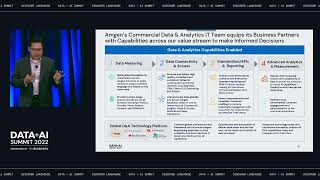
Amgen’s Journey To Building a Global 360 View of its Customers with the Lakehouse

Serving patients in over 100 countries, Amgen is a leading global biotech company focused on developing therapies that have the power to save lives. Delivering on this mission requires our commercial teams to regularly meet with healthcare providers to discuss new treatments that can help patients in need. With the onset of the pandemic, where face-to-face interactions with doctors and other Healthcare Providers (HCPs) were severely impacted, Amgen had to rethink these interactions. With that in mind, the Amgen Commercial Data and Analytics team leveraged a modern data and AI architecture built on the Databricks Lakehouse to help accelerate its digital and data insights capabilities. This foundation enabled Amgen’s teams to develop a comprehensive, customer-centric view to support flexible go-to-market models and provide personalized experiences to our customers. In this presentation, we will share our recent journey of how we took an agile approach to bringing together over 2.2 petabytes of internally generated and externally sourced vendor data , and onboard into our AWS Cloud and Databricks environments to enable a standardized, scalable and robust capabilities to meet the business requirements in our fast-changing life sciences environment. We will share use cases of how we harmonized and managed our diverse sets of data to deliver efficiency, simplification, and performance outcomes for the business. We will cover the following aspects of our journey along with best practices we learned over time: • Our architecture to support Amgen’s Commercial Data & Analytics constant processing around the globe • Engineering best practices for building large scale Data Lakes and Analytics platforms such as Team organization, Data Ingestion and Data Quality Frameworks, DevOps Toolkit and Maturity Frameworks, and more • Databricks capabilities adopted such as Delta Lake, Workspace policies, SQL workspace endpoints, and MLflow for model registry and deployment. Also, various tools were built for Databricks workspace administration • Databricks capabilities being explored for future, such as Multi-task Orchestration, Container-based Apache Spark Processing, Feature Store, Repos for Git integration, etc. • The types of commercial analytics use cases we are building on the Databricks Lakehouse platform Attendees building global and Enterprise scale data engineering solutions to meet diverse sets of business requirements will benefit from learning about our journey. Technologists will learn how we addressed specific Business problems via reusable capabilities built to maximize value.

Connect with us: Website: https://databricks.com Facebook: https://www.facebook.com/databricksinc Twitter: https://twitter.com/databricks LinkedIn: https://www.linkedin.com/company/data... Instagram: https://www.instagram.com/databricksinc/

Near Real-Time Analytics with Event Streaming, Live Tables, and Delta Sharing

Microservices is an increasingly popular architecture much loved by application teams, for it allows services to be developed and scaled independently. Data teams, though, often need a centralized repository where all data from different services come together to join and aggregate. The data platform can serve as a single source of company facts, enable near real time analytics, and secure sharing of massive data sets across clouds.

A viable microservices ingestion pattern is Change Data Capture, using AWS Database Migration Services or Debezium. CDC proves to be a scalable solution ideal for stable platforms, but it has several challenges for evolving services: Frequent schema changes, complex, unsupported DDL during migration, and automated deployments are but a few. An event streaming architecture can address these challenges.

Confluent, for example, provides a schema registry service where all services can register their event schemas. Schema registration helps with verifying that the events are being published based on the agreed contracts between data producers and consumers. It also provides a separation between internal service logic and the data consumed downstream. The services write their events to Kafka using the registered schemas with a specific topic based on the type of the event.

Data teams can leverage Spark jobs to ingest Kafka topics into Bronze tables in the Delta Lake. On ingestion, the registered schema from schema registry is used to validate the schema based on the provided version. A merge operation is sometimes called to translate events into final states of the records per business requirements.

Data teams can take advantage of Delta Live Tables on streaming datasets to produce Silver and Gold tables in near real time. Each input data source also has a set of expectations to ensure data quality and business rules. The pipeline allows Engineering and Analytics to collaborate by mixing Python and SQL. The refined data sets are then fed into Auto ML for discovery and baseline modeling.

To expose Gold tables to more consumers, especially non spark users across clouds, data teams can implement Delta Sharing. Recipients can accesses Silver tables from a different cloud and build their own analytics data sets. Analytics teams can also access Gold tables via pandas Delta Sharing client and BI tools.

Connect with us: Website: https://databricks.com Facebook: https://www.facebook.com/databricksinc Twitter: https://twitter.com/databricks LinkedIn: https://www.linkedin.com/company/data... Instagram: https://www.instagram.com/databricksinc/

Building a Lakehouse on AWS for Less with AWS Graviton and Photon

AWS Graviton processors are custom-designed by AWS to enable the best price performance for workloads in Amazon EC2. In this session we will review benchmarks that demonstrate how AWS Graviton based instances run Databricks workloads at a lower price and better performance than x86-based instances on AWS, and when combined with Photon, the new Databricks engine, the price performance gains are even greater. Learn how you can optimize your Databricks workloads on AWS and save more.

Website: https://databricks.com Facebook: https://www.facebook.com/databricksinc Twitter: https://twitter.com/databricks LinkedIn: https://www.linkedin.com/company/data... Instagram: https://www.instagram.com/databricksinc/

Running a Low Cost, Versatile Data Management Ecosystem with Apache Spark at Core

Data is the key component of Analytics, AI or ML platform. Organizations may not be successful without having a Platform that can Source, Transform, Quality check and present data in a reportable format that can drive actionable insights.

This session will focus on how Capital One HR Team built a Low Cost Data movement Ecosystem that can source data, transform at scale and build the data storage (Redshift) at a level that can be easily consumed by AI/ML programs - by using AWS Services with combination of Open source software(Spark) and Enterprise Edition Hydrograph (UI Based ETL tool with Spark as backend) This presentation is mainly to demonstrate the flexibility that Apache Spark provides for various types ETL Data Pipelines when we code in Spark.

We have been running 3 types of pipelines over 6+ years , over 400+ nightly batch jobs for $1000/mo. (1) Spark on EC2 (2) UI Based ETL tool with Spark backend (on the same EC2) (3) Spark on EMR. We have a CI/CD pipeline that supports easy integration and code deployment in all non-prod and prod regions ( even supports automated unit testing). We will also demonstrate how this ecosystem can failover to a different region in less than 15 minutes , making our application highly resilient.

Connect with us: Website: https://databricks.com Facebook: https://www.facebook.com/databricksinc Twitter: https://twitter.com/databricks LinkedIn: https://www.linkedin.com/company/data... Instagram: https://www.instagram.com/databricksinc/

Securing Databricks on AWS Using Private Link

Minimizing data transfers over the public internet is among the top priorities for organizations of any size, both for security and cost reasons. Modern cloud-native data analytics platforms need to support deployment architectures that meet this objective. For Databricks on AWS such an architecture is realized thanks to AWS PrivateLink, which allows computing resources deployed on different virtual private networks and different AWS accounts to communicate securely without ever crossing the public internet.

In this session, we want to provide a brief introduction to AWS Private Link and its main use cases in the context of a Databricks deployment: securing communications between control and data plane and securely connecting to the Databricks Web UI. We will then provide step-by-step walkthrough of the steps required in setting up PrivateLink connections with a Databricks deployment and demonstrate how to automate that process using AWS Cloud Formation or Terraform templates.

In this presentation we will cover the following topics: - Brief Introduction to AWS Private Link - How you can use PrivateLink to secure your AWS Databricks deployment - Step-by-step walkthrough of how to set up Private Link - How to automate and scale the setup using AWS CloudFormation or Terraform

Connect with us: Website: https://databricks.com Facebook: https://www.facebook.com/databricksinc Twitter: https://twitter.com/databricks LinkedIn: https://www.linkedin.com/company/data... Instagram: https://www.instagram.com/databricksinc/

Streaming Data into Delta Lake with Rust and Kafka

Scribd's data architecture was originally batch-oriented, but in the last couple years, we introduced streaming data ingestion to provide near-real-time ad hoc query capability, mitigate the need for more batch processing tasks, and set the foundation for building real-time data applications.

Kafka and Delta Lake are the two key components of our streaming ingestion pipeline. Various applications and services write messages to Kafka as events are happening. We were tasked with getting these messages into Delta Lake quickly and efficiently.

Our first solution was to deploy Spark Structured Streaming jobs. This got us off the ground quickly, but had some downsides.

Since Delta Lake and the Delta transaction protocol are open source, we kicked off a project to implement our own Rust ingestion daemon. We were confident we could deliver a Rust implementation since our ingestion jobs are append only. Rust offers high performance with a focus on code safety and modern syntax.

In this talk I will describe Scribd's unique approach to ingesting messages from Kafka topics into Delta Lake tables. I will describe the architecture, deployment model, and performance of our solution, which leverages the kafka-delta-ingest Rust daemon and the delta-rs crate hosted in auto-scaling ECS services. I will discuss foundational design aspects for achieving data integrity such as distributed locking with DynamoDb to overcome S3's lack of "PutIfAbsent" semantics, and avoiding duplicates or data loss when multiple concurrent tasks are handling the same stream. I'll highlight the reliability and performance characteristics we've observed so far. I'll also describe the Terraform deployment model we use to deliver our 70-and-growing production ingestion streams into AWS.

Connect with us: Website: https://databricks.com Facebook: https://www.facebook.com/databricksinc Twitter: https://twitter.com/databricks LinkedIn: https://www.linkedin.com/company/data... Instagram: https://www.instagram.com/databricksinc/

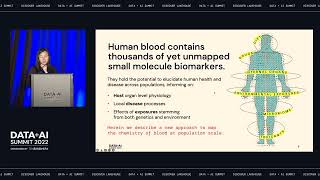
Turning Big Biology Data into Insights on Disease – The Power of Circulating Biomarkers

Profiling small molecules in human blood across global populations gives rise to a greater understanding of the varied biological pathways and processes that contribute to human health and diseases. Herein, we describe the development of a comprehensive Human Biology Database, derived from nontargeted molecular profiling of over 300,000 human blood samples from individuals across diverse backgrounds, demographics, geographical locations, lifestyles, diseases, and medication regimens, and its applications to inform drug development.

Approximately 11,000 circulating molecules have been captured and measured per sample using Sapient’s high-throughput, high-specificity rapid liquid chromatography-mass spectrometry (rLC-MS) platform. The samples come from cohorts with adjudicated clinical outcomes from prospective studies lasting 10-25 years, as well as data on individuals’ diet, nutrition, physical exercise, and mental health. Genetic information for a subset of subjects is also included and we have added microbiome sequencing data from over 150,000 human samples in diverse diseases.

An efficient data science environment is established to enable effective health insight mining across this vast database. Built on a customized AWS and Databricks “infrastructure-as-code” Terraform configuration, we employ streamlined data ETL and machine learning-based approaches for rapid rLC-MS data extraction. In mining the database, we have been able to identify circulating molecules potentially causal to disease; illuminate the impact of human exposures like diet and environment on disease development, aging, and mortality over decades of time; and support drug development efforts through identification of biomarkers of target engagement, pharmacodynamics, safety, efficacy, and more.

Connect with us: Website: https://databricks.com Facebook: https://www.facebook.com/databricksinc Twitter: https://twitter.com/databricks LinkedIn: https://www.linkedin.com/company/data... Instagram: https://www.instagram.com/databricksinc/

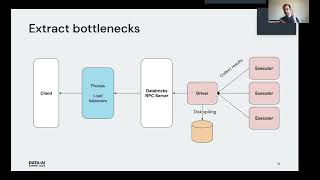
Cloud Fetch: High-bandwidth Connectivity With BI Tools

Business Intelligence (BI) tools such as Tableau and Microsoft Power BI are notoriously slow at extracting large query results from traditional data warehouses because they typically fetch the data in a single thread through a SQL endpoint that becomes a data transfer bottleneck. Data analysts can connect their BI tools to Databricks SQL endpoints to query data in tables through an ODBC/JDBC protocol integrated in our Simba drivers. With Cloud Fetch, which we released in Databricks Runtime 8.3 and Simba ODBC 2.6.17 driver, we introduce a new mechanism for fetching data in parallel via cloud storage such as AWS S3 and Azure Data Lake Storage to bring the data faster to BI tools. In our experiments using Cloud Fetch, we observed a 10x speed-up in extract performance due to parallelism.

Connect with us: Website: https://databricks.com Facebook: https://www.facebook.com/databricksinc Twitter: https://twitter.com/databricks LinkedIn: https://www.linkedin.com/company/data... Instagram: https://www.instagram.com/databricksinc/

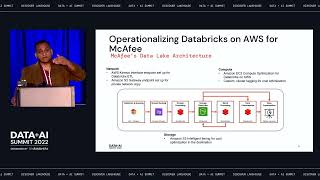
How McAfee Leverages Databricks on AWS at Scale

McAfee, a global leader in online protection security enables home users and businesses to stay ahead of fileless attacks, viruses, malware, and other online threats. Learn how McAfee leverages Databricks on AWS to create a centralized data platform as a single source of truth to power customer insights. We will also describe how McAfee uses additional AWS services specifically Kinesis and CloudWatch to provide real time data streaming and monitor and optimize their Databricks on AWS deployment. Finally, we’ll discuss business benefits and lessons learned during McAfee’s petabyte scale migration to Databricks on AWS using Databricks Delta clone technology coupled with network, compute, storage optimizations on AWS.

Connect with us: Website: https://databricks.com Facebook: https://www.facebook.com/databricksinc Twitter: https://twitter.com/databricks LinkedIn: https://www.linkedin.com/company/data... Instagram: https://www.instagram.com/databricksinc/

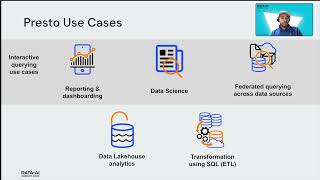
Presto 101: An Introduction to Open Source Presto

Presto is a widely adopted distributed SQL engine for data lake analytics. With Presto, you can perform ad hoc querying of data in place, which helps solve challenges around time to discover and the amount of time it takes to do ad hoc analysis. Additionally, new features like the disaggregated coordinator, Presto-on-Spark, scan optimizations, a reusable native engine, and a Pinot connector enable added benefits around performance, scale, and ecosystem.

In this session, Philip and Rohan will introduce the Presto technology and share why it’s becoming so popular – in fact, companies like Facebook, Uber, Twitter, Alibaba, and much more use Presto for interactive ad hoc queries, reporting & dashboarding data lake analytics, and much more. We’ll also show a quick demo on getting Presto running in AWS.

Connect with us: Website: https://databricks.com Facebook: https://www.facebook.com/databricksinc Twitter: https://twitter.com/databricks LinkedIn: https://www.linkedin.com/company/data... Instagram: https://www.instagram.com/databricksinc/