talk-data.com talk-data.com

Topic

ClickHouse

columnar_database big_data analytics database data_warehouse olap realtime

59

tagged

Activity Trend

17 peak/qtr
2020-Q1 2026-Q1

Activities

59 activities · Newest first

Delta Kernel for Rust and Java

Delta Kernel makes it easy for engines and connectors to read and write Delta tables. It supports many Delta features and robust connectors, including DuckDB, Clickhouse, Spice AI and delta-dotnet. In this session, we'll cover lessons learned about how to build a high-performance library that lets engines integrate the way they want, while not having to worry about the details of the Delta protocol. We'll talk through how we streamlined the API as well as its changes and underlying motivations. We'll discuss some new highlight features like write support, and the ability to do CDF scans. Finally we'll cover the future roadmap for the Kernel project and what you can expect from the project over the coming year.

Summary In this episode of the Data Engineering Podcast Sida Shen, product manager at CelerData, talks about StarRocks, a high-performance analytical database. Sida discusses the inception of StarRocks, which was forked from Apache Doris in 2020 and evolved into a high-performance Lakehouse query engine. He explains the architectural design of StarRocks, highlighting its capabilities in handling high concurrency and low latency queries, and its integration with open table formats like Apache Iceberg, Delta Lake, and Apache Hudi. Sida also discusses how StarRocks differentiates itself from other query engines by supporting on-the-fly joins and eliminating the need for denormalization pipelines, and shares insights into its use cases, such as customer-facing analytics and real-time data processing, as well as future directions for the platform.

Announcements Hello and welcome to the Data Engineering Podcast, the show about modern data managementData migrations are brutal. They drag on for months—sometimes years—burning through resources and crushing team morale. Datafold's AI-powered Migration Agent changes all that. Their unique combination of AI code translation and automated data validation has helped companies complete migrations up to 10 times faster than manual approaches. And they're so confident in their solution, they'll actually guarantee your timeline in writing. Ready to turn your year-long migration into weeks? Visit dataengineeringpodcast.com/datafold today for the details.Your host is Tobias Macey and today I'm interviewing Sida Shen about StarRocks, a high performance analytical database supporting shared nothing and shared data patternsInterview IntroductionHow did you get involved in the area of data management?Can you describe what StarRocks is and the story behind it?There are numerous analytical databases on the market. What are the attributes of StarRocks that differentiate it from other options?Can you describe the architecture of StarRocks?What are the "-ilities" that are foundational to the design of the system?How have the design and focus of the project evolved since it was first created?What are the tradeoffs involved in separating the communication layer from the data layers?The tiered architecture enables the shared nothing and shared data behaviors, which allows for the implementation of lakehouse patterns. What are some of the patterns that are possible due to the single interface/dual pattern nature of StarRocks?The shared data implementation has cacheing built in to accelerate interaction with datasets. What are some of the limitations/edge cases that operators and consumers should be aware of?StarRocks supports management of lakehouse tables (Iceberg, Delta, Hudi, etc.), which overlaps with use cases for Trino/Presto/Dremio/etc. What are the cases where StarRocks acts as a replacement for those systems vs. a supplement to them?The other major category of engines that StarRocks overlaps with is OLAP databases (e.g. Clickhouse, Firebolt, etc.). Why might someone use StarRocks in addition to or in place of those techologies?We would be remiss if we ignored the dominating trend of AI and the systems that support it. What is the role of StarRocks in the context of an AI application?What are the most interesting, innovative, or unexpected ways that you have seen StarRocks used?What are the most interesting, unexpected, or challenging lessons that you have learned while working on StarRocks?When is StarRocks the wrong choice?What do you have planned for the future of StarRocks?Contact Info LinkedInParting Question From your perspective, what is the biggest gap in the tooling or technology for data management today?Closing Announcements Thank you for listening! Don't forget to check out our other shows. Podcast.init covers the Python language, its community, and the innovative ways it is being used. The AI Engineering Podcast is your guide to the fast-moving world of building AI systems.Visit the site to subscribe to the show, sign up for the mailing list, and read the show notes.If you've learned something or tried out a project from the show then tell us about it! Email [email protected] with your story.Links StarRocksCelerDataApache DorisSIMD == Single Instruction Multiple DataApache IcebergClickHousePodcast EpisodeDruidFireboltPodcast EpisodeSnowflakeBigQueryTrinoDatabricksDremioData LakehouseDelta LakeApache HiveC++Cost-Based OptimizerIceberg Summit Tencent Games PresentationApache PaimonLancePodcast EpisodeDelta UniformApache ArrowStarRocks Python UDFDebeziumPodcast EpisodeThe intro and outro music is from The Hug by The Freak Fandango Orchestra / CC BY-SA

Streaming data with Apache Kafka® has become the backbone of modern day applications. While streams are ideal for continuous data flow, they lack built-in querying capability. Unlike databases with indexed lookups, Kafka's append-only logs are designed for high throughput processing, not for on-demand querying. This necessitates teams to build additional infrastructure to enable query capabilities for streaming data. Traditional methods replicate this data into external stores such as relational databases like PostgreSQL for operational workloads and object storage like S3 with Flink, Spark, or Trino for analytical use cases. While useful sometimes, these methods deepen the divide between operational and analytical estates, creating silos, complex ETL pipelines, and issues with schema mismatches, freshness, and failures.\n\nIn this session, we’ll explore and see live demos of some solutions to unify the operational and analytical estates, eliminating data silos. We’ll start with stream processing using Kafka Streams, Apache Flink®, and SQL implementations, then cover integration of relational databases with real-time analytics databases such as Apache Pinot® and ClickHouse. Finally, we’ll dive into modern approaches like Apache Iceberg® with Tableflow, which simplifies data preparation by seamlessly representing Kafka topics and associated schemas as Iceberg or Delta tables in a few clicks. While there's no single right answer to this problem, as responsible system builders, we must understand our options and trade-offs to build robust architectures.

Coalesce 2024: A strategic approach to testing & monitoring with Data Products

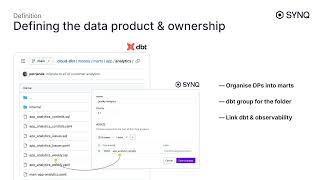
With analytics teams' growing ambition to build business automation, foundational AI systems, or customer-facing products, we must shift our mindset about data quality. Mechanically applied testing will not be enough; we need a more robust strategy akin to software engineering.

We outline a new approach to data testing and observability anchored in the ‘Data Products’ concept and walk through the practical implementation of a production-grade analytics system at SYNQ, powered by ClickHouse and dbt.

Speaker: Petr Janda Founder SYNQ

Read the blog to learn about the latest dbt Cloud features announced at Coalesce, designed to help organizations embrace analytics best practices at scale https://www.getdbt.com/blog/coalesce-2024-product-announcements

Some of the world's leading financial institutions use ClickHouse for real-time financial analytics use cases, including fraud detection, risk modeling, and stock price reporting. To demonstrate how ClickHouse delivers unparalleled performance and ease of use for financial analytics, we'll walk through ingesting live stock ticker data from a Kafka stream into ClickHouse to power a real-time web application. 

Summary

Databases are the core of most applications, whether transactional or analytical. In recent years the selection of database products has exploded, making the critical decision of which engine(s) to use even more difficult. In this episode Tanya Bragin shares her experiences as a product manager for two major vendors and the lessons that she has learned about how teams should approach the process of tool selection.

Announcements

Hello and welcome to the Data Engineering Podcast, the show about modern data management Introducing RudderStack Profiles. RudderStack Profiles takes the SaaS guesswork and SQL grunt work out of building complete customer profiles so you can quickly ship actionable, enriched data to every downstream team. You specify the customer traits, then Profiles runs the joins and computations for you to create complete customer profiles. Get all of the details and try the new product today at dataengineeringpodcast.com/rudderstack You shouldn't have to throw away the database to build with fast-changing data. You should be able to keep the familiarity of SQL and the proven architecture of cloud warehouses, but swap the decades-old batch computation model for an efficient incremental engine to get complex queries that are always up-to-date. With Materialize, you can! It’s the only true SQL streaming database built from the ground up to meet the needs of modern data products. Whether it’s real-time dashboarding and analytics, personalization and segmentation or automation and alerting, Materialize gives you the ability to work with fresh, correct, and scalable results — all in a familiar SQL interface. Go to dataengineeringpodcast.com/materialize today to get 2 weeks free! This episode is brought to you by Datafold – a testing automation platform for data engineers that finds data quality issues before the code and data are deployed to production. Datafold leverages data-diffing to compare production and development environments and column-level lineage to show you the exact impact of every code change on data, metrics, and BI tools, keeping your team productive and stakeholders happy. Datafold integrates with dbt, the modern data stack, and seamlessly plugs in your data CI for team-wide and automated testing. If you are migrating to a modern data stack, Datafold can also help you automate data and code validation to speed up the migration. Learn more about Datafold by visiting dataengineeringpodcast.com/datafold Data projects are notoriously complex. With multiple stakeholders to manage across varying backgrounds and toolchains even simple reports can become unwieldy to maintain. Miro is your single pane of glass where everyone can discover, track, and collaborate on your organization's data. I especially like the ability to combine your technical diagrams with data documentation and dependency mapping, allowing your data engineers and data consumers to communicate seamlessly about your projects. Find simplicity in your most complex projects with Miro. Your first three Miro boards are free when you sign up today at dataengineeringpodcast.com/miro. That’s three free boards at dataengineeringpodcast.com/miro. Your host is Tobias Macey and today I'm interviewing Tanya Bragin about her views on the database products market

Interview

Introduction How did you get involved in the area of data management? What are the aspects of the database market that keep you interested as a VP of product?

How have your experiences at Elastic informed your current work at Clickhouse?

What are the main product categories for databases today?

What are the industry trends that have the most impact on the development and growth of different product categories? Which categories do you see growing the fastest?

When a team is selecting a database technology for a given task, what are the types of questions that they should be asking? Transactional engines like Postgres, SQL Server, Oracle, etc. were long used

Summary

Real-time capabilities have quickly become an expectation for consumers. The complexity of providing those capabilities is still high, however, making it more difficult for small teams to compete. Meroxa was created to enable teams of all sizes to deliver real-time data applications. In this episode DeVaris Brown discusses the types of applications that are possible when teams don't have to manage the complex infrastructure necessary to support continuous data flows.

Announcements

Hello and welcome to the Data Engineering Podcast, the show about modern data management RudderStack helps you build a customer data platform on your warehouse or data lake. Instead of trapping data in a black box, they enable you to easily collect customer data from the entire stack and build an identity graph on your warehouse, giving you full visibility and control. Their SDKs make event streaming from any app or website easy, and their extensive library of integrations enable you to automatically send data to hundreds of downstream tools. Sign up free at dataengineeringpodcast.com/rudderstack Your host is Tobias Macey and today I'm interviewing DeVaris Brown about the impact of real-time data on business opportunities and risk profiles

Interview

Introduction How did you get involved in the area of data management? Can you describe what Meroxa is and the story behind it?

How have the focus and goals of the platform and company evolved over the past 2 years?

Who are the target customers for Meroxa?

What problems are they trying to solve when they come to your platform?

Applications powered by real-time data were the exclusive domain of large and/or sophisticated tech companies for several years due to the inherent complexities involved. What are the shifts that have made them more accessible to a wider variety of teams?

What are some of the remaining blockers for teams who want to start using real-time data?

With the democratization of real-time data, what are the new categories of products and applications that are being unlocked?

How are organizations thinking about the potential value that those types of apps/services can provide?

With data flowing constantly, there are new challenges around oversight and accuracy. How does real-time data change the risk profile for applications that are consuming it?

What are some of the technical controls that are available for organizations that are risk-averse?

What skills do developers need to be able to effectively design, develop, and deploy real-time data applications?

How does this differ when talking about internal vs. consumer/end-user facing applications?

What are the most interesting, innovative, or unexpected ways that you have seen Meroxa used? What are the most interesting, unexpected, or challenging lessons that you have learned while working on Meroxa? When is Meroxa the wrong choice? What do you have planned for the future of Meroxa?

Contact Info

LinkedIn @devarispbrown on Twitter

Parting Question

From your perspective, what is the biggest gap in the tooling or technology for data management today?

Closing Announcements

Thank you for listening! Don't forget to check out our other shows. Podcast.init covers the Python language, its community, and the innovative ways it is being used. The Machine Learning Podcast helps you go from idea to production with machine learning. Visit the site to subscribe to the show, sign up for the mailing list, and read the show notes. If you've learned something or tried out a project from the show then tell us about it! Email [email protected]) with your story. To help other people find the show please leave a review on Apple Podcasts and tell your friends and co-workers

Links

Meroxa

Podcast Episode

Kafka Kafka Connect Conduit - golang Kafka connect replacement Pulsar Redpanda Flink Beam Clickhouse Druid Pinot

The intro and outro music is from The Hug by The Freak Fandango Orchestra / CC

Opening the Floodgates: Enabling Fast, Unmediated End User Access to Trillion-Row Datasets with SQL

Spreadsheets revolutionized IT by giving end users the ability to create their own analytics. Providing direct end user access to trillion-row datasets generated in financial markets or digital marketing is much harder. New SQL data warehouses like ClickHouse and Druid can provide fixed latency with constant cost on very large datasets, which opens up new possibilities.

Our talk walks through recent experience on analytic apps developed by ClickHouse users that enable end users like market traders to develop their own analytics directly off raw data. We’ll cover the following topics.

  1. Characteristics of new open source column databases and how they enable low-latency analytics at constant cost.

  2. Idiomatic ways to validate new apps by building MVPs that support a wide range of queries on source data including storing source JSON, schema design, applying compression on columns, and building indexes for needle-in-a-haystack queries.

  3. Incrementally identifying hotspots and applying easy optimizations to bring query performance into line with long term latency and cost requirements.

  4. Methods of building accessible interfaces, including traditional dashboards, imitating existing APIs that are already known, and creating app-specific visualizations.

We’ll finish by summarizing a few of the benefits we’ve observed and also touch on ways that analytic infrastructure could be improved to make end user access even more productive. The lessons are as general as possible so that they can be applied across a wide range of analytic systems, not just ClickHouse.

Connect with us: Website: https://databricks.com Facebook: https://www.facebook.com/databricksinc Twitter: https://twitter.com/databricks LinkedIn: https://www.linkedin.com/company/data... Instagram: https://www.instagram.com/databricksinc/

ClickHouse, the lightning-fast open source OLAP database, was initially released in 2016 as an open source project out of Yandex, the Russian search giant. In 2021, Aaron Katz helped form a group to spin it out of Yandex as an independent company, dedicated to the development + commercialization of the open source project. In this conversation with Tristan and Julia, Aaron gets into why he believes open source, independent software companies are the future. And of course, this conversation wouldn't be complete without a riff on the classic "one database to rule all workloads" thread. For full show notes and to read 6+ years of back issues of the podcast's companion newsletter, head to https://roundup.getdbt.com.  The Analytics Engineering Podcast is sponsored by dbt Labs.

Summary Data and analytics are permeating every system, including customer-facing applications. The introduction of embedded analytics to an end-user product creates a significant shift in requirements for your data layer. The Pinot OLAP datastore was created for this purpose, optimizing for low latency queries on rapidly updating datasets with highly concurrent queries. In this episode Kishore Gopalakrishna and Xiang Fu explain how it is able to achieve those characteristics, their work at StarTree to make it more easily available, and how you can start using it for your own high throughput data workloads today.

Announcements

Hello and welcome to the Data Engineering Podcast, the show about modern data management When you’re ready to build your next pipeline, or want to test out the projects you hear about on the show, you’ll need somewhere to deploy it, so check out our friends at Linode. With their managed Kubernetes platform it’s now even easier to deploy and scale your workflows, or try out the latest Helm charts from tools like Pulsar and Pachyderm. With simple pricing, fast networking, object storage, and worldwide data centers, you’ve got everything you need to run a bulletproof data platform. Go to dataengineeringpodcast.com/linode today and get a $100 credit to try out a Kubernetes cluster of your own. And don’t forget to thank them for their continued support of this show! So now your modern data stack is set up. How is everyone going to find the data they need, and understand it? Select Star is a data discovery platform that automatically analyzes & documents your data. For every table in Select Star, you can find out where the data originated, which dashboards are built on top of it, who’s using it in the company, and how they’re using it, all the way down to the SQL queries. Best of all, it’s simple to set up, and easy for both engineering and operations teams to use. With Select Star’s data catalog, a single source of truth for your data is built in minutes, even across thousands of datasets. Try it out for free and double the length of your free trial today at dataengineeringpodcast.com/selectstar. You’ll also get a swag package when you continue on a paid plan. This episode is brought to you by Acryl Data, the company behind DataHub, the leading developer-friendly data catalog for the modern data stack. Open Source DataHub is running in production at several companies like Peloton, Optum, Udemy, Zynga and others. Acryl Data provides DataHub as an easy to consume SaaS product which has been adopted by several companies. Signup for the SaaS product today at dataengineeringpodcast.com/acryl Your host is Tobias Macey and today I’m interviewing Kishore Gopalakrishna and Xiang Fu about Apache Pinot and its applications for powering user-facing analytics

Interview

Introduction How did you get involved in the area of data management? Can you describe what Pinot is and the story behind it? What are the primary use cases that Pinot is designed to support? There are numerous OLAP engines available with varying tradeoffs and optimal use cases. What are the cases where Pinot is the preferred choice?

How does it compare to systems such as Clickhouse (for OLAP) or CubeJS/GoodData (for embedded analytics)?

How do the operational needs of a database engine change as you move from serving internal stakeholders to external end-users? Can you describe how Pinot is architected?

What were the key design elements that were necessary to support low-latency queries with high concurrency?

Can you describe a typical end-to-end architecture where Pinot will be used for embedded analytics?

What are some of the tools/technologies/platforms/design patterns that Pinot might replace or obviate?

What are some of the useful lessons related to data modeling that users of Pinot should consider?

What are some edge cases that they might encounter due to details of how the storage layer is architected? (e.g. data

Summary There are many dimensions to the work of protecting the privacy of users in our data. When you need to share a data set with other teams, departments, or businesses then it is of utmost importance that you eliminate or obfuscate personal information. In this episode Will Thompson explores the many ways that sensitive data can be leaked, re-identified, or otherwise be at risk, as well as the different strategies that can be employed to mitigate those attack vectors. He also explains how he and his team at Privacy Dynamics are working to make those strategies more accessible to organizations so that you can focus on all of the other tasks required of you.

Announcements

Hello and welcome to the Data Engineering Podcast, the show about modern data management When you’re ready to build your next pipeline, or want to test out the projects you hear about on the show, you’ll need somewhere to deploy it, so check out our friends at Linode. With their managed Kubernetes platform it’s now even easier to deploy and scale your workflows, or try out the latest Helm charts from tools like Pulsar and Pachyderm. With simple pricing, fast networking, object storage, and worldwide data centers, you’ve got everything you need to run a bulletproof data platform. Go to dataengineeringpodcast.com/linode today and get a $100 credit to try out a Kubernetes cluster of your own. And don’t forget to thank them for their continued support of this show! Today’s episode is Sponsored by Prophecy.io – the low-code data engineering platform for the cloud. Prophecy provides an easy-to-use visual interface to design & deploy data pipelines on Apache Spark & Apache Airflow. Now all the data users can use software engineering best practices – git, tests and continuous deployment with a simple to use visual designer. How does it work? – You visually design the pipelines, and Prophecy generates clean Spark code with tests on git; then you visually schedule these pipelines on Airflow. You can observe your pipelines with built in metadata search and column level lineage. Finally, if you have existing workflows in AbInitio, Informatica or other ETL formats that you want to move to the cloud, you can import them automatically into Prophecy making them run productively on Spark. Create your free account today at dataengineeringpodcast.com/prophecy. The only thing worse than having bad data is not knowing that you have it. With Bigeye’s data observability platform, if there is an issue with your data or data pipelines you’ll know right away and can get it fixed before the business is impacted. Bigeye let’s data teams measure, improve, and communicate the quality of your data to company stakeholders. With complete API access, a user-friendly interface, and automated yet flexible alerting, you’ve got everything you need to establish and maintain trust in your data. Go to dataengineeringpodcast.com/bigeye today to sign up and start trusting your analyses. Your host is Tobias Macey and today I’m interviewing Will Thompson about managing data privacy concerns for data sets used in analytics and machine learning

Interview

Introduction How did you get involved in the area of data management? Data privacy is a multi-faceted problem domain. Can you start by enumerating the different categories of privacy concern that are involved in analytical use cases? Can you describe what Privacy Dynamics is and the story behind it?

Which categor(y|ies) are you focused on addressing?

What are some of the best practices in the definition, protection, and enforcement of data privacy policies?

Is there a data security/privacy equivalent to the OWASP top 10?

What are some of the techniques that are available for anonymizing data while maintaining statistical utility/significance?

What are some of the engineering/systems capabilities that are required for data (platform) engineers to incorporate these practices in their platforms?

What are the tradeoffs of encryption vs. obfuscation when anonymizing data? What are some of the types of PII that are non-obvious? What are the risks associated with data re-identification, and what are some of the vectors that might be exploited to achieve that?

How can privacy risks mitigation be maintained as new data sources are introduced that might contribute to these re-identification vectors?

Can you describe how Privacy Dynamics is implemented?

What are the most challenging engineering problems that you are dealing with?

How do you approach validation of a data set’s privacy? What have you found to be useful heuristics for identifying private data?

What are the risks of false positives vs. false negatives?

Can you describe what is involved in integrating the Privacy Dynamics system into an existing data platform/warehouse?

What would be required to integrate with systems such as Presto, Clickhouse, Druid, etc.?

What are the most interesting, innovative, or unexpected ways that you have seen Privacy Dynamics used? What are the most interesting, unexpected, or challenging lessons that you have learned while working on Privacy Dynamics? When is Privacy Dynamics the wrong choice? What do you have planned for the future of Privacy Dynamics?

Contact Info

LinkedIn @willseth on Twitter

Parting Question

From your perspective, what is the biggest gap in the tooling or technology for data management today?

Closing Announcements

Thank you for listening! Don’t forget to check out our other show, Podcast.init to learn about the Python language, its community, and the innovative ways it is being used. Visit the site to subscribe to the show, sign up for the mailing list, and read the show notes. If you’ve learned something or tried out a project from the show then tell us about it! Email [email protected]) with your story. To help other people find the show please leave a review on iTunes and tell your friends and co-workers

Links

Privacy Dynamics Pandas

Podcast Episode – Pandas For Data Engineering

Homomorphic Encryption Differential Privacy Immuta

Podcast Episode

The intro and outro music is from The Hug by The Freak Fandango Orchestra / CC BY-SA

Support Data Engineering Podcast

Summary Building an API for real-time data is a challenging project. Making it robust, scalable, and fast is a full time job. The team at Tinybird wants to make it easy to turn a continuous stream of data into a production ready API or data product. In this episode CEO Jorge Sancha explains how they have architected their system to handle high data throughput and fast response times, and why they have invested heavily in Clickhouse as the core of their platform. This is a great conversation about the challenges of building a maintainable business from a technical and product perspective.

Announcements

Hello and welcome to the Data Engineering Podcast, the show about modern data management When you’re ready to build your next pipeline, or want to test out the projects you hear about on the show, you’ll need somewhere to deploy it, so check out our friends at Linode. With their managed Kubernetes platform it’s now even easier to deploy and scale your workflows, or try out the latest Helm charts from tools like Pulsar and Pachyderm. With simple pricing, fast networking, object storage, and worldwide data centers, you’ve got everything you need to run a bulletproof data platform. Go to dataengineeringpodcast.com/linode today and get a $100 credit to try out a Kubernetes cluster of your own. And don’t forget to thank them for their continued support of this show! RudderStack’s smart customer data pipeline is warehouse-first. It builds your customer data warehouse and your identity graph on your data warehouse, with support for Snowflake, Google BigQuery, Amazon Redshift, and more. Their SDKs and plugins make event streaming easy, and their integrations with cloud applications like Salesforce and ZenDesk help you go beyond event streaming. With RudderStack you can use all of your customer data to answer more difficult questions and then send those insights to your whole customer data stack. Sign up free at dataengineeringpodcast.com/rudder today. Ascend.io — recognized as a 2021 Gartner Cool Vendor in Enterprise AI Operationalization and Engineering—empowers data teams to to build, scale, and operate declarative data pipelines with 95% less code and zero maintenance. Connect to any data source using Ascend’s new flex code data connectors, rapidly iterate on transformations and send data to any destination in a fraction of the time it traditionally takes—just ask companies like Harry’s, HNI, and Mayvenn. Sound exciting? Come join the team! We’re hiring data engineers, so head on over to dataengineeringpodcast.com/ascend and check out our careers page to learn more. Your host is Tobias Macey and today I’m interviewing Jorge Sancha about Tinybird, a platform to easily build analytical APIs for real-time data

Interview

Introduction How did you get involved in the area of data management? Can you start by describing what you are building at Tinybird and the story behind it? What are some of the types of use cases that your customers are focused on? What are the areas of complexity that come up when building analytical APIs that are often overlooked when first designing a system to operate on and expose real-time data?

What are the supporting systems that are necessary and useful for operating this kind of system which contribute to the overall time and engineering cost beyond the baseline functionality?

How is the Tinybird platform architected?

How have the goals and implementation of Tinybird changed or evolved since you first began building it?

What was your criteria for selecting the core building block of your platform, and how did that lead to your choice to build on top of Clickhouse? What are some of the sharp edges that you have run into while operating Clickhouse?

What are some of the custom tools or systems that you have built to help deal with them?

What are some of the performance challenges that an API built with Tinybird might run into?

What are the considerations that users should be

Summary CouchDB is a distributed document database built for scale and ease of operation. With a built-in synchronization protocol and a HTTP interface it has become popular as a backend for web and mobile applications. Created 15 years ago, it has accrued some technical debt which is being addressed with a refactored architecture based on FoundationDB. In this episode Adam Kocoloski shares the history of the project, how it works under the hood, and how the new design will improve the project for our new era of computation. This was an interesting conversation about the challenges of maintaining a large and mission critical project and the work being done to evolve it.

Announcements

Hello and welcome to the Data Engineering Podcast, the show about modern data management When you’re ready to build your next pipeline, or want to test out the projects you hear about on the show, you’ll need somewhere to deploy it, so check out our friends at Linode. With 200Gbit private networking, scalable shared block storage, a 40Gbit public network, fast object storage, and a brand new managed Kubernetes platform, you’ve got everything you need to run a fast, reliable, and bullet-proof data platform. And for your machine learning workloads, they’ve got dedicated CPU and GPU instances. Go to dataengineeringpodcast.com/linode today to get a $20 credit and launch a new server in under a minute. And don’t forget to thank them for their continued support of this show! Are you spending too much time maintaining your data pipeline? Snowplow empowers your business with a real-time event data pipeline running in your own cloud account without the hassle of maintenance. Snowplow takes care of everything from installing your pipeline in a couple of hours to upgrading and autoscaling so you can focus on your exciting data projects. Your team will get the most complete, accurate and ready-to-use behavioral web and mobile data, delivered into your data warehouse, data lake and real-time streams. Go to dataengineeringpodcast.com/snowplow today to find out why more than 600,000 websites run Snowplow. Set up a demo and mention you’re a listener for a special offer! Setting up and managing a data warehouse for your business analytics is a huge task. Integrating real-time data makes it even more challenging, but the insights you obtain can make or break your business growth. You deserve a data warehouse engine that outperforms the demands of your customers and simplifies your operations at a fraction of the time and cost that you might expect. You deserve ClickHouse, the open-source analytical database that deploys and scales wherever and whenever you want it to and turns data into actionable insights. And Altinity, the leading software and service provider for ClickHouse, is on a mission to help data engineers and DevOps managers tame their operational analytics. Go to dataengineeringpodcast.com/altinity for a free consultation to find out how they can help you today. You listen to this show to learn and stay up to date with what’s happening in databases, streaming platforms, big data, and everything else you need to know about modern data management. For even more opportunities to meet, listen, and learn from your peers you don’t want to miss out on this year’s conference season. We have partnered with organizations such as O’Reilly Media, Corinium Global Intelligence, ODSC, and Data Council. Upcoming events include the Software Architecture Conference in NYC, Strata Data in San Jose, and PyCon US in Pittsburgh. Go to dataengineeringpodcast.com/conferences to learn more about these and other events, and take advantage of our partner discounts to save money when you register today. Your host is Tobias Macey and today I’m interviewing Adam Kocoloski about CouchDB and the work being done to migrate the storage layer to FoundationDB

Interview

Introduction How did you get involved in the area of data management? Can you starty by describing what CouchDB is?

How did you get involved in the CouchDB project and what is your current role in the community?

What are the use cases that it is well suited for? Can you share some of the history of CouchDB and its role in the NoSQL movement? How is CouchDB currently architected and how has it evolved since it was first introduced? What have been the benefits and challenges of Erlang as the runtime for CouchDB? How is the current storage engine implemented and what are its shortcomings? What problems are you trying to solve by replatforming on a new storage layer?

What were the selection criteria for the new storage engine and how did you structure the decision making process? What was the motivation for choosing FoundationDB as opposed to other options such as rocksDB, levelDB, etc.?

How is the adoption of FoundationDB going to impact the overall architecture and implementation of CouchDB? How will the use of FoundationDB impact the way that the current capabilities are implemented, such as data replication? What will the migration path be for people running an existing installation? What are some of the biggest challenges that you are facing in rearchitecting the codebase? What new capabilities will the FoundationDB storage layer enable? What are some of the most interesting/unexpected/innovative ways that you have seen CouchDB used?

What new capabilities or use cases do you anticipate once this migration is complete?

What are some of the most interesting/unexpected/challenging lessons that you have learned while working with the CouchDB project and community? What is in store for the future of CouchDB?

Contact Info

LinkedIn @kocolosk on Twitter kocolosk on GitHub

Parting Question

From your perspective, what is the biggest gap in the tooling or technology for data management today?

Links

Apache CouchDB FoundationDB

Podcast Episode

IBM Cloudant Experimental Particle Physics FPGA == Field Programmable Gate Array Apache Software Foundation CRDT == Conflict-free Replicated Data Type

Podcast Episode

Erlang Riak RabbitMQ Heisenbug Kubernetes Property Based Testing

The intro and outro music is from The Hug by The Freak Fandango Orchestra / CC BY-SA

Support Data Engineering Podcast
Summary Designing the structure for your data warehouse is a complex and challenging process. As businesses deal with a growing number of sources and types of information that they need to integrate, they need a data modeling strategy that provides them with flexibility and speed. Data Vault is an approach that allows for evolving a data model in place without requiring destructive transformations and massive up front design to answer valuable questions. In this episode Kent Graziano shares his journey with data vault, explains how it allows for an agile approach to data warehousing, and explains the core principles of how to use it. If you’re struggling with unwieldy dimensional models, slow moving projects, or challenges integrating new data sources then listen in on this conversation and then give data vault a try for yourself.

Announcements

Hello and welcome to the Data Engineering Podcast, the show about modern data management When you’re ready to build your next pipeline, or want to test out the projects you hear about on the show, you’ll need somewhere to deploy it, so check out our friends at Linode. With 200Gbit private networking, scalable shared block storage, a 40Gbit public network, fast object storage, and a brand new managed Kubernetes platform, you’ve got everything you need to run a fast, reliable, and bullet-proof data platform. And for your machine learning workloads, they’ve got dedicated CPU and GPU instances. Go to dataengineeringpodcast.com/linode today to get a $20 credit and launch a new server in under a minute. And don’t forget to thank them for their continued support of this show! Setting up and managing a data warehouse for your business analytics is a huge task. Integrating real-time data makes it even more challenging, but the insights you obtain can make or break your business growth. You deserve a data warehouse engine that outperforms the demands of your customers and simplifies your operations at a fraction of the time and cost that you might expect. You deserve Clickhouse, the open source analytical database that deploys and scales wherever and whenever you want it to and turns data into actionable insights. And Altinity, the leading software and service provider for Clickhouse, is on a mission to help data engineers and DevOps managers tame their operational analytics. Go to dataengineeringpodcast.com/altinity for a free consultation to find out how they can help you today. You listen to this show to learn and stay up to date with what’s happening in databases, streaming platforms, big data, and everything else you need to know about modern data management. For even more opportunities to meet, listen, and learn from your peers you don’t want to miss out on this year’s conference season. We have partnered with organizations such as O’Reilly Media, Corinium Global Intelligence, ODSC, and Data Council. Upcoming events include the Software Architecture Conference in NYC, Strata Data in San Jose, and PyCon US in Pittsburgh. Go to dataengineeringpodcast.com/conferences to learn more about these and other events, and take advantage of our partner discounts to save money when you register today. Your host is Tobias Macey and today I’m interviewing Kent Graziano about data vault modeling and the role that it plays in the current data landscape

Interview

Introduction How did you get involved in the area of data management? Can you start by giving an overview of what data vault modeling is and how it differs from other approaches such as third normal form or the star/snowflake schema?

What is the history of this approach and what limitations of alternate styles of modeling is it attempting to overcome? How did you first encounter this approach to data modeling and what is your motivation for dedicating so much time and energy to promoting it?

What are some of the primary challenges associated with data modeling that contribute to the long lead times for data requests or o

Summary The team at Sentry has built a platform for anyone in the world to send software errors and events. As they scaled the volume of customers and data they began running into the limitations of their initial architecture. To address the needs of their business and continue to improve their capabilities they settled on Clickhouse as the new storage and query layer to power their business. In this episode James Cunningham and Ted Kaemming describe the process of rearchitecting a production system, what they learned in the process, and some useful tips for anyone else evaluating Clickhouse.

Announcements

Hello and welcome to the Data Engineering Podcast, the show about modern data management When you’re ready to build your next pipeline, or want to test out the projects you hear about on the show, you’ll need somewhere to deploy it, so check out our friends at Linode. With 200Gbit private networking, scalable shared block storage, and a 40Gbit public network, you’ve got everything you need to run a fast, reliable, and bullet-proof data platform. If you need global distribution, they’ve got that covered too with world-wide datacenters including new ones in Toronto and Mumbai. And for your machine learning workloads, they just announced dedicated CPU instances. Go to dataengineeringpodcast.com/linode today to get a $20 credit and launch a new server in under a minute. And don’t forget to thank them for their continued support of this show! You listen to this show to learn and stay up to date with what’s happening in databases, streaming platforms, big data, and everything else you need to know about modern data management. For even more opportunities to meet, listen, and learn from your peers you don’t want to miss out on this year’s conference season. We have partnered with organizations such as O’Reilly Media, Dataversity, Corinium Global Intelligence, Alluxio, and Data Council. Go to dataengineeringpodcast.com/conferences to learn more about these and other events, and take advantage of our partner discounts to save money when you register today. Your host is Tobias Macey and today I’m interviewing Ted Kaemming and James Cunningham about Snuba, the new open source search service at Sentry implemented on top of Clickhouse

Interview

Introduction How did you get involved in the area of data management? Can you start by describing the internal and user-facing issues that you were facing at Sentry with the existing search capabilities?

What did the previous system look like?

What was your design criteria for building a new platform?

What was your initial list of possible system components and what was your evaluation process that resulted in your selection of Clickhouse?

Can you describe the system architecture of Snuba and some of the ways that it differs from your initial ideas of how it would work?

What have been some of the sharp edges of Clickhouse that you have had to engineer around? How have you found the operational aspects of Clickhouse?

How did you manage the introduction of this new piece of infrastructure to a business that was already handling massive amounts of real-time data? What are some of the downstream benefits of using Clickhouse for managing event data at Sentry? For someone who is interested in using Snuba for their own purposes, how flexible is it for different domain contexts? What are some of the other data challenges that you are currently facing at Sentry?

What is your next highest priority for evolving or rebuilding to address technical or business challenges?

Contact Info

James

@JTCunning on Twitter JTCunning on GitHub

Ted

tkaemming on GitHub Website @tkaemming on Twitter

Parting Question

From your perspective, what is the biggest gap in the tooling or technology for data management today?

Closing Announcements

Thank you for listening! Don’t forget to check out our other show, Podcast.init to learn about the Python language, its community, and t

Summary The market for data warehouse platforms is large and varied, with options for every use case. ClickHouse is an open source, column-oriented database engine built for interactive analytics with linear scalability. In this episode Robert Hodges and Alexander Zaitsev explain how it is architected to provide these features, the various unique capabilities that it provides, and how to run it in production. It was interesting to learn about some of the custom data types and performance optimizations that are included.

Announcements

Hello and welcome to the Data Engineering Podcast, the show about modern data management When you’re ready to build your next pipeline, or want to test out the projects you hear about on the show, you’ll need somewhere to deploy it, so check out our friends at Linode. With 200Gbit private networking, scalable shared block storage, and a 40Gbit public network, you’ve got everything you need to run a fast, reliable, and bullet-proof data platform. If you need global distribution, they’ve got that covered too with world-wide datacenters including new ones in Toronto and Mumbai. And for your machine learning workloads, they just announced dedicated CPU instances. Go to dataengineeringpodcast.com/linode today to get a $20 credit and launch a new server in under a minute. And don’t forget to thank them for their continued support of this show! Integrating data across the enterprise has been around for decades – so have the techniques to do it. But, a new way of integrating data and improving streams has evolved. By integrating each silo independently – data is able to integrate without any direct relation. At CluedIn they call it “eventual connectivity”. If you want to learn more on how to deliver fast access to your data across the enterprise leveraging this new method, and the technologies that make it possible, get a demo or presentation of the CluedIn Data Hub by visiting dataengineeringpodcast.com/cluedin. And don’t forget to thank them for supporting the show! You listen to this show to learn and stay up to date with what’s happening in databases, streaming platforms, big data, and everything else you need to know about modern data management.For even more opportunities to meet, listen, and learn from your peers you don’t want to miss out on this year’s conference season. We have partnered with organizations such as O’Reilly Media, Dataversity, and the Open Data Science Conference. Coming up this fall is the combined events of Graphorum and the Data Architecture Summit. The agendas have been announced and super early bird registration for up to $300 off is available until July 26th, with early bird pricing for up to $200 off through August 30th. Use the code BNLLC to get an additional 10% off any pass when you register. Go to dataengineeringpodcast.com/conferences to learn more and take advantage of our partner discounts when you register. Go to dataengineeringpodcast.com to subscribe to the show, sign up for the mailing list, read the show notes, and get in touch. To help other people find the show please leave a review on iTunes and tell your friends and co-workers Join the community in the new Zulip chat workspace at dataengineeringpodcast.com/chat Your host is Tobias Macey and today I’m interviewing Robert Hodges and Alexander Zaitsev about Clickhouse, an open source, column-oriented database for fast and scalable OLAP queries

Interview

Introduction How did you get involved in the area of data management? Can you start by explaining what Clickhouse is and how you each got involved with it?

What are the primary use cases that Clickhouse is targeting? Where does it fit in the database market and how does it compare to other column stores, both open source and commercial?

Can you describe how Clickhouse is architected? Can you talk through the lifecycle of a given record or set of records from when they first get inserted into Clickhouse, through the engine an