talk-data.com talk-data.com

Topic

Cloud Storage

object_storage file_storage cloud

67

tagged

Activity Trend

5 peak/qtr
2020-Q1 2026-Q1

Activities

67 activities · Newest first

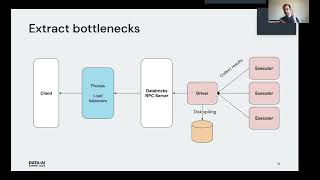
Cloud Fetch: High-bandwidth Connectivity With BI Tools

Business Intelligence (BI) tools such as Tableau and Microsoft Power BI are notoriously slow at extracting large query results from traditional data warehouses because they typically fetch the data in a single thread through a SQL endpoint that becomes a data transfer bottleneck. Data analysts can connect their BI tools to Databricks SQL endpoints to query data in tables through an ODBC/JDBC protocol integrated in our Simba drivers. With Cloud Fetch, which we released in Databricks Runtime 8.3 and Simba ODBC 2.6.17 driver, we introduce a new mechanism for fetching data in parallel via cloud storage such as AWS S3 and Azure Data Lake Storage to bring the data faster to BI tools. In our experiments using Cloud Fetch, we observed a 10x speed-up in extract performance due to parallelism.

Connect with us: Website: https://databricks.com Facebook: https://www.facebook.com/databricksinc Twitter: https://twitter.com/databricks LinkedIn: https://www.linkedin.com/company/data... Instagram: https://www.instagram.com/databricksinc/

IBM TS7700 Release 5.2.2 Guide

This IBM® Redbooks® publication covers IBM TS7700 R5.2. The IBM TS7700 is part of a family of IBM Enterprise tape products. This book is intended for system architects and storage administrators who want to integrate their storage systems for optimal operation. Building on 25 years of experience, the R5.2 release includes many features that enable improved performance, usability, and security. Highlights include IBM TS7700 Advanced Object Store, an all flash TS7770, grid resiliency enhancements, and Logical WORM retention. By using the same hierarchical storage techniques, the TS7700 (TS7770 and TS7760) can also off load to object storage. Because object storage is cloud-based and accessible from different regions, the TS7700 Cloud Storage Tier support essentially allows the cloud to be an extension of the grid. As of this writing, the TS7700C supports the ability to off load to IBM Cloud® Object Storage, Amazon S3, and RSTOR. This publication explains features and concepts that are specific to the IBM TS7700 as of release R5.2. The R5.2 microcode level provides IBM TS7700 Cloud Storage Tier enhancements, IBM DS8000® Object Storage enhancements, Management Interface dual control security, and other smaller enhancements. The R5.2 microcode level can be installed on the IBM TS7770 and IBM TS7760 models only. Note: The latest Release 5.2 was split into two phases: R5.2 Phase 1 (also referred to as and ) R5.2 Phase 2 ( and R) TS7700 provides tape virtualization for the IBM z environment. Off loading to physical tape behind a TS7700 is used by hundreds of organizations around the world. Tape virtualization can help satisfy the following requirements in a data processing environment. New and existing capabilities of the TS7700 5.2.2 release includes the following highlights: Eight-way Grid Cloud, which consists of up to three generations of TS7700 Synchronous and asynchronous replication of virtual tape and TCT objects Grid access to all logical volume and object data that is independent of where it exists An all-flash TS7770 option for improved performance Full Advanced Object Store Grid Cloud support of DS8000 Transparent Cloud Tier Full AES256 encryption for data that is in-flight and at-rest Tight integration with IBM Z® and DFSMS policy management DS8000 Object Store AES256 in-flight encryption and compression Regulatory compliance through Logical WORM and LWORM Retention support Cloud Storage Tier support for archive, logical volume version, and disaster recovery Optional integration with physical tape 16 Gb IBM FICON® throughput that exceeds 5 GBps per TS7700 cluster Grid Resiliency Support with Control Unit Initiated Reconfiguration (CUIR) support IBM Z hosts view up to 3,968 common devices per TS7700 grid TS7770 Cache On-demand feature that is based capacity licensing TS7770 support of SSD within the VED server The TS7700T writes data by policy to physical tape through attachment to high-capacity, high-performance IBM TS1160, IBM TS1150, and IBM TS1140 tape drives that are installed in an IBM TS4500 or TS3500 tape library. The TS7770 models are based on high-performance and redundant IBM POWER9™ technology. They provide improved performance for most IBM Z tape workloads when compared to the previous generations of IBM TS7700.

Data Engineering with Google Cloud Platform

In 'Data Engineering with Google Cloud Platform', you'll explore how to construct efficient, scalable data pipelines using GCP services. This hands-on guide covers everything from building data warehouses to deploying machine learning pipelines, helping you master GCP's ecosystem. What this Book will help me do Build comprehensive data ingestion and transformation pipelines using BigQuery, Cloud Storage, and Dataflow. Design end-to-end orchestration flows with Airflow and Cloud Composer for automated data processing. Leverage Pub/Sub for building real-time event-driven systems and streaming architectures. Gain skills to design and manage secure data systems with IAM and governance strategies. Prepare for and pass the Professional Data Engineer certification exam to elevate your career. Author(s) Adi Wijaya is a seasoned data engineer with significant experience in Google Cloud Platform products and services. His expertise in building data systems has equipped him with insights into the real-world challenges data engineers face. Adi aims to demystify technical topics and deliver practical knowledge through his writing, helping tech professionals excel. Who is it for? This book is tailored for data engineers and data analysts who want to leverage GCP for building efficient and scalable data systems. Readers should have a beginner-level understanding of topics like data science, Python, and Linux to fully benefit from the material. It is also suitable for individuals preparing for the Google Professional Data Engineer exam. The book is a practical companion for enhancing cloud and data engineering skills.

Storage as a Service Offering Guide

IBM® Storage as a Service (STaaS) extends your hybrid cloud experience with a new flexible consumption model enabled for both your on-premises and hybrid cloud infrastructure needs, giving you the agility, cash flow efficiency, and services of cloud storage with the flexibility to dynamically scale up or down and only pay for what you use beyond the minimal capacity. This IBM Redpaper provides a detailed introduction to the IBM STaaS service. The paper is targeted for data center managers and storage administrators.

Storage Systems

Storage Systems: Organization, Performance, Coding, Reliability and Their Data Processing was motivated by the 1988 Redundant Array of Inexpensive/Independent Disks proposal to replace large form factor mainframe disks with an array of commodity disks. Disk loads are balanced by striping data into strips—with one strip per disk— and storage reliability is enhanced via replication or erasure coding, which at best dedicates k strips per stripe to tolerate k disk failures. Flash memories have resulted in a paradigm shift with Solid State Drives (SSDs) replacing Hard Disk Drives (HDDs) for high performance applications. RAID and Flash have resulted in the emergence of new storage companies, namely EMC, NetApp, SanDisk, and Purestorage, and a multibillion-dollar storage market. Key new conferences and publications are reviewed in this book.The goal of the book is to expose students, researchers, and IT professionals to the more important developments in storage systems, while covering the evolution of storage technologies, traditional and novel databases, and novel sources of data. We describe several prototypes: FAWN at CMU, RAMCloud at Stanford, and Lightstore at MIT; Oracle's Exadata, AWS' Aurora, Alibaba's PolarDB, Fungible Data Center; and author's paper designs for cloud storage, namely heterogeneous disk arrays and hierarchical RAID. Surveys storage technologies and lists sources of data: measurements, text, audio, images, and video Familiarizes with paradigms to improve performance: caching, prefetching, log-structured file systems, and merge-trees (LSMs) Describes RAID organizations and analyzes their performance and reliability Conserves storage via data compression, deduplication, compaction, and secures data via encryption Specifies implications of storage technologies on performance and power consumption Exemplifies database parallelism for big data, analytics, deep learning via multicore CPUs, GPUs, FPGAs, and ASICs, e.g., Google's Tensor Processing Units

In Apache Airflow, Xcom is the default mechanism for passing data between tasks in a DAG. In practice, this has been restricted to small data elements, since the Xcom data is persisted in the Airflow metadatabase and is constrained by database and performance limitations. With the new TaskFlow API introduced in Airflow 2.0, it is seamless to pass data between tasks and the use of Xcom is invisible. However, the ability to pass data is restricted to a relatively small set of data types which can be natively converted in JSON. This tutorial describes how to go beyond these limitations by developing and deploying a Custom Xcom backend within Airflow to enable the sharing of large and varied data elements such as Pandas data frames between tasks in a data pipeline, using a cloud storage such as Google Storage or Amazon S3.

IBM TS7700 Release 5.1 Guide

This IBM® Redbooks® publication covers IBM TS7700 R5.1. The IBM TS7700 is part of a family of IBM Enterprise tape products. This book is intended for system architects and storage administrators who want to integrate their storage systems for optimal operation. Building on over 20 years of virtual tape experience, the TS7770 supports the ability to store virtual tape volumes in an object store. The TS7700 supported off loading to physical tape for over two decades. Off loading to physical tape behind a TS7700 is utilized by hundreds of organizations around the world. By using the same hierarchical storage techniques, the TS7700 (TS7770 and TS7760) can also off load to object storage. Because object storage is cloud-based and accessible from different regions, the TS7700 Cloud Storage Tier support essentially allows the cloud to be an extension of the grid. As of this writing, the TS7700C supports the ability to off load to IBM Cloud® Object Storage and Amazon S3. This publication explains features and concepts that are specific to the IBM TS7700 as of release R5.1. The R5.1 microcode level provides IBM TS7700 Cloud Storage Tier enhancements, IBM DS8000® Object Storage enhancements, Management Interface dual control security, and other smaller enhancements. The R5.1 microcode level can be installed on the IBM TS7770 and IBM TS7760 models only. TS7700 provides tape virtualization for the IBM z environment. Tape virtualization can help satisfy the following requirements in a data processing environment: Improved reliability and resiliency Reduction in the time that is needed for the backup and restore process Reduction of services downtime that is caused by physical tape drive and library outages Reduction in cost, time, and complexity by moving primary workloads to virtual tape Increased efficient procedures for managing daily batch, backup, recall, and restore processing On-premises and off-premises object store cloud storage support as an alternative to physical tape for archive and disaster recovery New and existing capabilities of the TS7700 5.1 include the following highlights: Eight-way Grid Cloud, which consists of up to three generations of TS7700 Synchronous and asynchronous replication Full AES256 encryption for replication data that is in-flight and at-rest Tight integration with IBM Z and DFSMS policy management Optional target for DS8000 Transparent Cloud Tier using DFSMS DS8000 Object Store AES256 in-flight encryption and compression Optional Cloud Storage Tier support for archive and disaster recovery 16 Gb IBM FICON® throughput up to 5 GBps per TS7700 cluster IBM Z hosts view up to 3,968 common devices per TS7700 grid Grid access to all data independent of where it exists TS7770 Cache On-demand feature that is based capacity licensing TS7770 support of SSD within the VED server The TS7700T writes data by policy to physical tape through attachment to high-capacity, high-performance IBM TS1150, and IBM TS1140 tape drives that are installed in an IBM TS4500 or TS3500 tape library. The TS7770 models are based on high-performance and redundant IBM POWER9™ technology. They provide improved performance for most IBM Z tape workloads when compared to the previous generations of IBM TS7700.

IBM FlashSystem 9100 Architecture, Performance, and Implementation

IBM® FlashSystem 9100 combines the performance of flash and Non-Volatile Memory Express (NVMe) with the reliability and innovation of IBM FlashCore® technology and the rich features of IBM Spectrum™ Virtualize — all in a powerful 2U storage system. Providing intensive data driven multi-cloud storage capacity, FlashSystem 9100 is deeply integrated with the software-defined capabilities of IBM Spectrum Storage™, which allows you to easily add the multi-cloud solutions that best support your business. In this IBM Redbooks® publication, we discuss the product's features and planning steps, architecture, installation, configuration, and hints and tips.

BigQuery is GCP’s serverless, highly scalable and cost-effective cloud data warehouse that can analyze petabytes of data at super fast speeds. Amazon S3 is one of the oldest and most popular cloud storage offerings. Folks with data in S3 often want to use BigQuery to gain insights into their data. Using Apache Airflow, they can build pipelines to seamlessly orchestrate that connection. In this talk, Leah walks through how they created an easily configurable pipeline to extract data. When a team at work mentioned wanting to set up a repeatable process for migrating data stored in S3 to BigQuery, Leah knew using Cloud Composer (GCP-hosted Airflow) was the right tool for the job, but she didn’t have much experience with the proprietary file types the data used. Luckily, one of her colleagues did have experience with that proprietary file type, though they hadn’t worked with Airflow. Leah and her colleague teamed up to build a reusable, easily configurable solution for the team. She will walk you through their problem, the solution, and the process they took for coming to that solution, highlighting resources that were especially useful to a first-time Airflow user.

IBM DS8000 Encryption for data at rest, Transparent Cloud Tiering, and Endpoint Security (DS8000 Release 9.0)

IBM® experts recognize the need for data protection, both from hardware or software failures, and from physical relocation of hardware, theft, and retasking of existing hardware. The IBM DS8000® supports encryption-capable hard disk drives (HDDs) and flash drives. These Full Disk Encryption (FDE) drive sets are used with key management services that are provided by IBM Security Key Lifecycle Manager software or Gemalto SafeNet KeySecure to allow encryption for data at rest. Use of encryption technology involves several considerations that are critical for you to understand to maintain the security and accessibility of encrypted data. Failure to follow the requirements that are described in the IBM Redpaper can result in an encryption deadlock. Starting with Release 8.5 code, the DS8000 also supports Transparent Cloud Tiering (TCT) data object encryption. With TCT encryption, data is encrypted before it is transmitted to the cloud. The data remains encrypted in cloud storage and is decrypted after it is transmitted back to the IBM DS8000. Starting with DS8000 Release 9.0, the DS8900F provides Fibre Channel Endpoint Security when communicating with an IBM z15™, which supports link authentication and the encryption of data that is in-flight. For more information, see IBM Fibre Channel Endpoint Security for IBM DS8900F and IBM Z, SG24-8455. This edition focuses on IBM Security Key Lifecycle Manager Version 3.0.1.3 or later, which enables support Key Management Interoperability Protocol (KMIP) with the DS8000 Release 9.0 code or later and updated DS GUI for encryption functions.

IBM DS8000 and Transparent Cloud Tiering

This IBM® Redbooks® publication gives a broad understanding of storage clouds and the initial functionality that was introduced for mainframes to have Transparent Cloud Tiering. IBM DFSMS and the IBM DS8000 added functionality to provide elements of serverless data movement, and for IBM z/OS® to communicate with a storage cloud. The function is known as Transparent Cloud Tiering and is composed of the following key elements: A gateway in the DS8000, which allows the movement of data to and from Object Storage by using a network connection, with the option to encrypt data in the Cloud. DFSMShsm enhancements to support Migrate and Recall functions to and from the Object Storage. Other commands were enhanced to monitor and report on the new functionality. DFSMShsm uses the Web Enablement toolkit for z/OS to create and access the metadata for specific clouds, containers, and objects. DFSMSdss enhancements to provide some basic backup and restore functions to and from the cloud. The IBM TS7700 can also be set up to act as if it were cloud storage from the DS8000 perspective. This IBM Redbooks publication is divided into the following parts: Part 1 provides you with an introduction to clouds. Part 2 shows you how we set up the Transparent Cloud Tiering in a controlled laboratory and how the new functions work. We provide points to consider to help you set up your storage cloud and integrate it into your operational environment. Part 3 shows you how we used the new functionality to communicate with the cloud and to send data and retrieve data from it..

IBM TS7700 R5.0 Cloud Storage Tier Guide

Building on over 20 years of virtual tape experience, the TS7700 (TS7760, TS7770) now supports the ability to store virtual tape volumes in an object store. This IBM® Redpaper publication helps you set up and configure the cloud object storage support for IBM Cloud™ Object Storage (COS) or Amazon Simple Storage Service (Amazon S3). The TS7700 supported off loading to physical tape for over two decades. Off loading to physical tape behind a TS7700 is used by hundreds of organizations around the world. By using the same hierarchical storage techniques, the TS7700 can also off load to object storage. Because object storage is cloud-based and accessible from different regions, the TS7700 Cloud Storage Tier support essentially allows the cloud to be an extension of the grid. In this IBM Redpaper publication, we provide a brief overview of cloud technology with an emphasis on Object Storage. Object Storage is used by a broad set of technologies, including those technologies that are exclusive to IBM Z®. The aim of this publication is to provide a basic understanding of cloud, Object Storage, and different ways it can be integrated into your environment. This Redpaper is intended for system architects and storage administrators with TS7700 experience who want to add the support of a Cloud Storage Tier to their TS7700 solution. Note: As of this writing, the TS7700C supports the ability to offload to on-premise cloud with IBM Cloud Object Storage and public cloud with Amazon S3.

IBM FlashSystem A9000R Product Guide (Version 12.3.2)

This IBM® Redbooks® Product Guide is an overview of the main characteristics, features, and technology that are used in IBM FlashSystem® A9000R Model 415 and Model 425, with IBM FlashSystem A9000R Software V12.3.2. Software version 12.3.2, with Hyper-Scale Manager version 5.6 or later, introduces support for VLAN tagging and port trunking.. IBM FlashSystem A9000R is a grid-scale, all-flash storage platform designed for industry leaders with rapidly growing cloud storage and mixed workload environments to help drive your business into the cognitive era. FlashSystem A9000R provides consistent, extreme performance for dynamic data at scale, integrating the microsecond latency and high availability of IBM FlashCore® technology. The rack-based offering comes integrated with the world class software features that are built with IBM Spectrum™ Accelerate. For example, comprehensive data reduction, including inline pattern removal, data deduplication, and compression, helps lower total cost of ownership (TCO) while the grid architecture and IBM Hyper-Scale framework simplify and automate storage administration. The A9000R features always on data reduction and now offers intelligent capacity management for deduplication. Ready for the cloud and well-suited for large deployments, FlashSystem A9000R delivers predictable high performance and ultra-low latency, even under heavy workloads with full data reduction enabled. As a result, the grid-scale architecture maintains this performance by automatically self-optimizing workloads across all storage resources without manual intervention.

A simple recipe for a delicious analytics platform: combine 3 cups of data schema with a pinch of JavaScript in a large pot of cloud storage. Bake in the deployment oven for a couple of months, and savory insights will emerge. Right? Why does this recipe have both 5-star and 1-star ratings?! On this episode, long-standing digital analytics maven June Dershewitz, Director of Analytics at Twitch, drops by the podcast's analytics kitchen to discuss the relative merits of building versus buying an analytics platform. Or, of course, doing something in between!

The episode was originally 3.5 hours long, but we edited out most of Michael's tangents into gaming geekdown, which brought the run-time down to a more normal length.

For complete show notes, including links to items mentioned in this episode and a transcript of the show, visit the show page.

IBM TS7700 Release 4.2 Guide

This IBM® Redbooks® publication covers IBM TS7700 R4.2. The IBM TS7700 is part of a family of IBM Enterprise tape products. This book is intended for system architects and storage administrators who want to integrate their storage systems for optimal operation. Building on over 20 years of virtual tape experience, the TS7760 now supports the ability to store virtual tape volumes in an object store. The TS7700 has supported off loading to physical tape for over two decades. Off loading to physical tape behind a TS7700 is utilized by hundreds of organizations around the world. Using the same hierarchical storage techniques, the TS7700 can also off load to object storage. Given object storage is cloud based and accessible from different regions, the TS7760 Cloud Storage Tier support essentially allows the cloud to be an extension of the grid. As of the release of this document, the TS7760C supports the ability to off load to IBM Cloud Object Storage as well as Amazon S3. To learn about the TS7760 cloud storage tier function, planning, implementation, best practices, and support see IBM Redpaper IBM TS7760 R4.2 Cloud Storage Tier Guide, redp-5514 at: http://www.redbooks.ibm.com/abstracts/redp5514.html The IBM TS7700 offers a modular, scalable, and high-performance architecture for mainframe tape virtualization for the IBM Z® environment. It is a fully integrated, tiered storage hierarchy of disk and tape. This storage hierarchy is managed by robust storage management microcode with extensive self-management capability. It includes the following advanced functions: Improved reliability and resiliency Reduction in the time that is needed for the backup and restore process Reduction of services downtime that is caused by physical tape drive and library outages Reduction in cost, time, and complexity by moving primary workloads to virtual tape More efficient procedures for managing daily backup and restore processing Infrastructure simplification through reduction of the number of physical tape libraries, drives, and media TS7700 delivers the following new capabilities: TS7760C supports the ability to off load to IBM Cloud Object Storage as well as Amazon S3 8-way Grid Cloud consisting of any generation of TS7700 Synchronous and asynchronous replication Tight integration with IBM Z and DFSMS policy management Optional Transparent Cloud Tiering Optional integration with physical tape Cumulative 16Gb FICON throughput up to 4.8GB/s 8 IBM Z hosts view up to 496 8 equivalent devices Grid access to all data independent of where it exists The TS7760T writes data by policy to physical tape through attachment to high-capacity, high-performance IBM TS1150 and IBM TS1140 tape drives installed in an IBM TS4500 or TS3500 tape library. The TS7760 models are based on high-performance and redundant IBM POWER8® technology. They provide improved performance for most IBM Z tape workloads when compared to the previous generations of IBM TS7700.

IBM DS8880 Encryption for data at rest and Transparent Cloud Tiering (DS8000 Release 8.5)

-update for Release 8.5 - IBM experts recognize the need for data protection, both from hardware or software failures, and also from physical relocation of hardware, theft, and retasking of existing hardware. The IBM DS8880 supports encryption-capable hard disk drives (HDDs) and flash drives. These Full Disk Encryption (FDE) drive sets are used with key management services that are provided by IBM Security Key Lifecycle Manager software or Gemalto SafeNet KeySecure to allow encryption for data at rest on a DS8880. Use of encryption technology involves several considerations that are critical for you to understand to maintain the security and accessibility of encrypted data. The IBM Security Key Lifecycle Manager software also supports Transparent Cloud Tiering (TCT) data object encryption, which is part of this publication. With TCT encryption, data is encrypted before it is transmitted to the Cloud. The data remains encrypted in cloud storage and is decrypted after it is transmitted back to the DS8000®. This IBM Redpaper™ publication contains information that can help storage administrators plan for disk and TCT data object encryption. It also explains how to install and manage the encrypted storage and how to comply with IBM requirements for using the IBM DS8000 encrypted disk storage system. This edition focuses on IBM Security Key Lifecycle Manager Version 3.0 which enables support Key Management Interoperability Protocol (KMIP) with the DS8000 Release 8.5 code or later and updated GUI for encryption functions. The publication also discusses support for data at rest encryption with Gemalto SafeNet KeySecure Version 8.3.2.

Enabling Hybrid Cloud Storage for IBM Spectrum Scale Using Transparent Cloud Tiering

This IBM® Redbooks® publication provides information to help you with the sizing, configuration, and monitoring of hybrid cloud solutions using the transparent cloud tiering (TCT) functionality of IBM Spectrum™ Scale. IBM Spectrum Scale™ is a scalable data, file, and object management solution that provides a global namespace for large data sets and several enterprise features. The IBM Spectrum Scale feature called transparent cloud tiering allows cloud object storage providers, such as IBM Cloud™ Object Storage, IBM Cloud, and Amazon S3, to be used as a storage tier for IBM Spectrum Scale. Transparent cloud tiering can help cut storage capital and operating costs by moving data that does not require local performance to an on-premise or off-premise cloud object storage provider. Transparent cloud tiering reduces the complexity of cloud object storage by making data transfers transparent to the user or application. This capability can help you adapt to a hybrid cloud deployment model where active data remains directly accessible to your applications and inactive data is placed in the correct cloud (private or public) automatically through IBM Spectrum Scale policies. This publication is intended for IT architects, IT administrators, storage administrators, and those wanting to learn more about sizing, configuration, and monitoring of hybrid cloud solutions using IBM Spectrum Scale and transparent cloud tiering.

Summary

Building an ETL pipeline is a common need across businesses and industries. It’s easy to get one started but difficult to manage as new requirements are added and greater scalability becomes necessary. Rather than duplicating the efforts of other engineers it might be best to use a hosted service to handle the plumbing so that you can focus on the parts that actually matter for your business. In this episode CTO and co-founder of Alooma, Yair Weinberger, explains how the platform addresses the common needs of data collection, manipulation, and storage while allowing for flexible processing. He describes the motivation for starting the company, how their infrastructure is architected, and the challenges of supporting multi-tenancy and a wide variety of integrations.

Preamble

Hello and welcome to the Data Engineering Podcast, the show about modern data management When you’re ready to build your next pipeline you’ll need somewhere to deploy it, so check out Linode. With private networking, shared block storage, node balancers, and a 40Gbit network, all controlled by a brand new API you’ve got everything you need to run a bullet-proof data platform. Go to dataengineeringpodcast.com/linode to get a $20 credit and launch a new server in under a minute. For complete visibility into the health of your pipeline, including deployment tracking, and powerful alerting driven by machine-learning, DataDog has got you covered. With their monitoring, metrics, and log collection agent, including extensive integrations and distributed tracing, you’ll have everything you need to find and fix performance bottlenecks in no time. Go to dataengineeringpodcast.com/datadog today to start your free 14 day trial and get a sweet new T-Shirt. Go to dataengineeringpodcast.com to subscribe to the show, sign up for the newsletter, read the show notes, and get in touch. Your host is Tobias Macey and today I’m interviewing Yair Weinberger about Alooma, a company providing data pipelines as a service

Interview

Introduction How did you get involved in the area of data management? What is Alooma and what is the origin story? How is the Alooma platform architected?

I want to go into stream VS batch here What are the most challenging components to scale?

How do you manage the underlying infrastructure to support your SLA of 5 nines? What are some of the complexities introduced by processing data from multiple customers with various compliance requirements?

How do you sandbox user’s processing code to avoid security exploits?

What are some of the potential pitfalls for automatic schema management in the target database? Given the large number of integrations, how do you maintain the

What are some challenges when creating integrations, isn’t it simply conforming with an external API?

For someone getting started with Alooma what does the workflow look like? What are some of the most challenging aspects of building and maintaining Alooma? What are your plans for the future of Alooma?

Contact Info

LinkedIn @yairwein on Twitter

Parting Question

From your perspective, what is the biggest gap in the tooling or technology for data management today?

Links

Alooma Convert Media Data Integration ESB (Enterprise Service Bus) Tibco Mulesoft ETL (Extract, Transform, Load) Informatica Microsoft SSIS OLAP Cube S3 Azure Cloud Storage Snowflake DB Redshift BigQuery Salesforce Hubspot Zendesk Spark The Log: What every software engineer should know about real-time data’s unifying abstraction by Jay Kreps RDBMS (Relational Database Management System) SaaS (Software as a Service) Change Data Capture Kafka Storm Google Cloud PubSub Amazon Kinesis Alooma Code Engine Zookeeper Idempotence Kafka Streams Kubernetes SOC2 Jython Docker Python Javascript Ruby Scala PII (Personally Identifiable Information) GDPR (General Data Protection Regulation) Amazon EMR (Elastic Map Reduce) Sequoia Capital Lightspeed Investors Redis Aerospike Cassandra MongoDB

The intro and outro music is from The Hug by The Freak Fandango Orchestra / CC BY-SA Support Data Engineering Podcast

Complete Guide to Open Source Big Data Stack

See a Mesos-based big data stack created and the components used. You will use currently available Apache full and incubating systems. The components are introduced by example and you learn how they work together. In the Complete Guide to Open Source Big Data Stack, the author begins by creating a private cloud and then installs and examines Apache Brooklyn. After that, he uses each chapter to introduce one piece of the big data stack—sharing how to source the software and how to install it. You learn by simple example, step by step and chapter by chapter, as a real big data stack is created. The book concentrates on Apache-based systems and shares detailed examples of cloud storage, release management, resource management, processing, queuing, frameworks, data visualization, and more. What You’ll Learn Install a private cloud onto the local cluster using Apache cloud stack Source, install, and configure Apache: Brooklyn, Mesos, Kafka, and Zeppelin See how Brooklyn can be used to install Mule ESB on a cluster and Cassandra in the cloud Install and use DCOS for big data processing Use Apache Spark for big data stack data processing Who This Book Is For Developers, architects, IT project managers, database administrators, and others charged with developing or supporting a big data system. It is also for anyone interested in Hadoop or big data, and those experiencing problems with data size.

Implementing or Migrating to an IBM Gen 5 b-type SAN

The IBM® b-type Gen 5 Fibre Channel directors and switches provide reliable, scalable, and secure high-performance foundations for high-density server virtualization, cloud architectures, and next generation flash and SSD storage. They are designed to meet the demands of highly virtualized private cloud storage and data center environments. This IBM Redbooks® publication helps administrators learn how to implement or migrate to an IBM Gen 5 b-type SAN. It provides an overview of the key hardware and software products and explains how to install, monitor, tune, and troubleshoot your storage area network (SAN). Read this publication to learn about fabric design, managing and monitoring your network, key tools such as IBM Network Advisor and Fabric Vision, and troubleshooting.