In this episode, Conor and Bryce chat with Doug Gregor from Apple about the Swift programming language! Link to Episode 184 on WebsiteDiscuss this episode, leave a comment, or ask a question (on GitHub)Twitter ADSP: The PodcastConor HoekstraBryce Adelstein LelbachAbout the Guest: Douglas Gregor is is a Distinguished Engineer at Apple working on the Swift programming language, compiler, and related libraries and tools. He is code owner emeritus of the Clang compiler (part of the LLVM project), a former member of the ISO C++ committee, and a co-author on the second edition of C++ Templates: The Complete Guide. He holds a Ph.D. in computer science from Rensselaer Polytechnic Institute. Show Notes Date Recorded: 2024-04-29 Date Released: 2024-05-31 Swift Programming LanguageSwift ActorsD Programming LanguageRust Programming LanguageFearless Concurrency? Understanding Concurrent Programming Safety in Real-World Rust SoftwareSwift Protocols2022 LLVM Dev Mtg: Implementing Language Support for ABI-Stable Software Evolution in Swift and LLVMOxide Episode - Discovering the XZ Backdoor with Andres FreundSwift Algorithms LibraryIntro Song Info Miss You by Sarah Jansen https://soundcloud.com/sarahjansenmusic Creative Commons — Attribution 3.0 Unported — CC BY 3.0 Free Download / Stream: http://bit.ly/l-miss-you Music promoted by Audio Library https://youtu.be/iYYxnasvfx8
 talk-data.com
Topic
Computer Science
166
tagged
Activity Trend
Top Events
In this episode, Conor and Bryce chat with Doug Gregor from Apple about the Swift programming language! Link to Episode 183 on WebsiteDiscuss this episode, leave a comment, or ask a question (on GitHub)Twitter ADSP: The PodcastConor HoekstraBryce Adelstein LelbachAbout the Guest: Douglas Gregor is is a Distinguished Engineer at Apple working on the Swift programming language, compiler, and related libraries and tools. He is code owner emeritus of the Clang compiler (part of the LLVM project), a former member of the ISO C++ committee, and a co-author on the second edition of C++ Templates: The Complete Guide. He holds a Ph.D. in computer science from Rensselaer Polytechnic Institute.
Show Notes
Date Recorded: 2024-04-29 Date Released: 2024-05-24 Swift Programming LanguageWWDC 2014 Swift AnnouncementSwift on LanguishIntro Song Info
Miss You by Sarah Jansen https://soundcloud.com/sarahjansenmusic Creative Commons — Attribution 3.0 Unported — CC BY 3.0 Free Download / Stream: http://bit.ly/l-miss-you Music promoted by Audio Library https://youtu.be/iYYxnasvfx8
Concepts of Database Management System is designed to meet the syllabi requirements of undergraduate students of computer applications and computer science. It describes the concepts in an easy-to-understand language with sufficient number of examples. The overview of emerging trends in databases is thoroughly explained. A brief introduction to PL/SQL, MS-Access and Oracle is discussed to help students get a flavor of different types of database management systems.
In this episode, Conor and Bryce chat with Doug Gregor from Apple about C++11 Variadic Templates, C++11 std::tuple, C++17 std::variant, Swift and more! Link to Episode 182 on WebsiteDiscuss this episode, leave a comment, or ask a question (on GitHub)Twitter ADSP: The PodcastConor HoekstraBryce Adelstein LelbachAbout the Guest: Douglas Gregor is is a Distinguished Engineer at Apple working on the Swift programming language, compiler, and related libraries and tools. He is code owner emeritus of the Clang compiler (part of the LLVM project), a former member of the ISO C++ committee, and a co-author on the second edition of C++ Templates: The Complete Guide. He holds a Ph.D. in computer science from Rensselaer Polytechnic Institute.
Show Notes
Date Recorded: 2024-04-29 Date Released: 2024-05-17 C++11 Variadic Templates / Parameter Packs / ExpansionC++26 Pack IndexingC++11 std::tupleC++17 std::variantC++11 Digit SeparatorsSwift Programming LanguageHPX (High Performance ParalleX)Intro Song Info Miss You by Sarah Jansen https://soundcloud.com/sarahjansenmusic Creative Commons — Attribution 3.0 Unported — CC BY 3.0 Free Download / Stream: http://bit.ly/l-miss-you Music promoted by Audio Library https://youtu.be/iYYxnasvfx8
MATLAB provides an interactive programming interface for numerical computation and data visualization making it the default framework used for analysis, design and research in many domains of science and industry. Programming in MATLAB is intended as an aid to engineers and scientists with no prior programming expertise. The book focuses on the systematic development of practical programming skills through MATLAB language constructs, backed by several well-designed examples and exercises. Designed to be as much a MATLAB reference tool for researchers in varied fields as it is a guide for undergraduate readers, the book builds on the concepts sequentially as it progresses through the chapters. Each chapter is complete, independent of the book's remaining contents. Thus, for teaching purposes, one can suitably the relevant portions.
About The Authors –
Ramnarayan Patel did his Ph.D. in the area of power systems from Indian Institute of Technology Delhi, in 2003. He received his M.Tech. from IIT Delhi and a graduate degree in electrical engineering from SGSITS, Indore. His manifold fields of interest include power system stability, optimization in electric power systems, application of artificial intelligence techniques, design of intelligent controllers and renewable energy systems. He has over 14 years of hands-on experience working with MATLAB and Simulink, as an instructor, researcher and trainer.
Dr Patel has served as faculty in the electrical engineering department at IIT Roorkee and at the Birla Institute of Technology and Science, Pilani. Currently, he is Professorin the Department of Electrical and Electronics Engineering, Shri Shankaracharya Technical Campus (SSGI), Bhilai, and has many publications to his credit in various international journals of repute. He has presented his research at various international conferences and organized many workshops and conferences within the country. He is a recipient of the prestigious ‘Career Award for Young Teachers’ from All India Council for Technical Education (AICTE), New Delhi. Dr Patel has successfully handled many research projects funded by AICTE, New Delhi, and Department of Science and Technology, Government of India, New Delhi.
Ankush Mittal received his B.Tech. in computer science and engineering from Indian Institute of Technology Delhi in 1996, and later, his Master’s degree in 1998 from the same institute. He received his Ph.D. degree in electrical and computer engineering from the National University of Singapore in 2001 and was a faculty member in the Department of Computer Science, National University of Singapore, for two years. He has also served as Associate Professor at IIT Roorkee. Currently, he is Director (Research) at Graphic Era University, Dehradun.
Dr Mittal has contributed more than 250 research papers in journals and conferences of high repute with significant impact in academic circles. A dedicated teacher and active researcher, he is a recipient of the IIT Roorkee Outstanding Teacher Award and the IBM Faculty Award. He has taught more than 20 courses and worked on MATLAB extensively since his Ph.D.
Book Contents –
- Introduction to MATLAB® Desktop
- Matrix Operations and Applications
- MATLAB® Graphics and Plotting
- Control Structures, Loops, and File Handling
- Scripts and Functions
- Numerical Methods, Calculus, and Statistics
- Using Memory Efficiently
- Using the MATLAB® Debugger and Profiler
- Efficient Coding Using Vectorization Technique
- Precision and Errors
- Advanced Concepts in MATLAB®
- Modeling with Simulink®
- Digital Image Processing Index
In this episode, Conor and Bryce chat with Doug Gregor from Apple about the history of C++0x Concepts (part 2). Link to Episode 181 on WebsiteDiscuss this episode, leave a comment, or ask a question (on GitHub)Twitter ADSP: The PodcastConor HoekstraBryce Adelstein LelbachAbout the Guest: Douglas Gregor is is a Distinguished Engineer at Apple working on the Swift programming language, compiler, and related libraries and tools. He is code owner emeritus of the Clang compiler (part of the LLVM project), a former member of the ISO C++ committee, and a co-author on the second edition of C++ Templates: The Complete Guide. He holds a Ph.D. in computer science from Rensselaer Polytechnic Institute.
Show Notes
Date Recorded: 2024-04-29 Date Released: 2024-05-10 C++20 ConceptsSwift Programming LanguageElements of ProgrammingTecton: A Language for Manipulating Generic ObjectsGeneric Programming by David Musser and Alexander StepanovOriginal paper on concepts for C++0x (Stroustrup and Dos Reis)C++ Concepts vs Rust Traits vs Haskell Typeclasses vs Swift Protocols - Conor Hoekstra - ACCU 2021Paper on the implementation of concepts in ConceptGCC (Gregor, Siek)C++0x Concepts proposal that explains the model (Gregor, Stroustrup)Language wording for concepts that went into C++0xDoug’s last-ditch effort to bring back a simpler C++0x Concepts model using archetypes for type checkingJeremy Siek’s extensive C++0x Concepts writeupType-Soundness and Optimization in the Concepts ProposalIntro Song Info Miss You by Sarah Jansen https://soundcloud.com/sarahjansenmusic Creative Commons — Attribution 3.0 Unported — CC BY 3.0 Free Download / Stream: http://bit.ly/l-miss-you Music promoted by Audio Library https://youtu.be/iYYxnasvfx8
In this episode, Conor and Bryce chat with Doug Gregor from Apple about the history of C++0x Concepts. Link to Episode 180 on WebsiteDiscuss this episode, leave a comment, or ask a question (on GitHub)Twitter ADSP: The PodcastConor HoekstraBryce Adelstein LelbachAbout the Guest: Douglas Gregor is is a Distinguished Engineer at Apple working on the Swift programming language, compiler, and related libraries and tools. He is code owner emeritus of the Clang compiler (part of the LLVM project), a former member of the ISO C++ committee, and a co-author on the second edition of C++ Templates: The Complete Guide. He holds a Ph.D. in computer science from Rensselaer Polytechnic Institute.
Show Notes
Date Recorded: 2024-04-29 Date Released: 2024-05-03 C++20 ConceptsSwift Programming LanguageElements of ProgrammingTecton: A Language for Manipulating Generic ObjectsGeneric Programming by David Musser and Alexander StepanovOriginal paper on concepts for C++0x (Stroustrup and Dos Reis)C++ Concepts vs Rust Traits vs Haskell Typeclasses vs Swift Protocols - Conor Hoekstra - ACCU 2021Paper on the implementation of concepts in ConceptGCC (Gregor, Siek)C++0x Concepts proposal that explains the model (Gregor, Stroustrup)Language wording for concepts that went into C++0xDoug’s last-ditch effort to bring back a simpler C++0x Concepts model using archetypes for type checkingJeremy Siek’s extensive C++0x Concepts writeupIntro Song Info Miss You by Sarah Jansen https://soundcloud.com/sarahjansenmusic Creative Commons — Attribution 3.0 Unported — CC BY 3.0 Free Download / Stream: http://bit.ly/l-miss-you Music promoted by Audio Library https://youtu.be/iYYxnasvfx8
Databases are ubiquitous, and you don’t need to be a data practitioner to know that all data everywhere is stored in a database—or is it? While the majority of data around the world lives in a database, the data that helps run the heart of our operating systems—the core functions of our computers— is not stored in the same place as everywhere else. This is due to database storage sitting ‘above’ the operating system, requiring the OS to run before the databases can be used. But what if the OS was built ‘on top’ of a database? What difference could this fundamental change make to how we use computers? Mike Stonebraker is a distinguished computer scientist known for his foundational work in database systems, he is also currently CTO & Co-Founder At DBOS. His extensive career includes significant contributions through academic prototypes and commercial startups, leading to the creation of several pivotal relational database companies such as Ingres Corporation, Illustra, Paradigm4, StreamBase Systems, Tamr, Vertica, and VoltDB. Stonebraker's role as chief technical officer at Informix and his influential research earned him the prestigious 2014 Turing Award. Stonebraker's professional journey spans two major phases: initially at the University of California, Berkeley, focusing on relational database management systems like Ingres and Postgres, and later, from 2001 at the Massachusetts Institute of Technology (MIT), where he pioneered advanced data management techniques including C-Store, H-Store, SciDB, and DBOS. He remains a professor emeritus at UC Berkeley and continues to influence as an adjunct professor at MIT’s Computer Science and Artificial Intelligence Laboratory. Stonebraker is also recognized for his editorial work on the book "Readings in Database Systems." In the episode, Richie and Mike explore the the success of PostgreSQL, the evolution of SQL databases, the shift towards cloud computing and what that means in practice when migrating to the cloud, the impact of disaggregated storage, software and serverless trends, the role of databases in facilitating new data and AI trends, DBOS and it’s advantages for security, and much more. Links Mentioned in the Show: DBOSPaper: What Goes Around Comes Around[Course] Understanding Cloud ComputingRelated Episode: Scaling Enterprise Analytics with Libby Duane Adams, Chief Advocacy Officer and Co-Founder of AlteryxRewatch sessions from RADAR: The Analytics Edition New to DataCamp? Learn on the go using the DataCamp mobile appEmpower your business with world-class data and AI skills with DataCamp for business
Data Science Fundamentals with R, Python, and Open Data Introduction to essential concepts and techniques of the fundamentals of R and Python needed to start data science projects Organized with a strong focus on open data, Data Science Fundamentals with R, Python, and Open Data discusses concepts, techniques, tools, and first steps to carry out data science projects, with a focus on Python and RStudio, reflecting a clear industry trend emerging towards the integration of the two. The text examines intricacies and inconsistencies often found in real data, explaining how to recognize them and guiding readers through possible solutions, and enables readers to handle real data confidently and apply transformations to reorganize, indexing, aggregate, and elaborate. This book is full of reader interactivity, with a companion website hosting supplementary material including datasets used in the examples and complete running code (R scripts and Jupyter notebooks) of all examples. Exam-style questions are implemented and multiple choice questions to support the readers’ active learning. Each chapter presents one or more case studies. Written by a highly qualified academic, Data Science Fundamentals with R, Python, and Open Data discuss sample topics such as: Data organization and operations on data frames, covering reading CSV dataset and common errors, and slicing, creating, and deleting columns in R Logical conditions and row selection, covering selection of rows with logical condition and operations on dates, strings, and missing values Pivoting operations and wide form-long form transformations, indexing by groups with multiple variables, and indexing by group and aggregations Conditional statements and iterations, multicolumn functions and operations, data frame joins, and handling data in list/dictionary format Data Science Fundamentals with R, Python, and Open Data is a highly accessible learning resource for students from heterogeneous disciplines where Data Science and quantitative, computational methods are gaining popularity, along with hard sciences not closely related to computer science, and medical fields using stochastic and quantitative models.
Harrison Chase is the CEO and Co-founder of LangChain, a company formed around the popular open-source Python/Typescript packages. After studying stats and computer science at Harvard, Harrison also went on to lead the machine learning team at Robust Intelligence (an MLOps company) and the entity linking team at Kensho (a fintech startup).
In this fireside chat, he will discuss how LangChain is making it easier to use large language models (LLMs) to develop context-aware reasoning applications. Leveraging the Google ecosystem, they are testing, evaluating, and observing common patterns for building more complex state machines and agents.
Click the blue “Learn more” button above to tap into special offers designed to help you implement what you are learning at Google Cloud Next 25.
We are in a Generative AI hype cycle. Every executive looking at the potential generative AI today is probably thinking about how they can allocate their department's budget to building some AI use cases. However, many of these use cases won't make it into production. In a similar vein, the hype around machine learning in the early 2010s led to lots of hype around the technology, but a lot of the value did not pan out. Four years ago, VentureBeat showed that 87% of data science projects did not make it into production. And in a lot of ways, things haven’t gotten much better. And if we don't learn why that is the case, generative AI could be destined to a similar fate. Eric Siegel, Ph.D., is a leading consultant and former Columbia University professor who helps companies deploy machine learning. He is the founder of the long-running Machine Learning Week conference series and its new sister, Generative AI World, the instructor of the acclaimed online course “Machine Learning Leadership and Practice – End-to-End Mastery,” executive editor of The Machine Learning Times, and a frequent keynote speaker. He wrote the bestselling Predictive Analytics: The Power to Predict Who Will Click, Buy, Lie, or Die, as well as The AI Playbook: Mastering the Rare Art of Machine Learning Deployment. Eric’s interdisciplinary work bridges the stubborn technology/business gap. At Columbia, he won the Distinguished Faculty award when teaching graduate computer science courses in ML and AI. Later, he served as a business school professor at UVA Darden. Eric also publishes op-eds on analytics and social justice. In the episode, Adel and Eric explore the reasons why machine learning projects don't make it into production, the BizML Framework or how to bring business stakeholders into the room when building machine learning use cases, the skill gap between business stakeholders and data practitioners, use cases of organizations have leveraged machine learning for operational improvements, what the previous machine learning hype cycle can teach us about generative AI and a lot more. Links Mentioned in the Show: The AI Playbook: Mastering the Rare Art of Machine Learning Deployment by Eric SiegelGenerating ROI with AIBizML Cheat SheetGooderSurvey: Machine Learning Projects Still Routinely Fail to Deploy[Skill Track] MLOps Fundamentals
Principles of Data Science offers an end-to-end introduction to data science fundamentals, blending key mathematical concepts with practical programming. You'll learn how to clean and prepare data, construct predictive models, and leverage modern tools like pre-trained models for NLP and computer vision. By integrating theory and practice, this book sets the foundation for impactful data-driven decision-making. What this Book will help me do Develop a solid understanding of foundational statistics and machine learning. Learn how to clean, transform, and visualize data for impactful analysis. Explore transfer learning and pre-trained models for advanced AI tasks. Understand ethical implications, biases, and governance in AI and ML. Gain the knowledge to implement complete data pipelines effectively. Author(s) Sinan Ozdemir is an experienced data scientist, educator, and author with a deep passion for making complex topics accessible. With a background in computer science and applied statistics, Sinan has taught data science at leading institutions and authored multiple books on the topic. His practical approach to teaching combines real-world examples with insightful explanations, ensuring learners gain both competence and confidence. Who is it for? This book is ideal for beginners in data science who want to gain a comprehensive understanding of the field. If you have a background in programming or mathematics and are eager to combine these skills to analyze and extract insights from data, this book will guide you. Individuals working with machine learning or AI who need to solidify their foundational knowledge will find it invaluable. Some familiarity with Python is recommended to follow along seamlessly.
In 2015 an MIT Researcher set out to build a mirror that would augment their face to look like those of their idols. The execution of this went well, until it came to testing. When the researcher came to use the mirror, no face was detected. The researcher was not detected in the mirror, until that is, she put on a white mask, at which point, the mirror worked as expected. Three years later, a paper named ‘Gender Shades: Intersectional Accuracy Disparities in Commercial Gender Classification’ was published by the same researcher. Its release started a wider conversation about bias within AI-based facial recognition systems, and about bias within AI in general. Work to fight against algorithmic bias, or ‘The Coded-Gaze’, has been ongoing since. But who spearheaded this work and highlighted these issues to the AI and tech community? Dr. Joy Buolamwini is an AI researcher, artist, and advocate. In 2023, she is one of Time’s top 100 most influential people in AI. Joy founded the Algorithmic Justice League to create a world with more equitable and accountable technology. Her TED Featured Talk on algorithmic bias has over 1.5 million views and in 2020 Netflix released the documentary ‘Coded Bias’ following Joy’s research into the flaws of facial recognition systems. Her MIT thesis methodology uncovered large racial and gender bias in AI services from companies like Microsoft, IBM, and Amazon. Her research has been covered in over 40 countries, and as a renowned international speaker she has championed the need for algorithmic justice at the World Economic Forum and the United Nations. She serves on the Global Tech Panel convened by the vice president of European Commission to advise world leaders and technology executives on ways to reduce the harms of A.I. As a creative science communicator, she has written op-eds on the impact of artificial intelligence for publications like TIME Magazine and New York Times. Her spoken word visual audit "AI, Ain't I A Woman?" which shows AI failures on the faces of iconic women like Oprah Winfrey, Michelle Obama, and Serena Williams as well as the Coded Gaze short have been part of exhibitions ranging from the Museum of Fine Arts, Boston to the Barbican Centre, UK. A Rhodes Scholar and Fulbright Fellow, Joy has been named to notable lists including Bloomberg 50, Tech Review 35 under 35, , Forbes Top 50 Women in Tech (youngest), and Forbes 30 under 30. She holds two masters degrees from Oxford University and MIT; and a bachelor's degree in Computer Science from the Georgia Institute of Technology. Fortune Magazine named her to their 2019 list of world's greatest leaders describing her as "the conscience of the A.I. Revolution." In the episode, Richie and Joy discuss her journey into AI, the ethics of AI, the inception of Joy’s interest in AI bias, the Aspire Mirror and Gender Shades projects, The Algorithmic Justice League, consequences of biased facial recognition systems, highlights from Joy’s book (Unmasking AI), challenges in AI research such as misleading datasets and the importance of context, balancing working in AI and data while being an artist, and much more. Links mentioned in the show: Unmasking AI by Joy BuolamwiniAlgorithmic Justice LeagueGender Shades ProjectThe Coded Gaze

Did you finish the Photon whitepaper and think, wait, what? I know I did; it’s my job to understand it, explain it, and then use it. If your role involves using Apache Spark™ on Databricks, then you need to know about Photon and where to use it. Join me, chief dummy, nay "supreme" dummy, as I break down this whitepaper into easy to understand explanations that don’t require a computer science degree. Together we will unravel mysteries such as:
- Why is a Java Virtual Machine the current bottleneck for Spark enhancements?
- What does vectorized even mean? And how was it done before?
- Why is the relationship status between Spark and Photon "complicated?"
In this session, we’ll start with the basics of Apache Spark, the details we pretend to know, and where those performance cracks are starting to show through. Only then will we start to look at Photon, how it’s different, where the clever design choices are and how you can make the most of this in your own workloads. I’ve spent over 50 hours going over the paper in excruciating detail; every reference, and in some instances, the references of the references so that you don’t have to.
Talk by: Holly Smith
Connect with us: Website: https://databricks.com Twitter: https://twitter.com/databricks LinkedIn: https://www.linkedin.com/company/databricks Instagram: https://www.instagram.com/databricksinc Facebook: https://www.facebook.com/databricksinc
When I joined Grammarly, it could fit in a small apartment. My first task was to fix a scalability problem: the service crashed with . . . 300 online users. Ten years later, millions of users relied on Grammarly apps everywhere—in browsers, on Windows, Mac, mobile, at home, in the enterprise, and through partnerships. Our product footprint grew, and so did our team. Along the way, we realized that scaling a software company is harder than scaling servers on AWS. As we kept hiring engineers and other essential experts, we began asking ourselves: Are we really moving faster with this big team? Are we productive? Can we even measure our developers' productivity? In this meetup I’ll tell you about engineering processes, software tools, and even the computer science principles we tried on our quest to scale engineering productivity and ease the growing pains. Join our conversation and have fun guessing: What worked and what didn't?
ABOUT THE TALK: While giving a talk to a group of up-and-coming data scientists, a question that surprised Dean Pleban was: "When you say “production”, what exactly do you mean?"
In this talk, Dean defines what production actually means. I’ll present a first-principles, step-by-step approach to thinking about deploying a model to production. He will talk about challenges you might face in each step, and provides further reading if you want to dive deeper into each one.
ABOUT THE SPEAKER: Dean Pleban has a background combining physics and computer science. He’s worked on quantum optics and communication, computer vision, software development and design. He’s currently CEO at DagsHub, where he builds products that enable data scientists to work together and get their models to production, using popular open source tools. He’s also the host of the MLOps Podcast, where he speaks with industry experts about ML in production.
ABOUT DATA COUNCIL: Data Council (https://www.datacouncil.ai/) is a community and conference series that provides data professionals with the learning and networking opportunities they need to grow their careers.
Make sure to subscribe to our channel for the most up-to-date talks from technical professionals on data related topics including data infrastructure, data engineering, ML systems, analytics and AI from top startups and tech companies.
FOLLOW DATA COUNCIL: Twitter: https://twitter.com/DataCouncilAI LinkedIn: https://www.linkedin.com/company/datacouncil-ai/
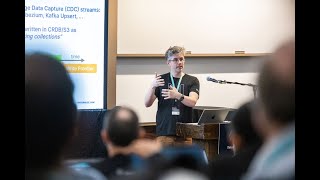
ABOUT THE TALK: A streaming database is a potentially intimidating product to build. Frank McSherry, Chief Scientist at Materialize, breaks down the manageable parts, through three foundational choices that fit together well. Frank also talks about the trade-offs, and how their simplifications lead to a much more manageable streaming database.
ABOUT THE SPEAKER: Frank McSherry is Chief Scientist at Materialize, where he (and others) convert SQL into scale-out, streaming, and interactive dataflows. Before this, he developed the timely and differential dataflow Rust libraries (with colleagues at ETHZ), and led the Naiad research project and co-invented differential privacy while at MSR Silicon Valley. He has a PhD in computer science from the University of Washington.
ABOUT DATA COUNCIL: Data Council (https://www.datacouncil.ai/) is a community and conference series that provides data professionals with the learning and networking opportunities they need to grow their careers.
Make sure to subscribe to our channel for the most up-to-date talks from technical professionals on data related topics including data infrastructure, data engineering, ML systems, analytics and AI from top startups and tech companies.
FOLLOW DATA COUNCIL: Twitter: https://twitter.com/DataCouncilAI LinkedIn: https://www.linkedin.com/company/datacouncil-ai/
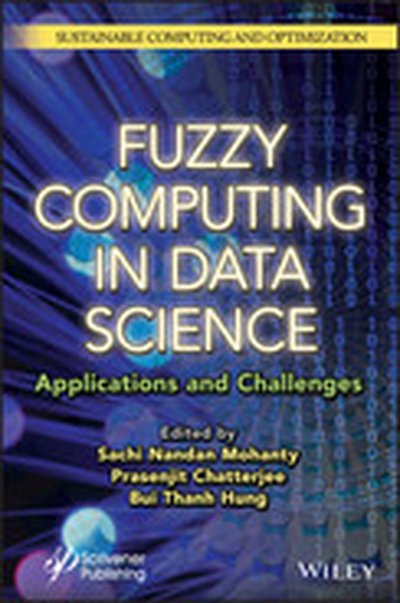
FUZZY COMPUTING IN DATA SCIENCE This book comprehensively explains how to use various fuzzy-based models to solve real-time industrial challenges. The book provides information about fundamental aspects of the field and explores the myriad applications of fuzzy logic techniques and methods. It presents basic conceptual considerations and case studies of applications of fuzzy computation. It covers the fundamental concepts and techniques for system modeling, information processing, intelligent system design, decision analysis, statistical analysis, pattern recognition, automated learning, system control, and identification. The book also discusses the combination of fuzzy computation techniques with other computational intelligence approaches such as neural and evolutionary computation. Audience Researchers and students in computer science, artificial intelligence, machine learning, big data analytics, and information and communication technology.
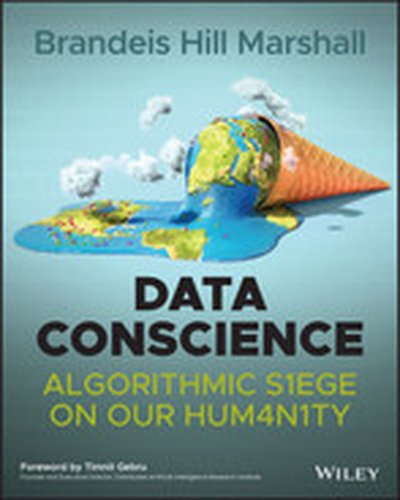
DATA CONSCIENCE ALGORITHMIC S1EGE ON OUR HUM4N1TY EXPLORE HOW D4TA STRUCTURES C4N HELP OR H1NDER SOC1AL EQU1TY Data has enjoyed ‘bystander’ status as we’ve attempted to digitize responsibility and morality in tech. In fact, data’s importance should earn it a spot at the center of our thinking and strategy around building a better, more ethical world. It’s use—and misuse—lies at the heart of many of the racist, gendered, classist, and otherwise oppressive practices of modern tech. In Data Conscience: Algorithmic Siege on our Humanity, computer science and data inclusivity thought leader Dr. Brandeis Hill Marshall delivers a call to action for rebel tech leaders, who acknowledge and are prepared to address the current limitations of software development. In the book, Dr. Brandeis Hill Marshall discusses how the philosophy of “move fast and break things” is, itself, broken, and requires change. You’ll learn about the ways that discrimination rears its ugly head in the digital data space and how to address them with several known algorithms, including social network analysis, and linear regression A can’t-miss resource for junior-level to senior-level software developers who have gotten their hands dirty with at least a handful of significant software development projects, Data Conscience also provides readers with: Discussions of the importance of transparency Explorations of computational thinking in practice Strategies for encouraging accountability in tech Ways to avoid double-edged data visualization Schemes for governing data structures with law and algorithms
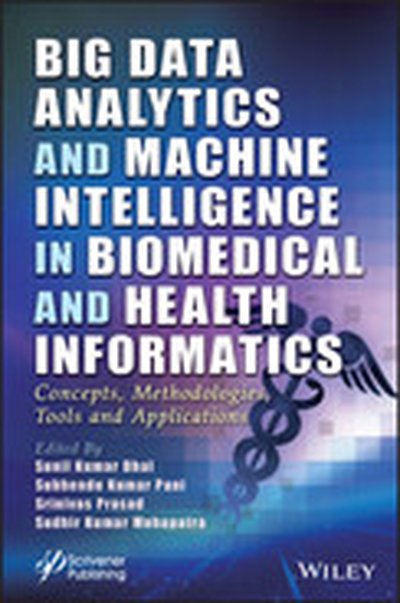
BIG DATA ANALYTICS AND MACHINE INTELLIGENCE IN BIOMEDICAL AND HEALTH INFORMATICS Provides coverage of developments and state-of-the-art methods in the broad and diversified data analytics field and applicable areas such as big data analytics, data mining, and machine intelligence in biomedical and health informatics. The novel applications of Big Data Analytics and machine intelligence in the biomedical and healthcare sector is an emerging field comprising computer science, medicine, biology, natural environmental engineering, and pattern recognition. Biomedical and health informatics is a new era that brings tremendous opportunities and challenges due to the plentifully available biomedical data and the aim is to ensure high-quality and efficient healthcare by analyzing the data. The 12 chapters in??Big Data Analytics and Machine Intelligence in Biomedical and Health Informatics??cover the latest advances and developments in health informatics, data mining, machine learning, and artificial intelligence. They have been organized with respect to the similarity of topics addressed, ranging from issues pertaining to the Internet of Things (IoT) for biomedical engineering and health informatics, computational intelligence for medical data processing, and Internet of Medical Things??(IoMT). New researchers and practitioners working in the field will benefit from reading the book as they can quickly ascertain the best performing methods and compare the different approaches. Audience Researchers and practitioners working in the fields of biomedicine, health informatics, big data analytics, Internet of Things, and machine learning.