talk-data.com talk-data.com

Topic

Java

programming_language object_oriented enterprise

392

tagged

Activity Trend

25 peak/qtr
2020-Q1 2026-Q1

Activities

392 activities · Newest first

Summary Exploratory data analysis works best when the feedback loop is fast and iterative. This is easy to achieve when you are working on small datasets, but as they scale up beyond what can fit on a single machine those short iterations quickly become long and tedious. The Arkouda project is a Python interface built on top of the Chapel compiler to bring back those interactive speeds for exploratory analysis on horizontally scalable compute that parallelizes operations on large volumes of data. In this episode David Bader explains how the framework operates, the algorithms that are built into it to support complex analyses, and how you can start using it today.

Announcements

Hello and welcome to the Data Engineering Podcast, the show about modern data management When you’re ready to build your next pipeline, or want to test out the projects you hear about on the show, you’ll need somewhere to deploy it, so check out our friends at Linode. With their new managed database service you can launch a production ready MySQL, Postgres, or MongoDB cluster in minutes, with automated backups, 40 Gbps connections from your application hosts, and high throughput SSDs. Go to dataengineeringpodcast.com/linode today and get a $100 credit to launch a database, create a Kubernetes cluster, or take advantage of all of their other services. And don’t forget to thank them for their continued support of this show! Data stacks are becoming more and more complex. This brings infinite possibilities for data pipelines to break and a host of other issues, severely deteriorating the quality of the data and causing teams to lose trust. Sifflet solves this problem by acting as an overseeing layer to the data stack – observing data and ensuring it’s reliable from ingestion all the way to consumption. Whether the data is in transit or at rest, Sifflet can detect data quality anomalies, assess business impact, identify the root cause, and alert data teams’ on their preferred channels. All thanks to 50+ quality checks, extensive column-level lineage, and 20+ connectors across the Data Stack. In addition, data discovery is made easy through Sifflet’s information-rich data catalog with a powerful search engine and real-time health statuses. Listeners of the podcast will get $2000 to use as platform credits when signing up to use Sifflet. Sifflet also offers a 2-week free trial. Find out more at dataengineeringpodcast.com/sifflet today! RudderStack helps you build a customer data platform on your warehouse or data lake. Instead of trapping data in a black box, they enable you to easily collect customer data from the entire stack and build an identity graph on your warehouse, giving you full visibility and control. Their SDKs make event streaming from any app or website easy, and their state-of-the-art reverse ETL pipelines enable you to send enriched data to any cloud tool. Sign up free… or just get the free t-shirt for being a listener of the Data Engineering Podcast at dataengineeringpodcast.com/rudder. Data teams are increasingly under pressure to deliver. According to a recent survey by Ascend.io, 95% in fact reported being at or over capacity. With 72% of data experts reporting demands on their team going up faster than they can hire, it’s no surprise they are increasingly turning to automation. In fact, while only 3.5% report having current investments in automation, 85% of data teams plan on investing in automation in the next 12 months. 85%!!! That’s where our friends at Ascend.io come in. The Ascend Data Automation Cloud provides a unified platform for data ingestion, transformation, orchestration, and observability. Ascend users love its declarative pipelines, powerful SDK, elegant UI, and extensible plug-in architecture, as well as its support for Python, SQL, Scala, and Java. Ascend automates workloads on Snowflake, Databricks, BigQuery, and open source Spark, and can be deployed in AWS, Azure, or GCP. Go to dataengineeringpodc
Summary The current stage of evolution in the data management ecosystem has resulted in domain and use case specific orchestration capabilities being incorporated into various tools. This complicates the work involved in making end-to-end workflows visible and integrated. Dagster has invested in bringing insights about external tools’ dependency graphs into one place through its "software defined assets" functionality. In this episode Nick Schrock discusses the importance of orchestration and a central location for managing data systems, the road to Dagster’s 1.0 release, and the new features coming with Dagster Cloud’s general availability.

Announcements

Hello and welcome to the Data Engineering Podcast, the show about modern data management When you’re ready to build your next pipeline, or want to test out the projects you hear about on the show, you’ll need somewhere to deploy it, so check out our friends at Linode. With their new managed database service you can launch a production ready MySQL, Postgres, or MongoDB cluster in minutes, with automated backups, 40 Gbps connections from your application hosts, and high throughput SSDs. Go to dataengineeringpodcast.com/linode today and get a $100 credit to launch a database, create a Kubernetes cluster, or take advantage of all of their other services. And don’t forget to thank them for their continued support of this show! RudderStack helps you build a customer data platform on your warehouse or data lake. Instead of trapping data in a black box, they enable you to easily collect customer data from the entire stack and build an identity graph on your warehouse, giving you full visibility and control. Their SDKs make event streaming from any app or website easy, and their state-of-the-art reverse ETL pipelines enable you to send enriched data to any cloud tool. Sign up free… or just get the free t-shirt for being a listener of the Data Engineering Podcast at dataengineeringpodcast.com/rudder. Data teams are increasingly under pressure to deliver. According to a recent survey by Ascend.io, 95% in fact reported being at or over capacity. With 72% of data experts reporting demands on their team going up faster than they can hire, it’s no surprise they are increasingly turning to automation. In fact, while only 3.5% report having current investments in automation, 85% of data teams plan on investing in automation in the next 12 months. 85%!!! That’s where our friends at Ascend.io come in. The Ascend Data Automation Cloud provides a unified platform for data ingestion, transformation, orchestration, and observability. Ascend users love its declarative pipelines, powerful SDK, elegant UI, and extensible plug-in architecture, as well as its support for Python, SQL, Scala, and Java. Ascend automates workloads on Snowflake, Databricks, BigQuery, and open source Spark, and can be deployed in AWS, Azure, or GCP. Go to dataengineeringpodcast.com/ascend and sign up for a free trial. If you’re a data engineering podcast listener, you get credits worth $5,000 when you become a customer. Your host is Tobias Macey and today I’m interviewing Nick Schrock about software defined assets and improving the developer experience for data orchestration with Dagster

Interview

Introduction How did you get involved in the area of data management? What are the notable updates in Dagster since the last time we spoke? (November, 2021) One of the core concepts that you introduced and then stabilized in recent releases is the "software defined asset" (SDA). How have your users reacted to this capability?

What are the notable outcomes in development and product practices that you have seen as a result?

What are the changes to the interfaces and internals of Dagster that were necessary to support SDA? How did the API design shift from the initial implementation once the community started providing feedback? You’re releasing the stable 1.0 version of Dagster as part of something call

Improving Apache Spark Application Processing Time by Configurations, Code Optimizations, etc.

In this session, we'll go over several use-cases and describe the process of improving our spark structured streaming application micro-batch time from ~55 to ~30 seconds in several steps.

Our app is processing ~ 700 MB/s of compressed data, it has very strict KPIs, and it is using several technologies and frameworks such as: Spark 3.1, Kafka, Azure Blob Storage, AKS and Java 11.

We'll share our work and experience in those fields, and go over a few tips to create better Spark structured streaming applications.

The main areas that will be discussed are: Spark Configuration changes, code optimizations and the implementation of the Spark custom data source.

Connect with us: Website: https://databricks.com Facebook: https://www.facebook.com/databricksinc Twitter: https://twitter.com/databricks LinkedIn: https://www.linkedin.com/company/data... Instagram: https://www.instagram.com/databricksinc/

Mosaic: A Framework for Geospatial Analytics at Scale

In this session we’ll present Mosaic, a new Databricks Labs project with a geospatial flavour.

Mosaic provides users of Spark and Databricks with a unified framework for distributing geospatial analytics. Users can choose to employ existing Java-based tools such as JTS or Esri's Geometry API for Java and Mosaic will handle the task of parallelizing these tools' operations: e.g. efficiently reading and writing geospatial data and performing spatial functions on geometries. Mosaic helps users scale these operations by providing spatial indexing capabilities (using, for example, Uber's H3 library) and advanced techniques for optimising common point-in-polygon and polygon-polygon intersection operations.

The development of Mosaic builds upon techniques developed with Ordnance Survey (the central hub for geospatial data across UK Government) and described in this blog post: https://databricks.com/blog/2021/10/11/efficient-point-in-polygon-joins-via-pyspark-and-bng-geospatial-indexing.html

Connect with us: Website: https://databricks.com Facebook: https://www.facebook.com/databricksinc Twitter: https://twitter.com/databricks LinkedIn: https://www.linkedin.com/company/data... Instagram: https://www.instagram.com/databricksinc/

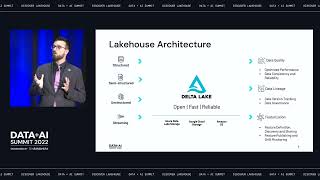
Delta Lake 2.0 Overview

After three years of hard work by the Delta community, we are proud to announce the release of Delta Lake 2.0. Completing the work to open-source all of Delta Lake while tens of thousands of organizations were running in production was no small feat and we have the ever-expanding Delta community to thank! Join this session to learn about how the wider Delta community collaborated together to bring these features and integrations together.

Join this session to learn about how the wider Delta community collaborated together to bring these features and integrations together. This includes the Integrations with Apache Spark™, Apache Flink, Apache Pulsar, Presto, Trino, and more.

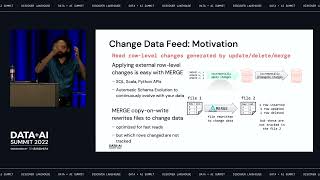
Features such as OPTIMIZE ZORDER, data skipping using column stats, S3 multi-cluster writes, Change Data Feed, and more.

Language APIs including Rust, Python, Ruby, GoLang, Scala, and Java.

Connect with us: Website: https://databricks.com Facebook: https://www.facebook.com/databricksinc Twitter: https://twitter.com/databricks LinkedIn: https://www.linkedin.com/company/data... Instagram: https://www.instagram.com/databricksinc/

Privacy Preserving Machine Learning and Big Data Analytics Using Apache Spark

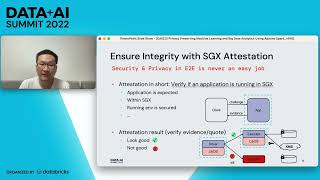
In recent years, latest privacy laws & regulations bring a fundamental shift in the protection of data and privacy, placing new challenges to data applications. To resolve these privacy & security challenges in big data ecosystem without impacting existing applications, several hardware TEE (Trusted Execution Environment) solutions have been proposed for Apache Spark, e.g., PySpark with Scone and Opaque etc. However, to the best of our knowledge, none of them provide full protection to data pipelines in Spark applications. An adversary may still get sensitive information from unprotected components and stages. Furthermore, some of them greatly narrowed supported applications, e.g., only support SparkSQL. In this presentation, we will present a new PPMLA (privacy preserving machine learning and analytics) solution built on top of Apache Spark, BigDL, Occlum and Intel SGX. It ensures all spark components and pipelines are fully protected by Intel SGX, and existing Spark applications written in Scala, Java or Python can be migrated into our platform without any code change. We will demonstrate how to build distributed end-to-end SparkML/SparkSQL workloads with our solution on untrusted cloud environment and share real-world use cases for PPMLA.

Connect with us: Website: https://databricks.com Facebook: https://www.facebook.com/databricksinc Twitter: https://twitter.com/databricks LinkedIn: https://www.linkedin.com/company/data... Instagram: https://www.instagram.com/databricksinc/

Summary Data engineering is a large and growing subject, with new technologies, specializations, and "best practices" emerging at an accelerating pace. This podcast does its best to explore this fractal ecosystem, and has been at it for the past 5+ years. In this episode Joe Reis, founder of Ternary Data and co-author of "Fundamentals of Data Engineering", turns the tables and interviews the host, Tobias Macey, about his journey into podcasting, how he runs the show behind the scenes, and the other things that occupy his time.

Announcements

Hello and welcome to the Data Engineering Podcast, the show about modern data management When you’re ready to build your next pipeline, or want to test out the projects you hear about on the show, you’ll need somewhere to deploy it, so check out our friends at Linode. With their new managed database service you can launch a production ready MySQL, Postgres, or MongoDB cluster in minutes, with automated backups, 40 Gbps connections from your application hosts, and high throughput SSDs. Go to dataengineeringpodcast.com/linode today and get a $100 credit to launch a database, create a Kubernetes cluster, or take advantage of all of their other services. And don’t forget to thank them for their continued support of this show! RudderStack helps you build a customer data platform on your warehouse or data lake. Instead of trapping data in a black box, they enable you to easily collect customer data from the entire stack and build an identity graph on your warehouse, giving you full visibility and control. Their SDKs make event streaming from any app or website easy, and their state-of-the-art reverse ETL pipelines enable you to send enriched data to any cloud tool. Sign up free… or just get the free t-shirt for being a listener of the Data Engineering Podcast at dataengineeringpodcast.com/rudder. Data teams are increasingly under pressure to deliver. According to a recent survey by Ascend.io, 95% in fact reported being at or over capacity. With 72% of data experts reporting demands on their team going up faster than they can hire, it’s no surprise they are increasingly turning to automation. In fact, while only 3.5% report having current investments in automation, 85% of data teams plan on investing in automation in the next 12 months. 85%!!! That’s where our friends at Ascend.io come in. The Ascend Data Automation Cloud provides a unified platform for data ingestion, transformation, orchestration, and observability. Ascend users love its declarative pipelines, powerful SDK, elegant UI, and extensible plug-in architecture, as well as its support for Python, SQL, Scala, and Java. Ascend automates workloads on Snowflake, Databricks, BigQuery, and open source Spark, and can be deployed in AWS, Azure, or GCP. Go to dataengineeringpodcast.com/ascend and sign up for a free trial. If you’re a data engineering podcast listener, you get credits worth $5,000 when you become a customer. Your host is Tobias Macey and today we’re flipping the script. Joe Reis of Ternary Data will be interviewing me about my time as the host of this show and my perspectives on the data ecosystem

Interview

Introduction How did you get involved in the area of data management? Now I’ll hand it off to Joe…

Joe’s Notes

You do a lot of podcasts. Why? Podcast.init started in 2015, and your first episode of Data Engineering was published January 14, 2017. Walk us through the start of these podcasts. why not a data science podcast? why DE? You’ve published 306 of shows of the Data Engineering Podcast, plus 370 for the init podcast, then you’ve got a new ML podcast. How have you kept the motivation over the years? What’s the process for the show (finding guests, topics, etc….recording, publishing)? It’s a lot of work. Walk us through this process. You’ve done a ton of shows and have a lot of context with what’s going on in the field of both data engineering and Python. What have been some of the

Summary Building and maintaining reliable data assets is the prime directive for data engineers. While it is easy to say, it is endlessly complex to implement, requiring data professionals to be experts in a wide range of disparate topics while designing and implementing complex topologies of information workflows. In order to make this a tractable problem it is essential that engineers embrace automation at every opportunity. In this episode Chris Riccomini shares his experiences building and scaling data operations at WePay and LinkedIn, as well as the lessons he has learned working with other teams as they automated their own systems.

Announcements

Hello and welcome to the Data Engineering Podcast, the show about modern data management When you’re ready to build your next pipeline, or want to test out the projects you hear about on the show, you’ll need somewhere to deploy it, so check out our friends at Linode. With their new managed database service you can launch a production ready MySQL, Postgres, or MongoDB cluster in minutes, with automated backups, 40 Gbps connections from your application hosts, and high throughput SSDs. Go to dataengineeringpodcast.com/linode today and get a $100 credit to launch a database, create a Kubernetes cluster, or take advantage of all of their other services. And don’t forget to thank them for their continued support of this show! RudderStack helps you build a customer data platform on your warehouse or data lake. Instead of trapping data in a black box, they enable you to easily collect customer data from the entire stack and build an identity graph on your warehouse, giving you full visibility and control. Their SDKs make event streaming from any app or website easy, and their state-of-the-art reverse ETL pipelines enable you to send enriched data to any cloud tool. Sign up free… or just get the free t-shirt for being a listener of the Data Engineering Podcast at dataengineeringpodcast.com/rudder. Data teams are increasingly under pressure to deliver. According to a recent survey by Ascend.io, 95% in fact reported being at or over capacity. With 72% of data experts reporting demands on their team going up faster than they can hire, it’s no surprise they are increasingly turning to automation. In fact, while only 3.5% report having current investments in automation, 85% of data teams plan on investing in automation in the next 12 months. 85%!!! That’s where our friends at Ascend.io come in. The Ascend Data Automation Cloud provides a unified platform for data ingestion, transformation, orchestration, and observability. Ascend users love its declarative pipelines, powerful SDK, elegant UI, and extensible plug-in architecture, as well as its support for Python, SQL, Scala, and Java. Ascend automates workloads on Snowflake, Databricks, BigQuery, and open source Spark, and can be deployed in AWS, Azure, or GCP. Go to dataengineeringpodcast.com/ascend and sign up for a free trial. If you’re a data engineering podcast listener, you get credits worth $5,000 when you become a customer. Your host is Tobias Macey and today I’m interviewing Chris Riccomini about building awareness of data usage into CI/CD pipelines for application development

Interview

Introduction How did you get involved in the area of data management? What are the pieces of data platforms and processing that have been most difficult to scale in an organizational sense? What are the opportunities for automation to alleviate some of the toil that data and analytics engineers get caught up in? The application delivery ecosystem has been going through ongoing transformation in the form of CI/CD, infrastructure as code, etc. What are the parallels in the data ecosystem that are still nascent? What are the principles that still need to be translated for data practitioners? Which are subject to impedance mismatch and may never make sense to translate? As someone with a software engineering background and extensive e

Summary The perennial challenge of data engineers is ensuring that information is integrated reliably. While it is straightforward to know whether a synchronization process succeeded, it is not always clear whether every record was copied correctly. In order to quickly identify if and how two data systems are out of sync Gleb Mezhanskiy and Simon Eskildsen partnered to create the open source data-diff utility. In this episode they explain how the utility is implemented to run quickly and how you can start using it in your own data workflows to ensure that your data warehouse isn’t missing any records from your source systems.

Announcements

Hello and welcome to the Data Engineering Podcast, the show about modern data management When you’re ready to build your next pipeline, or want to test out the projects you hear about on the show, you’ll need somewhere to deploy it, so check out our friends at Linode. With their new managed database service you can launch a production ready MySQL, Postgres, or MongoDB cluster in minutes, with automated backups, 40 Gbps connections from your application hosts, and high throughput SSDs. Go to dataengineeringpodcast.com/linode today and get a $100 credit to launch a database, create a Kubernetes cluster, or take advantage of all of their other services. And don’t forget to thank them for their continued support of this show! Random data doesn’t do it — and production data is not safe (or legal) for developers to use. What if you could mimic your entire production database to create a realistic dataset with zero sensitive data? Tonic.ai does exactly that. With Tonic, you can generate fake data that looks, acts, and behaves like production because it’s made from production. Using universal data connectors and a flexible API, Tonic integrates seamlessly into your existing pipelines and allows you to shape and size your data to the scale, realism, and degree of privacy that you need. The platform offers advanced subsetting, secure de-identification, and ML-driven data synthesis to create targeted test data for all of your pre-production environments. Your newly mimicked datasets are safe to share with developers, QA, data scientists—heck, even distributed teams around the world. Shorten development cycles, eliminate the need for cumbersome data pipeline work, and mathematically guarantee the privacy of your data, with Tonic.ai. Data Engineering Podcast listeners can sign up for a free 2-week sandbox account, go to dataengineeringpodcast.com/tonic today to give it a try! Data teams are increasingly under pressure to deliver. According to a recent survey by Ascend.io, 95% in fact reported being at or over capacity. With 72% of data experts reporting demands on their team going up faster than they can hire, it’s no surprise they are increasingly turning to automation. In fact, while only 3.5% report having current investments in automation, 85% of data teams plan on investing in automation in the next 12 months. 85%!!! That’s where our friends at Ascend.io come in. The Ascend Data Automation Cloud provides a unified platform for data ingestion, transformation, orchestration, and observability. Ascend users love its declarative pipelines, powerful SDK, elegant UI, and extensible plug-in architecture, as well as its support for Python, SQL, Scala, and Java. Ascend automates workloads on Snowflake, Databricks, BigQuery, and open source Spark, and can be deployed in AWS, Azure, or GCP. Go to dataengineeringpodcast.com/ascend and sign up for a free trial. If you’re a data engineering podcast listener, you get credits worth $5,000 when you become a customer. RudderStack helps you build a customer data platform on your warehouse or data lake. Instead of trapping data in a black box, they enable you to easily collect customer data from the entire stack and build an identity graph on your warehouse, giving you full visibility and control. Their SDKs make event streaming from any app or

Summary The most complicated part of data engineering is the effort involved in making the raw data fit into the narrative of the business. Master Data Management (MDM) is the process of building consensus around what the information actually means in the context of the business and then shaping the data to match those semantics. In this episode Malcolm Hawker shares his years of experience working in this domain to explore the combination of technical and social skills that are necessary to make an MDM project successful both at the outset and over the long term.

Announcements

Hello and welcome to the Data Engineering Podcast, the show about modern data management When you’re ready to build your next pipeline, or want to test out the projects you hear about on the show, you’ll need somewhere to deploy it, so check out our friends at Linode. With their new managed database service you can launch a production ready MySQL, Postgres, or MongoDB cluster in minutes, with automated backups, 40 Gbps connections from your application hosts, and high throughput SSDs. Go to dataengineeringpodcast.com/linode today and get a $100 credit to launch a database, create a Kubernetes cluster, or take advantage of all of their other services. And don’t forget to thank them for their continued support of this show! Random data doesn’t do it — and production data is not safe (or legal) for developers to use. What if you could mimic your entire production database to create a realistic dataset with zero sensitive data? Tonic.ai does exactly that. With Tonic, you can generate fake data that looks, acts, and behaves like production because it’s made from production. Using universal data connectors and a flexible API, Tonic integrates seamlessly into your existing pipelines and allows you to shape and size your data to the scale, realism, and degree of privacy that you need. The platform offers advanced subsetting, secure de-identification, and ML-driven data synthesis to create targeted test data for all of your pre-production environments. Your newly mimicked datasets are safe to share with developers, QA, data scientists—heck, even distributed teams around the world. Shorten development cycles, eliminate the need for cumbersome data pipeline work, and mathematically guarantee the privacy of your data, with Tonic.ai. Data Engineering Podcast listeners can sign up for a free 2-week sandbox account, go to dataengineeringpodcast.com/tonic today to give it a try! RudderStack helps you build a customer data platform on your warehouse or data lake. Instead of trapping data in a black box, they enable you to easily collect customer data from the entire stack and build an identity graph on your warehouse, giving you full visibility and control. Their SDKs make event streaming from any app or website easy, and their state-of-the-art reverse ETL pipelines enable you to send enriched data to any cloud tool. Sign up free… or just get the free t-shirt for being a listener of the Data Engineering Podcast at dataengineeringpodcast.com/rudder. Data teams are increasingly under pressure to deliver. According to a recent survey by Ascend.io, 95% in fact reported being at or over capacity. With 72% of data experts reporting demands on their team going up faster than they can hire, it’s no surprise they are increasingly turning to automation. In fact, while only 3.5% report having current investments in automation, 85% of data teams plan on investing in automation in the next 12 months. 85%!!! That’s where our friends at Ascend.io come in. The Ascend Data Automation Cloud provides a unified platform for data ingestion, transformation, orchestration, and observability. Ascend users love its declarative pipelines, powerful SDK, elegant UI, and extensible plug-in architecture, as well as its support for Python, SQL, Scala, and Java. Ascend automates workloads on Snowflake, Databricks, BigQuery, and open source Spark, and can be deployed in AWS, Azure

Summary Metadata is the lifeblood of your data platform, providing information about what is happening in your systems. A variety of platforms have been developed to capture and analyze that information to great effect, but they are inherently limited in their utility due to their nature as storage systems. In order to level up their value a new trend of active metadata is being implemented, allowing use cases like keeping BI reports up to date, auto-scaling your warehouses, and automated data governance. In this episode Prukalpa Sankar joins the show to talk about the work she and her team at Atlan are doing to push this capability into the mainstream.

Announcements

Hello and welcome to the Data Engineering Podcast, the show about modern data management When you’re ready to build your next pipeline, or want to test out the projects you hear about on the show, you’ll need somewhere to deploy it, so check out our friends at Linode. With their new managed database service you can launch a production ready MySQL, Postgres, or MongoDB cluster in minutes, with automated backups, 40 Gbps connections from your application hosts, and high throughput SSDs. Go to dataengineeringpodcast.com/linode today and get a $100 credit to launch a database, create a Kubernetes cluster, or take advantage of all of their other services. And don’t forget to thank them for their continued support of this show! RudderStack helps you build a customer data platform on your warehouse or data lake. Instead of trapping data in a black box, they enable you to easily collect customer data from the entire stack and build an identity graph on your warehouse, giving you full visibility and control. Their SDKs make event streaming from any app or website easy, and their state-of-the-art reverse ETL pipelines enable you to send enriched data to any cloud tool. Sign up free… or just get the free t-shirt for being a listener of the Data Engineering Podcast at dataengineeringpodcast.com/rudder. Data teams are increasingly under pressure to deliver. According to a recent survey by Ascend.io, 95% in fact reported being at or over capacity. With 72% of data experts reporting demands on their team going up faster than they can hire, it’s no surprise they are increasingly turning to automation. In fact, while only 3.5% report having current investments in automation, 85% of data teams plan on investing in automation in the next 12 months. 85%!!! That’s where our friends at Ascend.io come in. The Ascend Data Automation Cloud provides a unified platform for data ingestion, transformation, orchestration, and observability. Ascend users love its declarative pipelines, powerful SDK, elegant UI, and extensible plug-in architecture, as well as its support for Python, SQL, Scala, and Java. Ascend automates workloads on Snowflake, Databricks, BigQuery, and open source Spark, and can be deployed in AWS, Azure, or GCP. Go to dataengineeringpodcast.com/ascend and sign up for a free trial. If you’re a data engineering podcast listener, you get credits worth $5,000 when you become a customer. Today’s episode is Sponsored by Prophecy.io – the low-code data engineering platform for the cloud. Prophecy provides an easy-to-use visual interface to design & deploy data pipelines on Apache Spark & Apache Airflow. Now all the data users can use software engineering best practices – git, tests and continuous deployment with a simple to use visual designer. How does it work? – You visually design the pipelines, and Prophecy generates clean Spark code with tests on git; then you visually schedule these pipelines on Airflow. You can observe your pipelines with built in metadata search and column level lineage. Finally, if you have existing workflows in AbInitio, Informatica or other ETL formats that you want to move to the cloud, you can import them automatically into Prophecy making them run productively on Spark. Create your free account today at dataengineeringpodcast.com/prophecy. Your host is Tobias Macey and today I’m interviewing Prukalpa Sankar about how data platforms can benefit from the idea of "active metadata" and the work that she and her team at Atlan are doing to make it a reality

Interview

Introduction How did you get involved in the area of data management? Can you describe what "active metadata" is and how it differs from the current approaches to metadata systems? What are some of the use cases that "active metadata" can enable for data producers and consumers?

What are the points of friction that those users encounter in the current formulation of metadata systems?

Central metadata systems/data catalogs came about as a solution to the challenge of integrating every data tool with every other data tool, giving a single place to integrate. What are the lessons that are being learned from the "modern data stack" that can be applied to centralized metadata? Can you describe the approach that you are taking at Atlan to enable the adoption of "active metadata"?

What are the architectural capabilities that you had to build to power the outbound traffic flows?

How are you addressing the N x M integration problem for pushing metadata into the necessary contexts at Atlan?

What are the interfaces that are necessary for receiving systems to be able to make use of the metadata that is being delivered? How does the type/category of metadata impact the type of integration that is necessary?

What are some of the automation possibilities that metadata activation offers for data teams?

What are the cases where you still need a human in the loop?

What are the most interesting, innovative, or unexpected ways that you have seen active metadata capabilities used? What are the most interesting, unexpected, or challenging lessons that you have learned while working on activating metadata for your users? When is an active approach to metadata the wrong choice? What do you have planned for the future of Atlan and active metadata?

Contact Info

LinkedIn @prukalpa on Twitter

Parting Question

From your perspective, what is the biggest gap in the tooling or technology for data management today?

Closing Announcements

Thank you for listening! Don’t forget to check out our other shows. Podcast.init covers the Python language, its community, and the innovative ways it is being used. The Machine Learning Podcast helps you go from idea to production with machine learning. Visit the site to subscribe to the show, sign up for the mailing list, and read the show notes. If you’ve learned something or tried out a project from the show then tell us about it! Email [email protected]) with your story. To help other people find the show please leave a review on Apple Podcasts and tell your friends and co-workers

Links

Atlan What is Active Metadata? Segment

Podcast Episode

Zapier ArgoCD Kubernetes Wix AWS Lambda Modern Data Culture Blog Post

The intro and outro music is from The Hug by The Freak Fandango Orchestra / CC BY-SA

Support Data Engineering Podcast

Summary Unstructured data takes many forms in an organization. From a data engineering perspective that often means things like JSON files, audio or video recordings, images, etc. Another category of unstructured data that every business deals with is PDFs, Word documents, workstation backups, and countless other types of information. Aparavi was created to tame the sprawl of information across machines, datacenters, and clouds so that you can reduce the amount of duplicate data and save time and money on managing your data assets. In this episode Rod Christensen shares the story behind Aparavi and how you can use it to cut costs and gain value for the long tail of your unstructured data.

Announcements

Hello and welcome to the Data Engineering Podcast, the show about modern data management When you’re ready to build your next pipeline, or want to test out the projects you hear about on the show, you’ll need somewhere to deploy it, so check out our friends at Linode. With their new managed database service you can launch a production ready MySQL, Postgres, or MongoDB cluster in minutes, with automated backups, 40 Gbps connections from your application hosts, and high throughput SSDs. Go to dataengineeringpodcast.com/linode today and get a $100 credit to launch a database, create a Kubernetes cluster, or take advantage of all of their other services. And don’t forget to thank them for their continued support of this show! This episode is brought to you by Acryl Data, the company behind DataHub, the leading developer-friendly data catalog for the modern data stack. Open Source DataHub is running in production at several companies like Peloton, Optum, Udemy, Zynga and others. Acryl Data provides DataHub as an easy to consume SaaS product which has been adopted by several companies. Signup for the SaaS product at dataengineeringpodcast.com/acryl RudderStack helps you build a customer data platform on your warehouse or data lake. Instead of trapping data in a black box, they enable you to easily collect customer data from the entire stack and build an identity graph on your warehouse, giving you full visibility and control. Their SDKs make event streaming from any app or website easy, and their state-of-the-art reverse ETL pipelines enable you to send enriched data to any cloud tool. Sign up free… or just get the free t-shirt for being a listener of the Data Engineering Podcast at dataengineeringpodcast.com/rudder. Data teams are increasingly under pressure to deliver. According to a recent survey by Ascend.io, 95% in fact reported being at or over capacity. With 72% of data experts reporting demands on their team going up faster than they can hire, it’s no surprise they are increasingly turning to automation. In fact, while only 3.5% report having current investments in automation, 85% of data teams plan on investing in automation in the next 12 months. 85%!!! That’s where our friends at Ascend.io come in. The Ascend Data Automation Cloud provides a unified platform for data ingestion, transformation, orchestration, and observability. Ascend users love its declarative pipelines, powerful SDK, elegant UI, and extensible plug-in architecture, as well as its support for Python, SQL, Scala, and Java. Ascend automates workloads on Snowflake, Databricks, BigQuery, and open source Spark, and can be deployed in AWS, Azure, or GCP. Go to dataengineeringpodcast.com/ascend and sign up for a free trial. If you’re a data engineering podcast listener, you get credits worth $5,000 when you become a customer. Your host is Tobias Macey and today I’m interviewing Rod Christensen about Aparavi, a platform designed to find and unlock the value of data, no matter where it lives

Interview

Introduction How did you get involved in the area of data management? Can you describe what Aparavi is and the story behind it? Who are the target customers for Aparavi and how does that inform your product roadmap and messaging? What are some of th

We talked about:

Summary of “Getting a Data Engineering Job” webinar Python and engineering skills  Interview process Behavioral interviews Technical interviews Learning Python and SQL from scratch Is having non-coding experience a disadvantage? Analyst or engineer? Do you need certificates? Do I need a master’s degree? Fully remote data engineering jobs Should I include teaching on my resume? Object-oriented programming for data engineering Python vs Java/Scala SQL and Python technical interview questions GCP certificates Is commercial experience really necessary? From sales to engineering Solution engineers Wrapping up

Links:

Getting a Data Engineering Job (webinar): https://www.youtube.com/watch?v=yvEWG-S1F_M The Flask Mega-Tutorial Part I - Hello, World! blog: https://blog.miguelgrinberg.com/post/the-flask-mega-tutorial-part-i-hello-world Mode SQL Tutorial: https://mode.com/sql-tutorial/

MLOps Zoomcamp: https://github.com/DataTalksClub/mlops-zoomcamp

Join DataTalks.Club: https://datatalks.club/slack.html

Our events: https://datatalks.club/events.html

Summary The best way to make sure that you don’t leak sensitive data is to never have it in the first place. The team at Skyflow decided that the second best way is to build a storage system dedicated to securely managing your sensitive information and making it easy to integrate with your applications and data systems. In this episode Sean Falconer explains the idea of a data privacy vault and how this new architectural element can drastically reduce the potential for making a mistake with how you manage regulated or personally identifiable information.

Announcements

Hello and welcome to the Data Engineering Podcast, the show about modern data management When you’re ready to build your next pipeline, or want to test out the projects you hear about on the show, you’ll need somewhere to deploy it, so check out our friends at Linode. With their new managed database service you can launch a production ready MySQL, Postgres, or MongoDB cluster in minutes, with automated backups, 40 Gbps connections from your application hosts, and high throughput SSDs. Go to dataengineeringpodcast.com/linode today and get a $100 credit to launch a database, create a Kubernetes cluster, or take advantage of all of their other services. And don’t forget to thank them for their continued support of this show! Atlan is the metadata hub for your data ecosystem. Instead of locking all of that information into a new silo, unleash its transformative potential with Atlan’s active metadata capabilities. Push information about data freshness and quality to your business intelligence, automatically scale up and down your warehouse based on usage patterns, and let the bots answer those questions in Slack so that the humans can focus on delivering real value. Go to dataengineeringpodcast.com/atlan today to learn more about how you can take advantage of active metadata and escape the chaos. Modern data teams are dealing with a lot of complexity in their data pipelines and analytical code. Monitoring data quality, tracing incidents, and testing changes can be daunting and often takes hours to days or even weeks. By the time errors have made their way into production, it’s often too late and damage is done. Datafold built automated regression testing to help data and analytics engineers deal with data quality in their pull requests. Datafold shows how a change in SQL code affects your data, both on a statistical level and down to individual rows and values before it gets merged to production. No more shipping and praying, you can now know exactly what will change in your database! Datafold integrates with all major data warehouses as well as frameworks such as Airflow & dbt and seamlessly plugs into CI workflows. Visit dataengineeringpodcast.com/datafold today to book a demo with Datafold. Data teams are increasingly under pressure to deliver. According to a recent survey by Ascend.io, 95% in fact reported being at or over capacity. With 72% of data experts reporting demands on their team going up faster than they can hire, it’s no surprise they are increasingly turning to automation. In fact, while only 3.5% report having current investments in automation, 85% of data teams plan on investing in automation in the next 12 months. 85%!!! That’s where our friends at Ascend.io come in. The Ascend Data Automation Cloud provides a unified platform for data ingestion, transformation, orchestration, and observability. Ascend users love its declarative pipelines, powerful SDK, elegant UI, and extensible plug-in architecture, as well as its support for Python, SQL, Scala, and Java. Ascend automates workloads on Snowflake, Databricks, BigQuery, and open source Spark, and can be deployed in AWS, Azure, or GCP. Go to dataengineeringpodcast.com/ascend and sign up for a free trial. If you’re a data engineering podcast listener, you get credits worth $5,000 when you become a customer. Your host is Tobias Macey and today I’m interviewing Sean Falconer about the idea of a data privacy vault and how the Skyflow team are working to make it turn-key

Interview

Introduction How did you get involved in the area of data management? Can you describe what Skyflow is and the story behind it? What is a "data privacy vault" and how does it differ from strategies such as privacy engineering or existing data governance patterns? What are the primary use cases and capabilities that you are focused on solving for with Skyflow?

Who is the target customer for Skyflow (e.g. how does it enter an organization)?

How is the Skyflow platform architected?

How have the design and goals of the system changed or evolved over time?

Can you describe the process of integrating with Skyflow at the application level? For organizations that are building analytical capabilities on top of the data managed in their applications, what are the interactions with Skyflow at each of the stages in the data lifecycle? One of the perennial problems with distributed systems is the challenge of joining data across machine boundaries. How do you mitigate that problem? On your website there are different "vaults" advertised in the form of healthcare, fintech, and PII. What are the different requirements across each of those problem domains?

What are the commonalities?

As a relatively new company in an emerging product category, what are some of the customer education challenges that you are facing? What are the most interesting, innovative, or unexpected ways that you have seen Skyflow used? What are the most interesting, unexpected, or challenging lessons that you have learned while working on Skyflow? When is Skyflow the wrong choice? What do you have planned for the future of Skyflow?

Contact Info

LinkedIn @seanfalconer on Twitter Website

Parting Question

From your perspective, what is the biggest gap in the tooling or technology for data management today?

Closing Announcements

Thank you for listening! Don’t forget to check out our other show, Podcast.init to learn about the Python language, its community, and the innovative ways it is being used. Visit the site to subscribe to the show, sign up for the mailing list, and read the show notes. If you’ve learned something or tried out a project from the show then tell us about it! Email [email protected]) with your story. To help other people find the show please leave a review on iTunes and tell your friends and co-workers

Links

Skyflow Privacy Engineering Data Governance Homomorphic Encryption Polymorphic Encryption

The intro and outro music is from The Hug by The Freak Fandango Orchestra / CC BY-SA

Support Data Engineering Podcast

Summary A large fraction of data engineering work involves moving data from one storage location to another in order to support different access and query patterns. Singlestore aims to cut down on the number of database engines that you need to run so that you can reduce the amount of copying that is required. By supporting fast, in-memory row-based queries and columnar on-disk representation, it lets your transactional and analytical workloads run in the same database. In this episode SVP of engineering Shireesh Thota describes the impact on your overall system architecture that Singlestore can have and the benefits of using a cloud-native database engine for your next application.

Announcements

Hello and welcome to the Data Engineering Podcast, the show about modern data management When you’re ready to build your next pipeline, or want to test out the projects you hear about on the show, you’ll need somewhere to deploy it, so check out our friends at Linode. With their managed Kubernetes platform it’s now even easier to deploy and scale your workflows, or try out the latest Helm charts from tools like Pulsar and Pachyderm. With simple pricing, fast networking, object storage, and worldwide data centers, you’ve got everything you need to run a bulletproof data platform. Go to dataengineeringpodcast.com/linode today and get a $100 credit to try out a Kubernetes cluster of your own. And don’t forget to thank them for their continued support of this show! Atlan is a collaborative workspace for data-driven teams, like Github for engineering or Figma for design teams. By acting as a virtual hub for data assets ranging from tables and dashboards to SQL snippets & code, Atlan enables teams to create a single source of truth for all their data assets, and collaborate across the modern data stack through deep integrations with tools like Snowflake, Slack, Looker and more. Go to dataengineeringpodcast.com/atlan today and sign up for a free trial. If you’re a data engineering podcast listener, you get credits worth $3000 on an annual subscription So now your modern data stack is set up. How is everyone going to find the data they need, and understand it? Select Star is a data discovery platform that automatically analyzes & documents your data. For every table in Select Star, you can find out where the data originated, which dashboards are built on top of it, who’s using it in the company, and how they’re using it, all the way down to the SQL queries. Best of all, it’s simple to set up, and easy for both engineering and operations teams to use. With Select Star’s data catalog, a single source of truth for your data is built in minutes, even across thousands of datasets. Try it out for free and double the length of your free trial today at dataengineeringpodcast.com/selectstar. You’ll also get a swag package when you continue on a paid plan. Data teams are increasingly under pressure to deliver. According to a recent survey by Ascend.io, 95% in fact reported being at or over capacity. With 72% of data experts reporting demands on their team going up faster than they can hire, it’s no surprise they are increasingly turning to automation. In fact, while only 3.5% report having current investments in automation, 85% of data teams plan on investing in automation in the next 12 months. 85%!!! That’s where our friends at Ascend.io come in. The Ascend Data Automation Cloud provides a unified platform for data ingestion, transformation, orchestration, and observability. Ascend users love its declarative pipelines, powerful SDK, elegant UI, and extensible plug-in architecture, as well as its support for Python, SQL, Scala, and Java. Ascend automates workloads on Snowflake, Databricks, BigQuery, and open source Spark, and can be deployed in AWS, Azure, or GCP. Go to dataengineeringpodcast.com/ascend and sign up for a free trial. If you’re a data engineering podcast listener, you get credits worth $5,000 when you becom

Elasticsearch 8.x Cookbook - Fifth Edition

"Elasticsearch 8.x Cookbook" is your go-to resource for harnessing the full potential of Elasticsearch 8. This book provides over 180 hands-on recipes to help you efficiently implement, customize, and scale Elasticsearch solutions in your enterprise. Whether you're handling complex queries, analytics, or cluster management, you'll find practical insights to enhance your capabilities. What this Book will help me do Understand the advanced features of Elasticsearch 8.x, including X-Pack, for improving functionality and security. Master advanced indexing and query techniques to perform efficient and scalable data operations. Implement and manage Elasticsearch clusters effectively including monitoring performance via Kibana. Integrate Elasticsearch seamlessly into Java, Scala, Python, and big data environments. Develop custom plugins and extend Elasticsearch to meet unique project requirements. Author(s) Alberto Paro is a seasoned Elasticsearch expert with years of experience in search technologies and enterprise solution development. As a professional developer and consultant, he has worked with numerous organizations to implement Elasticsearch at scale. Alberto brings his deep technical knowledge and hands-on approach to this book, ensuring readers gain practical insights and skills. Who is it for? This book is perfect for software engineers, data professionals, and developers working with Elasticsearch in enterprise environments. If you're seeking to advance your Elasticsearch knowledge, enhance your query-writing abilities, or seek to integrate it into big data workflows, this book will be invaluable. Regardless of whether you're deploying Elasticsearch in e-commerce, applications, or for analytics, you'll find the content purposeful and engaging.

Summary There are very few tools which are equally useful for data engineers, data scientists, and machine learning engineers. WhyLogs is a powerful library for flexibly instrumenting all of your data systems to understand the entire lifecycle of your data from source to productionized model. In this episode Andy Dang explains why the project was created, how you can apply it to your existing data systems, and how it functions to provide detailed context for being able to gain insight into all of your data processes.

Announcements

Hello and welcome to the Data Engineering Podcast, the show about modern data management When you’re ready to build your next pipeline, or want to test out the projects you hear about on the show, you’ll need somewhere to deploy it, so check out our friends at Linode. With their managed Kubernetes platform it’s now even easier to deploy and scale your workflows, or try out the latest Helm charts from tools like Pulsar and Pachyderm. With simple pricing, fast networking, object storage, and worldwide data centers, you’ve got everything you need to run a bulletproof data platform. Go to dataengineeringpodcast.com/linode today and get a $100 credit to try out a Kubernetes cluster of your own. And don’t forget to thank them for their continued support of this show! This episode is brought to you by Acryl Data, the company behind DataHub, the leading developer-friendly data catalog for the modern data stack. Open Source DataHub is running in production at several companies like Peloton, Optum, Udemy, Zynga and others. Acryl Data provides DataHub as an easy to consume SaaS product which has been adopted by several companies. Signup for the SaaS product at dataengineeringpodcast.com/acryl RudderStack helps you build a customer data platform on your warehouse or data lake. Instead of trapping data in a black box, they enable you to easily collect customer data from the entire stack and build an identity graph on your warehouse, giving you full visibility and control. Their SDKs make event streaming from any app or website easy, and their state-of-the-art reverse ETL pipelines enable you to send enriched data to any cloud tool. Sign up free… or just get the free t-shirt for being a listener of the Data Engineering Podcast at dataengineeringpodcast.com/rudder. The most important piece of any data project is the data itself, which is why it is critical that your data source is high quality. PostHog is your all-in-one product analytics suite including product analysis, user funnels, feature flags, experimentation, and it’s open source so you can host it yourself or let them do it for you! You have full control over your data and their plugin system lets you integrate with all of your other data tools, including data warehouses and SaaS platforms. Give it a try today with their generous free tier at dataengineeringpodcast.com/posthog Your host is Tobias Macey and today I’m interviewing Andy Dang about powering observability of AI systems with the whylogs data logging library

Interview

Introduction How did you get involved in the area of data management? Can you describe what Whylabs is and the story behind it? How is "data logging" differentiated from logging for the purpose of debugging and observability of software logic? What are the use cases that you are aiming to support with Whylogs?

How does it compare to libraries and services like Great Expectations/Monte Carlo/Soda Data/Datafold etc.

Can you describe how Whylogs is implemented?

How have the design and goals of the project changed or evolved since you started working on it?

How do you maintain feature parity between the Python and Java integrations? How do you structure the log events and metadata to provide detail and context for data applications?

How does that structure support aggregation and interpretation/analysis of the log information?

What is the process for integrating Whylogs into an existing project?

Once you ha

Grokking Streaming Systems

A friendly, framework-agnostic tutorial that will help you grok how streaming systems work—and how to build your own! In Grokking Streaming Systems you will learn how to: Implement and troubleshoot streaming systems Design streaming systems for complex functionalities Assess parallelization requirements Spot networking bottlenecks and resolve back pressure Group data for high-performance systems Handle delayed events in real-time systems Grokking Streaming Systems is a simple guide to the complex concepts behind streaming systems. This friendly and framework-agnostic tutorial teaches you how to handle real-time events, and even design and build your own streaming job that’s a perfect fit for your needs. Each new idea is carefully explained with diagrams, clear examples, and fun dialogue between perplexed personalities! About the Technology Streaming systems minimize the time between receiving and processing event data, so they can deliver responses in real time. For applications in finance, security, and IoT where milliseconds matter, streaming systems are a requirement. And streaming is hot! Skills on platforms like Spark, Heron, and Kafka are in high demand. About the Book Grokking Streaming Systems introduces real-time event streaming applications in clear, reader-friendly language. This engaging book illuminates core concepts like data parallelization, event windows, and backpressure without getting bogged down in framework-specific details. As you go, you’ll build your own simple streaming tool from the ground up to make sure all the ideas and techniques stick. The helpful and entertaining illustrations make streaming systems come alive as you tackle relevant examples like real-time credit card fraud detection and monitoring IoT services. What's Inside Implement and troubleshoot streaming systems Design streaming systems for complex functionalities Spot networking bottlenecks and resolve backpressure Group data for high-performance systems About the Reader No prior experience with streaming systems is assumed. Examples in Java. About the Authors Josh Fischer and Ning Wang are Apache Committers, and part of the committee for the Apache Heron distributed stream processing engine. Quotes Very well-written and enjoyable. I recommend this book to all software engineers working on data processing. - Apoorv Gupta, Facebook Finally, a much-needed introduction to streaming systems—a must-read for anyone interested in this technology. - Anupam Sengupta, Red Hat Tackles complex topics in a very approachable manner. - Marc Roulleau, GIRO A superb resource for helping you grasp the fundamentals of open-source streaming systems. - Simon Verhoeven, Cronos Explains all the main streaming concepts in a friendly way. Start with this one! - Cicero Zandona, Calypso Technologies

Simplify Big Data Analytics with Amazon EMR

Simplify Big Data Analytics with Amazon EMR is a thorough guide to harnessing Amazon's EMR service for big data processing and analytics. From distributed computation pipelines to real-time streaming analytics, this book provides hands-on knowledge and actionable steps for implementing data solutions efficiently. What this Book will help me do Understand the architecture and key components of Amazon EMR and how to deploy it effectively. Learn to configure and manage distributed data processing pipelines using Amazon EMR. Implement security and data governance best practices within the Amazon EMR ecosystem. Master batch ETL and real-time analytics techniques using technologies like Apache Spark. Apply optimization and cost-saving strategies to scalable data solutions. Author(s) Sakti Mishra is a seasoned data professional with extensive expertise in deploying scalable analytics solutions on cloud platforms like AWS. With a background in big data technologies and a passion for teaching, Sakti ensures practical insights accompany every concept. Readers will find his approach thorough, hands-on, and highly informative. Who is it for? This book is perfect for data engineers, data scientists, and other professionals looking to leverage Amazon EMR for scalable analytics. If you are familiar with Python, Scala, or Java and have some exposure to Hadoop or AWS ecosystems, this book will empower you to design and implement robust data pipelines efficiently.

Summary When you think about selecting a database engine for your project you typically consider options focused on serving multiple concurrent users. Sometimes what you really need is an embedded database that is blazing fast for single user workloads. DuckDB is an in-process database engine optimized for OLAP applications to speed up your analytical queries that meets you where you are, whether that’s Python, R, Java, even the web. In this episode, Hannes Mühleisen, co-creator and CEO of DuckDB Labs, shares the motivations for creating the project, the myriad ways that it can be used to speed up your data projects, and the detailed engineering efforts that go into making it adaptable to any environment. This is a fascinating and humorous exploration of a truly useful piece of technology.

Announcements

Hello and welcome to the Data Engineering Podcast, the show about modern data management When you’re ready to build your next pipeline, or want to test out the projects you hear about on the show, you’ll need somewhere to deploy it, so check out our friends at Linode. With their managed Kubernetes platform it’s now even easier to deploy and scale your workflows, or try out the latest Helm charts from tools like Pulsar and Pachyderm. With simple pricing, fast networking, object storage, and worldwide data centers, you’ve got everything you need to run a bulletproof data platform. Go to dataengineeringpodcast.com/linode today and get a $100 credit to try out a Kubernetes cluster of your own. And don’t forget to thank them for their continued support of this show! Atlan is a collaborative workspace for data-driven teams, like Github for engineering or Figma for design teams. By acting as a virtual hub for data assets ranging from tables and dashboards to SQL snippets & code, Atlan enables teams to create a single source of truth for all their data assets, and collaborate across the modern data stack through deep integrations with tools like Snowflake, Slack, Looker and more. Go to dataengineeringpodcast.com/atlan today and sign up for a free trial. If you’re a data engineering podcast listener, you get credits worth $3000 on an annual subscription RudderStack helps you build a customer data platform on your warehouse or data lake. Instead of trapping data in a black box, they enable you to easily collect customer data from the entire stack and build an identity graph on your warehouse, giving you full visibility and control. Their SDKs make event streaming from any app or website easy, and their state-of-the-art reverse ETL pipelines enable you to send enriched data to any cloud tool. Sign up free… or just get the free t-shirt for being a listener of the Data Engineering Podcast at dataengineeringpodcast.com/rudder. Your host is Tobias Macey and today I’m interviewing Hannes Mühleisen about DuckDB, an in-process embedded database engine for columnar analytics

Interview

Introduction How did you get involved in the area of data management? Can you describe what DuckDB is and the story behind it? Where did the name come from? What are some of the use cases that DuckDB is designed to support? The interface for DuckDB is similar (at least in spirit) to SQLite. What are the deciding factors for when to use one vs. the other?

How might they be used in concert to take advantage of their relative strengths?

What are some of the ways that DuckDB can be used to better effect than options provided by different language ecosystems? Can you describe how DuckDB is implemented?

How has the design and goals of the project changed or evolved since you began working on it? What are some of the optimizations that you have had to make in order to support performant access to data that exceeds available memory?

Can you describe a typical workflow of incorporating DuckDB into an analytical project? What are some of the libraries/tools/systems that DuckDB might replace in the scope of a project or team? What are some of the