Data observability provides intelligence about data quality and data pipeline performance, contributing to the disciplines of DataOps and FinOps. Vendors such as DataKitchen, DataOps.live, Informatica, and Unravel offer solutions to help enterprises address these overlapping disciplines. Published at: https://www.eckerson.com/articles/the-blending-disciplines-of-data-observability-dataops-and-finops
 talk-data.com
Topic
Data Quality
data_management
data_cleansing
data_validation
537
tagged
Activity Trend
82
peak/qtr
2020-Q1
2026-Q2
Top Events
Data Engineering Podcast
125
O'Reilly Data Engineering Books
38
Data + AI Summit 2025
37
Databricks DATA + AI Summit 2023
30
O'Reilly Data Science Books
26
DataFramed
22
Big Data LDN 2024
17
Big Data LDN 2025
16
Secrets of Data Analytics Leaders
16
Data Universe 2024
13
Airflow Summit 2025
10
gartner-data-analytics-uk-2025
9
Summary The problems that are easiest to fix are the ones that you prevent from happening in the first place. Sifflet is a platform that brings your entire data stack into focus to improve the reliability of your data assets and empower collaboration across your teams. In this episode CEO and founder Salma Bakouk shares her views on the causes and impacts of "data entropy" and how you can tame it before it leads to failures.
Announcements
Hello and welcome to the Data Engineering Podcast, the show about modern data management When you’re ready to build your next pipeline, or want to test out the projects you hear about on the show, you’ll need somewhere to deploy it, so check out our friends at Linode. With their new managed database service you can launch a production ready MySQL, Postgres, or MongoDB cluster in minutes, with automated backups, 40 Gbps connections from your application hosts, and high throughput SSDs. Go to dataengineeringpodcast.com/linode today and get a $100 credit to launch a database, create a Kubernetes cluster, or take advantage of all of their other services. And don’t forget to thank them for their continued support of this show! Modern data teams are dealing with a lot of complexity in their data pipelines and analytical code. Monitoring data quality, tracing incidents, and testing changes can be daunting and often takes hours to days or even weeks. By the time errors have made their way into production, it’s often too late and damage is done. Datafold built automated regression testing to help data and analytics engineers deal with data quality in their pull requests. Datafold shows how a change in SQL code affects your data, both on a statistical level and down to individual rows and values before it gets merged to production. No more shipping and praying, you can now know exactly what will change in your database! Datafold integrates with all major data warehouses as well as frameworks such as Airflow & dbt and seamlessly plugs into CI workflows. Visit dataengineeringpodcast.com/datafold today to book a demo with Datafold. RudderStack helps you build a customer data platform on your warehouse or data lake. Instead of trapping data in a black box, they enable you to easily collect customer data from the entire stack and build an identity graph on your warehouse, giving you full visibility and control. Their SDKs make event streaming from any app or website easy, and their extensive library of integrations enable you to automatically send data to hundreds of downstream tools. Sign up free at dataengineeringpodcast.com/rudder Data teams are increasingly under pressure to deliver. According to a recent survey by Ascend.io, 95% in fact reported being at or over capacity. With 72% of data experts reporting demands on their team going up faster than they can hire, it’s no surprise they are increasingly turning to automation. In fact, while only 3.5% report having current investments in automation, 85% of data teams plan on investing in automation in the next 12 months. 85%!!! That’s where our friends at Ascend.io come in. The Ascend Data Automation Cloud provides a unified platform for data ingestion, transformation, orchestration, and observability. Ascend users love its declarative pipelines, powerful SDK, elegant UI, and extensible plug-in architecture, as well as its support for Python, SQL, Scala, and Java. Ascend automates workloads on Snowflake, Databricks, BigQuery, and open source Spark, and can be deployed in AWS, Azure, or GCP. Go to dataengineeringpodcast.com/ascend and sign up for a free trial. If you’re a data engineering podcast listener, you get credits worth $5,000 when you become a customer. Your host is Tobias Macey and today I’m interviewing Salma Bakouk about achieving data reliability and reducing entropy within your data stack with sifflet
Interview
Introduction How did you get involved in the area of data management? Can you describe what Sifflet is and the st
WARNING: This episode contains detailed discussion of data contracts. The modern data stack introduces challenges in terms of collaboration between data producers and consumers. How might we solve them to ultimately build trust in data quality? Chad Sanderson leads the data platform team at Convoy, a late-stage series-E freight technology startup. He manages everything from instrumentation and data ingestion to ETL, in addition to the metrics layer, experimentation software and ML. Prukalpa Sankar is a co-founder of Atlan, where she develops products that enable improved collaboration between diverse users like businesses, analysts, and engineers, creating higher efficiency and agility in data projects. For full show notes and to read 6+ years of back issues of the podcast's companion newsletter, head to https://roundup.getdbt.com. The Analytics Engineering Podcast is sponsored by dbt Labs.
Summary CreditKarma builds data products that help consumers take advantage of their credit and financial capabilities. To make that possible they need a reliable data platform that empowers all of the organization’s stakeholders. In this episode Vishnu Venkataraman shares the journey that he and his team have taken to build and evolve their systems and improve the product offerings that they are able to support.
Announcements
Hello and welcome to the Data Engineering Podcast, the show about modern data management When you’re ready to build your next pipeline, or want to test out the projects you hear about on the show, you’ll need somewhere to deploy it, so check out our friends at Linode. With their new managed database service you can launch a production ready MySQL, Postgres, or MongoDB cluster in minutes, with automated backups, 40 Gbps connections from your application hosts, and high throughput SSDs. Go to dataengineeringpodcast.com/linode today and get a $100 credit to launch a database, create a Kubernetes cluster, or take advantage of all of their other services. And don’t forget to thank them for their continued support of this show! Modern data teams are dealing with a lot of complexity in their data pipelines and analytical code. Monitoring data quality, tracing incidents, and testing changes can be daunting and often takes hours to days or even weeks. By the time errors have made their way into production, it’s often too late and damage is done. Datafold built automated regression testing to help data and analytics engineers deal with data quality in their pull requests. Datafold shows how a change in SQL code affects your data, both on a statistical level and down to individual rows and values before it gets merged to production. No more shipping and praying, you can now know exactly what will change in your database! Datafold integrates with all major data warehouses as well as frameworks such as Airflow & dbt and seamlessly plugs into CI workflows. Visit dataengineeringpodcast.com/datafold today to book a demo with Datafold. RudderStack helps you build a customer data platform on your warehouse or data lake. Instead of trapping data in a black box, they enable you to easily collect customer data from the entire stack and build an identity graph on your warehouse, giving you full visibility and control. Their SDKs make event streaming from any app or website easy, and their extensive library of integrations enable you to automatically send data to hundreds of downstream tools. Sign up free at dataengineeringpodcast.com/rudder Data teams are increasingly under pressure to deliver. According to a recent survey by Ascend.io, 95% in fact reported being at or over capacity. With 72% of data experts reporting demands on their team going up faster than they can hire, it’s no surprise they are increasingly turning to automation. In fact, while only 3.5% report having current investments in automation, 85% of data teams plan on investing in automation in the next 12 months. 85%!!! That’s where our friends at Ascend.io come in. The Ascend Data Automation Cloud provides a unified platform for data ingestion, transformation, orchestration, and observability. Ascend users love its declarative pipelines, powerful SDK, elegant UI, and extensible plug-in architecture, as well as its support for Python, SQL, Scala, and Java. Ascend automates workloads on Snowflake, Databricks, BigQuery, and open source Spark, and can be deployed in AWS, Azure, or GCP. Go to dataengineeringpodcast.com/ascend and sign up for a free trial. If you’re a data engineering podcast listener, you get credits worth $5,000 when you become a customer. Your host is Tobias Macey and today I’m interviewing Vishnu Venkataraman about building the data platform at CreditKarma and the forces that shaped the design
Interview
Introduction How did you get involved in the area of data management? Can you describe what CreditKarma is and the role
Summary Despite the best efforts of data engineers, data is as messy as the real world. Entity resolution and fuzzy matching are powerful utilities for cleaning up data from disconnected sources, but it has typically required custom development and training machine learning models. Sonal Goyal created and open-sourced Zingg as a generalized tool for data mastering and entity resolution to reduce the effort involved in adopting those practices. In this episode she shares the story behind the project, the details of how it is implemented, and how you can use it for your own data projects.
Announcements
Hello and welcome to the Data Engineering Podcast, the show about modern data management When you’re ready to build your next pipeline, or want to test out the projects you hear about on the show, you’ll need somewhere to deploy it, so check out our friends at Linode. With their new managed database service you can launch a production ready MySQL, Postgres, or MongoDB cluster in minutes, with automated backups, 40 Gbps connections from your application hosts, and high throughput SSDs. Go to dataengineeringpodcast.com/linode today and get a $100 credit to launch a database, create a Kubernetes cluster, or take advantage of all of their other services. And don’t forget to thank them for their continued support of this show! RudderStack helps you build a customer data platform on your warehouse or data lake. Instead of trapping data in a black box, they enable you to easily collect customer data from the entire stack and build an identity graph on your warehouse, giving you full visibility and control. Their SDKs make event streaming from any app or website easy, and their extensive library of integrations enable you to automatically send data to hundreds of downstream tools. Sign up free at dataengineeringpodcast.com/rudder Modern data teams are dealing with a lot of complexity in their data pipelines and analytical code. Monitoring data quality, tracing incidents, and testing changes can be daunting and often takes hours to days or even weeks. By the time errors have made their way into production, it’s often too late and damage is done. Datafold built automated regression testing to help data and analytics engineers deal with data quality in their pull requests. Datafold shows how a change in SQL code affects your data, both on a statistical level and down to individual rows and values before it gets merged to production. No more shipping and praying, you can now know exactly what will change in your database! Datafold integrates with all major data warehouses as well as frameworks such as Airflow & dbt and seamlessly plugs into CI workflows. Visit dataengineeringpodcast.com/datafold today to book a demo with Datafold. Data teams are increasingly under pressure to deliver. According to a recent survey by Ascend.io, 95% in fact reported being at or over capacity. With 72% of data experts reporting demands on their team going up faster than they can hire, it’s no surprise they are increasingly turning to automation. In fact, while only 3.5% report having current investments in automation, 85% of data teams plan on investing in automation in the next 12 months. 85%!!! That’s where our friends at Ascend.io come in. The Ascend Data Automation Cloud provides a unified platform for data ingestion, transformation, orchestration, and observability. Ascend users love its declarative pipelines, powerful SDK, elegant UI, and extensible plug-in architecture, as well as its support for Python, SQL, Scala, and Java. Ascend automates workloads on Snowflake, Databricks, BigQuery, and open source Spark, and can be deployed in AWS, Azure, or GCP. Go to dataengineeringpodcast.com/ascend and sign up for a free trial. If you’re a data engineering podcast listener, you get credits worth $5,000 when you become a customer. Your host is Tobias Macey and today I’m interviewing Sonal Goyal about Zingg, an open source entity resolution frame
Summary One of the most impactful technologies for data analytics in recent years has been dbt. It’s hard to have a conversation about data engineering or analysis without mentioning it. Despite its widespread adoption there are still rough edges in its workflow that cause friction for data analysts. To help simplify the adoption and management of dbt projects Nandam Karthik helped create Optimus. In this episode he shares his experiences working with organizations to adopt analytics engineering patterns and the ways that Optimus and dbt were combined to let data analysts deliver insights without the roadblocks of complex pipeline management.
Announcements
Hello and welcome to the Data Engineering Podcast, the show about modern data management When you’re ready to build your next pipeline, or want to test out the projects you hear about on the show, you’ll need somewhere to deploy it, so check out our friends at Linode. With their new managed database service you can launch a production ready MySQL, Postgres, or MongoDB cluster in minutes, with automated backups, 40 Gbps connections from your application hosts, and high throughput SSDs. Go to dataengineeringpodcast.com/linode today and get a $100 credit to launch a database, create a Kubernetes cluster, or take advantage of all of their other services. And don’t forget to thank them for their continued support of this show! Modern data teams are dealing with a lot of complexity in their data pipelines and analytical code. Monitoring data quality, tracing incidents, and testing changes can be daunting and often takes hours to days or even weeks. By the time errors have made their way into production, it’s often too late and damage is done. Datafold built automated regression testing to help data and analytics engineers deal with data quality in their pull requests. Datafold shows how a change in SQL code affects your data, both on a statistical level and down to individual rows and values before it gets merged to production. No more shipping and praying, you can now know exactly what will change in your database! Datafold integrates with all major data warehouses as well as frameworks such as Airflow & dbt and seamlessly plugs into CI workflows. Visit dataengineeringpodcast.com/datafold today to book a demo with Datafold. RudderStack helps you build a customer data platform on your warehouse or data lake. Instead of trapping data in a black box, they enable you to easily collect customer data from the entire stack and build an identity graph on your warehouse, giving you full visibility and control. Their SDKs make event streaming from any app or website easy, and their extensive library of integrations enable you to automatically send data to hundreds of downstream tools. Sign up free at dataengineeringpodcast.com/rudder Data teams are increasingly under pressure to deliver. According to a recent survey by Ascend.io, 95% in fact reported being at or over capacity. With 72% of data experts reporting demands on their team going up faster than they can hire, it’s no surprise they are increasingly turning to automation. In fact, while only 3.5% report having current investments in automation, 85% of data teams plan on investing in automation in the next 12 months. 85%!!! That’s where our friends at Ascend.io come in. The Ascend Data Automation Cloud provides a unified platform for data ingestion, transformation, orchestration, and observability. Ascend users love its declarative pipelines, powerful SDK, elegant UI, and extensible plug-in architecture, as well as its support for Python, SQL, Scala, and Java. Ascend automates workloads on Snowflake, Databricks, BigQuery, and open source Spark, and can be deployed in AWS, Azure, or GCP. Go to dataengineeringpodcast.com/ascend and sign up for a free trial. If you’re a data engineering podcast listener, you get credits worth $5,000 when you become a customer. Your host is Tobias Macey and today I’m interviewing Nand
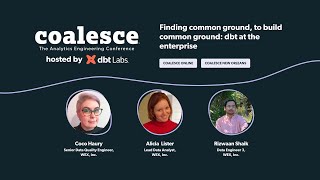
A Senior Business Analyst, an Analytics Engineer, and a Data Quality Engineer walk into the office. All three of them ask for dbt. Why? Join Coco Haury (WEX, Inc.) to hear about the universal appeal of dbt to folks outside traditional data engineer and analyst roles, and how dbt has helped WEX modernize their entire enterprise data platform.
Check the slides here: https://docs.google.com/presentation/d/1XNphR_il_3SGy9dU7G7PxmVoCXCCWBuFMvZYESN6KgE/edit?usp=sharing
Coalesce 2023 is coming! Register for free at https://coalesce.getdbt.com/.
Everyone is talking about data lineage these days, and for a good reason. Data lineage helps ensure better data quality across your modern data stack. But not everyone speaks the same lineage language. Data engineers use lineage for impact and root cause analysis. Analysts and Analytics engineers use lineage to trace jobs and transformations in their warehouses. And consumers use lineage to understand why data never reached their expected destination. This results in a narrow, siloed view lineage in which only one group benefits. It’s time to stop using siloed lineage views for pretty graphs and start using end-to-end lineage to drive focused actions. In the talk, you will learn:
• How data quality tailors to specific needs of data engineers, analysts, & consumers
• How data lineage should drive actions
• A real-world example of end-to-end data lineage with Airflow, dbt, Spark, and Redshift
Coalesce 2023 is coming! Register for free at https://coalesce.getdbt.com/.
When Prateek Chawla, founding engineer, joined Monte Carlo in 2019, he was responsible for spinning up our data platform from scratch. He was more of a backend/cloud engineer, but like with any startup had to wear many hats, so got the opportunity to play the role of data engineer too. In this talk, we’ll walk through how we spun up Monte Calro’s data stack with Snowflake, Looker, and dbt, touching on how and why we implemented dbt (and later, dbt Cloud), key use cases, and handy tricks for integrating dbt with other popular tools, like Airflow, and Spark. We’ll discuss what worked, what didn’t work, and other lessons learned along the way, as well as share how our data stack evolved over time to scale to meet the demands of our growing startup. We’ll also touch on a very critical component of the dbt value proposition, data quality testing, and discuss some of our favorite tests and what we’ve done to automate and integrate them with other elements of our stack.
Coalesce 2023 is coming! Register for free at https://coalesce.getdbt.com/.
In this session participants will learn:
-
How a product analytics platform can help you understand User Flows — how users are flowing in and out of certain features.
-
The impacts that certain features can have on engagement and retention. - Understanding User and Product-Feature Usage Patterns - Quantify Impact on User Engagement - Quantify Impact on User Retention
-
Prioritize Roadmap Features Using Data Insights
-
Ensure insight fidelity and compliance with data quality and privacy tools that a PM can use
-
Increase product adoption by activating user behavior data
Check the slides here: https://docs.google.com/presentation/d/1G6qIbWkzMp_IXACvuJw1oBb46BjbV7_jCeWk5P6rOlk/edit?usp=sharing
Coalesce 2023 is coming! Register for free at https://coalesce.getdbt.com/.
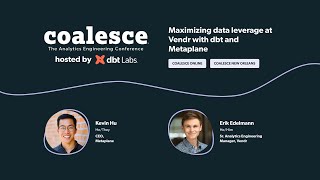
How do you support exponentially growing companies without breaking as a data team? The answer is increasing your leverage with tools and processes. This session centers around four principles to achieve this goal: 1. don’t reinvent the wheel, 2. make your own job easier, 3. save time for innovation, and 4. invest in onboarding.
First, the first data leader at Vendr, the SaaS buying platform with customers like GitLab, Brex, and The Washington Post, will share his learnings on building a stack and team that scaled as the company grew 10x from 30 to 300 employees in under two years.
Second, we’ll give a demo of how Metaplane pulls lineage and metadata from a modern data stack that is centered around dbt. By the end of the demo, you’ll know how to setup tests, extract lineage throughout your data stack, and triage data quality alerts.More details coming soon!
Check the slides here: https://docs.google.com/presentation/d/15dQJIGeGhG0WGO6MLXtxWhmf8neY-u0c8ZLRG9GJB-s/edit?usp=sharing
Coalesce 2023 is coming! Register for free at https://coalesce.getdbt.com/.
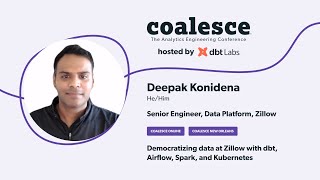
Building data pipelines is difficult—and adding a data governance and observability framework doesn’t make it any easier. But that was the task ahead for Deepak Konidena during his early days at Zillow. In this session, he’ll share how the platform they build on top of dbt, Airflow, Spark, and Kubernetes—ZSQL—eliminated the need for internal data teams to build their own DAGs, models, schemas and lineage from scratch, while also providing an easy way to enforce data quality, monitor changes, and alert on disruptions.
Check the slides here: https://docs.google.com/presentation/d/18HEil3_nXD8nYBhcg4m-Kpy8I8Na6MXI/edit?usp=sharing&ouid=110293204340061069659&rtpof=true&sd=true
Coalesce 2023 is coming! Register for free at https://coalesce.getdbt.com/.
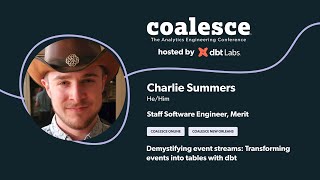
Pulling data directly out of application databases is commonplace in the MDS, but also risky. Apps change quickly, and application teams might update database schemas in unexpected ways, leading to pipeline failures, data quality issues, data delivery slow-downs. There is a better way. In his session, Charlie Summers (Merit) describes how their organization transforms application event streams into analytics-ready tables, more resilient to event scheme changes.
Check the slides here:https://docs.google.com/presentation/d/1K5PcoVshiHKZs_xI3K4P5JRNYTkbmnQJPMl8NmBlGfo/edit
Coalesce 2023 is coming! Register for free at https://coalesce.getdbt.com/.
Summary The database market has seen unprecedented activity in recent years, with new options addressing a variety of needs being introduced on a nearly constant basis. Despite that, there are a handful of databases that continue to be adopted due to their proven reliability and robust features. MariaDB is one of those default options that has continued to grow and innovate while offering a familiar and stable experience. In this episode field CTO Manjot Singh shares his experiences as an early user of MySQL and MariaDB and explains how the suite of products being built on top of the open source foundation address the growing needs for advanced storage and analytical capabilities.
Announcements
Hello and welcome to the Data Engineering Podcast, the show about modern data management When you’re ready to build your next pipeline, or want to test out the projects you hear about on the show, you’ll need somewhere to deploy it, so check out our friends at Linode. With their new managed database service you can launch a production ready MySQL, Postgres, or MongoDB cluster in minutes, with automated backups, 40 Gbps connections from your application hosts, and high throughput SSDs. Go to dataengineeringpodcast.com/linode today and get a $100 credit to launch a database, create a Kubernetes cluster, or take advantage of all of their other services. And don’t forget to thank them for their continued support of this show! You wake up to a Slack message from your CEO, who’s upset because the company’s revenue dashboard is broken. You’re told to fix it before this morning’s board meeting, which is just minutes away. Enter Metaplane, the industry’s only self-serve data observability tool. In just a few clicks, you identify the issue’s root cause, conduct an impact analysis—and save the day. Data leaders at Imperfect Foods, Drift, and Vendr love Metaplane because it helps them catch, investigate, and fix data quality issues before their stakeholders ever notice they exist. Setup takes 30 minutes. You can literally get up and running with Metaplane by the end of this podcast. Sign up for a free-forever plan at dataengineeringpodcast.com/metaplane, or try out their most advanced features with a 14-day free trial. Mention the podcast to get a free "In Data We Trust World Tour" t-shirt. RudderStack helps you build a customer data platform on your warehouse or data lake. Instead of trapping data in a black box, they enable you to easily collect customer data from the entire stack and build an identity graph on your warehouse, giving you full visibility and control. Their SDKs make event streaming from any app or website easy, and their state-of-the-art reverse ETL pipelines enable you to send enriched data to any cloud tool. Sign up free… or just get the free t-shirt for being a listener of the Data Engineering Podcast at dataengineeringpodcast.com/rudder. Data teams are increasingly under pressure to deliver. According to a recent survey by Ascend.io, 95% in fact reported being at or over capacity. With 72% of data experts reporting demands on their team going up faster than they can hire, it’s no surprise they are increasingly turning to automation. In fact, while only 3.5% report having current investments in automation, 85% of data teams plan on investing in automation in the next 12 months. 85%!!! That’s where our friends at Ascend.io come in. The Ascend Data Automation Cloud provides a unified platform for data ingestion, transformation, orchestration, and observability. Ascend users love its declarative pipelines, powerful SDK, elegant UI, and extensible plug-in architecture, as well as its support for Python, SQL, Scala, and Java. Ascend automates workloads on Snowflake, Databricks, BigQuery, and open source Spark, and can be deployed in AWS, Azure, or GCP. Go to dataengineeringpodcast.com/ascend and sign up for a free trial. If you’re a data engineering podcast listener, you get credits worth $5,000 when
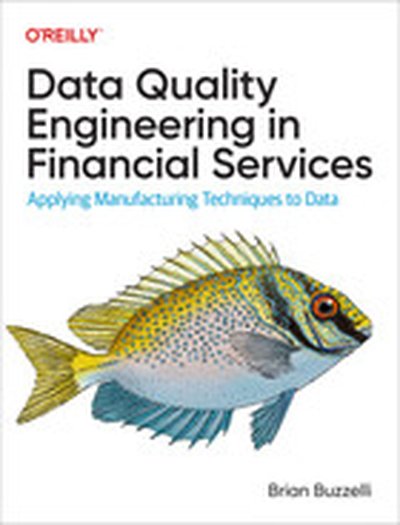
Data quality will either make you or break you in the financial services industry. Missing prices, wrong market values, trading violations, client performance restatements, and incorrect regulatory filings can all lead to harsh penalties, lost clients, and financial disaster. This practical guide provides data analysts, data scientists, and data practitioners in financial services firms with the framework to apply manufacturing principles to financial data management, understand data dimensions, and engineer precise data quality tolerances at the datum level and integrate them into your data processing pipelines. You'll get invaluable advice on how to: Evaluate data dimensions and how they apply to different data types and use cases Determine data quality tolerances for your data quality specification Choose the points along the data processing pipeline where data quality should be assessed and measured Apply tailored data governance frameworks within a business or technical function or across an organization Precisely align data with applications and data processing pipelines And more
Summary The "data lakehouse" architecture balances the scalability and flexibility of data lakes with the ease of use and transaction support of data warehouses. Dremio is one of the companies leading the development of products and services that support the open lakehouse. In this episode Jason Hughes explains what it means for a lakehouse to be "open" and describes the different components that the Dremio team build and contribute to.
Announcements
Hello and welcome to the Data Engineering Podcast, the show about modern data management When you’re ready to build your next pipeline, or want to test out the projects you hear about on the show, you’ll need somewhere to deploy it, so check out our friends at Linode. With their new managed database service you can launch a production ready MySQL, Postgres, or MongoDB cluster in minutes, with automated backups, 40 Gbps connections from your application hosts, and high throughput SSDs. Go to dataengineeringpodcast.com/linode today and get a $100 credit to launch a database, create a Kubernetes cluster, or take advantage of all of their other services. And don’t forget to thank them for their continued support of this show! You wake up to a Slack message from your CEO, who’s upset because the company’s revenue dashboard is broken. You’re told to fix it before this morning’s board meeting, which is just minutes away. Enter Metaplane, the industry’s only self-serve data observability tool. In just a few clicks, you identify the issue’s root cause, conduct an impact analysis—and save the day. Data leaders at Imperfect Foods, Drift, and Vendr love Metaplane because it helps them catch, investigate, and fix data quality issues before their stakeholders ever notice they exist. Setup takes 30 minutes. You can literally get up and running with Metaplane by the end of this podcast. Sign up for a free-forever plan at dataengineeringpodcast.com/metaplane, or try out their most advanced features with a 14-day free trial. Mention the podcast to get a free "In Data We Trust World Tour" t-shirt. RudderStack helps you build a customer data platform on your warehouse or data lake. Instead of trapping data in a black box, they enable you to easily collect customer data from the entire stack and build an identity graph on your warehouse, giving you full visibility and control. Their SDKs make event streaming from any app or website easy, and their state-of-the-art reverse ETL pipelines enable you to send enriched data to any cloud tool. Sign up free… or just get the free t-shirt for being a listener of the Data Engineering Podcast at dataengineeringpodcast.com/rudder. Data teams are increasingly under pressure to deliver. According to a recent survey by Ascend.io, 95% in fact reported being at or over capacity. With 72% of data experts reporting demands on their team going up faster than they can hire, it’s no surprise they are increasingly turning to automation. In fact, while only 3.5% report having current investments in automation, 85% of data teams plan on investing in automation in the next 12 months. 85%!!! That’s where our friends at Ascend.io come in. The Ascend Data Automation Cloud provides a unified platform for data ingestion, transformation, orchestration, and observability. Ascend users love its declarative pipelines, powerful SDK, elegant UI, and extensible plug-in architecture, as well as its support for Python, SQL, Scala, and Java. Ascend automates workloads on Snowflake, Databricks, BigQuery, and open source Spark, and can be deployed in AWS, Azure, or GCP. Go to dataengineeringpodcast.com/ascend and sign up for a free trial. If you’re a data engineering podcast listener, you get credits worth $5,000 when you become a customer. Your host is Tobias Macey and today I’m interviewing Jason Hughes about the work that Dremio is doing to support the open lakehouse
Interview
Introduction How did you get involved in the area of data management? Can you d
Summary For any business that wants to stay in operation, the most important thing they can do is understand their customers. American Express has invested substantial time and effort in their Customer 360 product to achieve that understanding. In this episode Purvi Shah, the VP of Enterprise Big Data Platforms at American Express, explains how they have invested in the cloud to power this visibility and the complex suite of integrations they have built and maintained across legacy and modern systems to make it possible.
Announcements
Hello and welcome to the Data Engineering Podcast, the show about modern data management When you’re ready to build your next pipeline, or want to test out the projects you hear about on the show, you’ll need somewhere to deploy it, so check out our friends at Linode. With their new managed database service you can launch a production ready MySQL, Postgres, or MongoDB cluster in minutes, with automated backups, 40 Gbps connections from your application hosts, and high throughput SSDs. Go to dataengineeringpodcast.com/linode today and get a $100 credit to launch a database, create a Kubernetes cluster, or take advantage of all of their other services. And don’t forget to thank them for their continued support of this show! You wake up to a Slack message from your CEO, who’s upset because the company’s revenue dashboard is broken. You’re told to fix it before this morning’s board meeting, which is just minutes away. Enter Metaplane, the industry’s only self-serve data observability tool. In just a few clicks, you identify the issue’s root cause, conduct an impact analysis—and save the day. Data leaders at Imperfect Foods, Drift, and Vendr love Metaplane because it helps them catch, investigate, and fix data quality issues before their stakeholders ever notice they exist. Setup takes 30 minutes. You can literally get up and running with Metaplane by the end of this podcast. Sign up for a free-forever plan at dataengineeringpodcast.com/metaplane, or try out their most advanced features with a 14-day free trial. Mention the podcast to get a free "In Data We Trust World Tour" t-shirt. RudderStack helps you build a customer data platform on your warehouse or data lake. Instead of trapping data in a black box, they enable you to easily collect customer data from the entire stack and build an identity graph on your warehouse, giving you full visibility and control. Their SDKs make event streaming from any app or website easy, and their state-of-the-art reverse ETL pipelines enable you to send enriched data to any cloud tool. Sign up free… or just get the free t-shirt for being a listener of the Data Engineering Podcast at dataengineeringpodcast.com/rudder. Data teams are increasingly under pressure to deliver. According to a recent survey by Ascend.io, 95% in fact reported being at or over capacity. With 72% of data experts reporting demands on their team going up faster than they can hire, it’s no surprise they are increasingly turning to automation. In fact, while only 3.5% report having current investments in automation, 85% of data teams plan on investing in automation in the next 12 months. 85%!!! That’s where our friends at Ascend.io come in. The Ascend Data Automation Cloud provides a unified platform for data ingestion, transformation, orchestration, and observability. Ascend users love its declarative pipelines, powerful SDK, elegant UI, and extensible plug-in architecture, as well as its support for Python, SQL, Scala, and Java. Ascend automates workloads on Snowflake, Databricks, BigQuery, and open source Spark, and can be deployed in AWS, Azure, or GCP. Go to dataengineeringpodcast.com/ascend and sign up for a free trial. If you’re a data engineering podcast listener, you get credits worth $5,000 when you become a customer. Your host is Tobias Macey and today I’m interviewing Purvi Shah about building the Customer 360 data product for American Express and mig
Summary The global economy is dependent on complex and dynamic networks of supply chains powered by sophisticated logistics. This requires a significant amount of data to track shipments and operational characteristics of materials and goods. Roambee is a platform that collects, integrates, and analyzes all of that information to provide companies with the critical insights that businesses need to stay running, especially in a time of such constant change. In this episode Roambee CEO, Sanjay Sharma, shares the types of questions that companies are asking about their logistics, the technical work that they do to provide ways to answer those questions, and how they approach the challenge of data quality in its many forms.
Announcements
Hello and welcome to the Data Engineering Podcast, the show about modern data management When you’re ready to build your next pipeline, or want to test out the projects you hear about on the show, you’ll need somewhere to deploy it, so check out our friends at Linode. With their new managed database service you can launch a production ready MySQL, Postgres, or MongoDB cluster in minutes, with automated backups, 40 Gbps connections from your application hosts, and high throughput SSDs. Go to dataengineeringpodcast.com/linode today and get a $100 credit to launch a database, create a Kubernetes cluster, or take advantage of all of their other services. And don’t forget to thank them for their continued support of this show! Atlan is the metadata hub for your data ecosystem. Instead of locking your metadata into a new silo, unleash its transformative potential with Atlan’s active metadata capabilities. Push information about data freshness and quality to your business intelligence, automatically scale up and down your warehouse based on usage patterns, and let the bots answer those questions in Slack so that the humans can focus on delivering real value. Go to dataengineeringpodcast.com/atlan today to learn more about how Atlan’s active metadata platform is helping pioneering data teams like Postman, Plaid, WeWork & Unilever achieve extraordinary things with metadata and escape the chaos. Prefect is the modern Dataflow Automation platform for the modern data stack, empowering data practitioners to build, run and monitor robust pipelines at scale. Guided by the principle that the orchestrator shouldn’t get in your way, Prefect is the only tool of its kind to offer the flexibility to write code as workflows. Prefect specializes in glueing together the disparate pieces of a pipeline, and integrating with modern distributed compute libraries to bring power where you need it, when you need it. Trusted by thousands of organizations and supported by over 20,000 community members, Prefect powers over 100MM business critical tasks a month. For more information on Prefect, visit dataengineeringpodcast.com/prefect. Data engineers don’t enjoy writing, maintaining, and modifying ETL pipelines all day, every day. Especially once they realize 90% of all major data sources like Google Analytics, Salesforce, Adwords, Facebook, Spreadsheets, etc., are already available as plug-and-play connectors with reliable, intuitive SaaS solutions. Hevo Data is a highly reliable and intuitive data pipeline platform used by data engineers from 40+ countries to set up and run low-latency ELT pipelines with zero maintenance. Boasting more than 150 out-of-the-box connectors that can be set up in minutes, Hevo also allows you to monitor and control your pipelines. You get: real-time data flow visibility, fail-safe mechanisms, and alerts if anything breaks; preload transformations and auto-schema mapping precisely control how data lands in your destination; models and workflows to transform data for analytics; and reverse-ETL capability to move the transformed data back to your business software to inspire timely action. All of this, plus its transparent pricing and 24*7 live support, makes it consistently voted by user
Summary Data lineage is something that has grown from a convenient feature to a critical need as data systems have grown in scale, complexity, and centrality to business. Alvin is a platform that aims to provide a low effort solution for data lineage capabilities focused on simplifying the work of data engineers. In this episode co-founder Martin Sahlen explains the impact that easy access to lineage information can have on the work of data engineers and analysts, and how he and his team have designed their platform to offer that information to engineers and stakeholders in the places that they interact with data.
Announcements
Hello and welcome to the Data Engineering Podcast, the show about modern data management When you’re ready to build your next pipeline, or want to test out the projects you hear about on the show, you’ll need somewhere to deploy it, so check out our friends at Linode. With their new managed database service you can launch a production ready MySQL, Postgres, or MongoDB cluster in minutes, with automated backups, 40 Gbps connections from your application hosts, and high throughput SSDs. Go to dataengineeringpodcast.com/linode today and get a $100 credit to launch a database, create a Kubernetes cluster, or take advantage of all of their other services. And don’t forget to thank them for their continued support of this show! You wake up to a Slack message from your CEO, who’s upset because the company’s revenue dashboard is broken. You’re told to fix it before this morning’s board meeting, which is just minutes away. Enter Metaplane, the industry’s only self-serve data observability tool. In just a few clicks, you identify the issue’s root cause, conduct an impact analysis—and save the day. Data leaders at Imperfect Foods, Drift, and Vendr love Metaplane because it helps them catch, investigate, and fix data quality issues before their stakeholders ever notice they exist. Setup takes 30 minutes. You can literally get up and running with Metaplane by the end of this podcast. Sign up for a free-forever plan at dataengineeringpodcast.com/metaplane, or try out their most advanced features with a 14-day free trial. Mention the podcast to get a free "In Data We Trust World Tour" t-shirt. RudderStack helps you build a customer data platform on your warehouse or data lake. Instead of trapping data in a black box, they enable you to easily collect customer data from the entire stack and build an identity graph on your warehouse, giving you full visibility and control. Their SDKs make event streaming from any app or website easy, and their state-of-the-art reverse ETL pipelines enable you to send enriched data to any cloud tool. Sign up free… or just get the free t-shirt for being a listener of the Data Engineering Podcast at dataengineeringpodcast.com/rudder. Data teams are increasingly under pressure to deliver. According to a recent survey by Ascend.io, 95% in fact reported being at or over capacity. With 72% of data experts reporting demands on their team going up faster than they can hire, it’s no surprise they are increasingly turning to automation. In fact, while only 3.5% report having current investments in automation, 85% of data teams plan on investing in automation in the next 12 months. 85%!!! That’s where our friends at Ascend.io come in. The Ascend Data Automation Cloud provides a unified platform for data ingestion, transformation, orchestration, and observability. Ascend users love its declarative pipelines, powerful SDK, elegant UI, and extensible plug-in architecture, as well as its support for Python, SQL, Scala, and Java. Ascend automates workloads on Snowflake, Databricks, BigQuery, and open source Spark, and can be deployed in AWS, Azure, or GCP. Go to dataengineeringpodcast.com/ascend and sign up for a free trial. If you’re a data engineering podcast listener, you get credits worth $5,000 when you become a customer. Your host is Tobias Macey and today I’m interviewing Martin Sahlen about his work on data lineage at Alvin and how it factors into the day-to-day work of data engineers
Interview
Introduction How did you get involved in the area of data management? Can you describe what Alvin is and the story behind it? What is the core problem that you are trying to solve at Alvin? Data lineage has quickly become an overloaded term. What are the elements of lineage that you are focused on addressing?
What are some of the other sources/pieces of information that you integrate into the lineage graph?
How does data lineage show up in the work of data engineers?
In what ways does your focus on data engineers inform the way that you model the lineage information?
As with every data asset/product, the lineage graph is only as useful as the data that it stores. What are some of the ways that you focus on establishing and ensuring a complete view of lineage?
How do you account for assets (e.g. tables, dashboards, exports, etc.) that are created outside of the "officially supported" methods? (e.g. someone manually runs a SQL create statement, etc.)
Can you describe how you have implemented the Alvin platform?
How have the design and goals shifted from when you first started exploring the problem?
What are the types of data systems/assets that you are focused on supporting? (e.g. data warehouses vs. lakes, structured vs. unstructured, which BI tools, etc.) How does Alvin fit into the workflow of data engineers and their downstream customers/collaborators?
What are some of the design choices (both visual and functional) that you focused on to avoid friction in the data engineer’s workflow?
What are some of the open questions/areas for investigation/improvement in the space of data lineage?
What are the factors that contribute to the difficulty of a truly holistic and complete view of lineage across an organization?
What are the most interesting, innovative, or unexpected ways that you have seen Alvin used? What are the most interesting, unexpected, or challenging lessons that you have learned while working on Alvin? When is Alvin the wrong choice? What do you have planned for the future of Alvin?
Contact Info
LinkedIn @martinsahlen on Twitter
Parting Question
From your perspective, what is the biggest gap in the tooling or technology for data management today?
Closing Announcements
Thank you for listening! Don’t forget to check out our other shows. Podcast.init covers the Python language, its community, and the innovative ways it is being used. The Machine Learning Podcast helps you go from idea to production with machine learning. Visit the site to subscribe to the show, sign up for the mailing list, and read the show notes. If you’ve learned something or tried out a project from the show then tell us about it! Email [email protected]) with your story. To help other people find the show please leave a review on Apple Podcasts and tell your friends and co-workers
Links
Alvin Unacast sqlparse Python library Cython
Podcast.init Episode
Antlr Kotlin programming language PostgreSQL
Podcast Episode
OpenSearch ElasticSearch Redis Kubernetes Airflow BigQuery Spark Looker Mode
The intro and outro music is from The Hug by The Freak Fandango Orchestra / CC BY-SA
Support Data Engineering Podcast
We talked about:
Supreet’s background Responsible AI Example of explainable AI Responsible AI vs explainable AI Explainable AI tools and frameworks (glass box approach) Checking for bias in data and handling personal data Understanding whether your company needs certain type of data Data quality checks and automation Responsibility vs profitability The human touch in AI The trade-off between model complexity and explainability Is completely automated AI out of the question? Detecting model drift and overfitting How Supreet became interested in explainable AI Trustworthy AI Reliability vs fairness Bias indicators The future of explainable AI About DataBuzz The diversity of data science roles Ethics in data science Conclusion
Links:
LinkedIn: https://www.linkedin.com/in/supreet-kaur1995/ Databuzz page: https://www.linkedin.com/company/databuzz-club/ Medium Blog Page: https://medium.com/@supreetkaur_66831
ML Zoomcamp: https://github.com/alexeygrigorev/mlbookcamp-code/tree/master/course-zoomcamp
Join DataTalks.Club: https://datatalks.club/slack.html
Our events: https://datatalks.club/events.html