talk-data.com talk-data.com

Topic

Git

version_control source_code_management collaboration

22

tagged

Activity Trend

16 peak/qtr
2020-Q1 2026-Q1

Activities

22 activities · Newest first

Model Context Protocol: Principles and Practice

Large‑language‑model agents are only as useful as the context and tools they can reach.

Anthropic’s Model Context Protocol (MCP) proposes a universal, bidirectional interface that turns every external system—SQL databases, Slack, Git, web browsers, even your local file‑system—into first‑class “context providers.”

In just 30 minutes we’ll step from high‑level buzzwords to hands‑on engineering details:

  • How MCP’s JSON‑RPC message format, streaming channels, and version‑negotiation work under the hood.
  • Why per‑tool sandboxing via isolated client processes hardens security (and what happens when an LLM tries rm ‑rf /).
  • Techniques for hierarchical context retrieval that stretch a model’s effective window beyond token limits.
  • Real‑world patterns for accessing multiple tools—Postgres, Slack, GitHub—and plugging MCP into GenAI applications.

Expect code snippets and lessons from early adoption.

You’ll leave ready to wire your own services into any MCP‑aware model and level‑up your GenAI applications—without the N×M integration nightmare.

Lakeflow in Production: CI/CD, Testing and Monitoring at Scale

Building robust, production-grade data pipelines goes beyond writing transformation logic — it requires rigorous testing, version control, automated CI/CD workflows and a clear separation between development and production. In this talk, we’ll demonstrate how Lakeflow, paired with Databricks Asset Bundles (DABs), enables Git-based workflows, automated deployments and comprehensive testing for data engineering projects. We’ll share best practices for unit testing, CI/CD automation, data quality monitoring and environment-specific configurations. Additionally, we’ll explore observability techniques and performance tuning to ensure your pipelines are scalable, maintainable and production-ready.

Comprehensive Guide to MLOps on Databricks

This in-depth session explores advanced MLOps practices for implementing production-grade machine learning workflows on Databricks. We'll examine the complete MLOps journey from foundational principles to sophisticated implementation patterns, covering essential tools including MLflow, Unity Catalog, Feature Stores and version control with Git. Dive into Databricks' latest MLOps capabilities including MLflow 3.0, which enhances the entire ML lifecycle from development to deployment with particular focus on generative AI applications. Key session takeaways include: Advanced MLflow 3.0 features for LLM management and deployment Enterprise-grade governance with Unity Catalog integration Robust promotion patterns across development, staging and production CI/CD pipeline automation for continuous deployment GenAI application evaluation and streamlined deployment

From Days to Seconds — Reducing Query Times on Large Geospatial Datasets by 99%

The Global Water Security Center translates environmental science into actionable insights for the U.S. Department of Defense. Prior to incorporating Databricks, responding to these requests required querying approximately five hundred thousand raster files representing over five hundred billion points. By leveraging lakehouse architecture, Databricks Auto Loader, Spark Streaming, Databricks Spatial SQL, H3 geospatial indexing and Databricks Liquid Clustering, we were able to drastically reduce our “time to analysis” from multiple business days to a matter of seconds. Now, our data scientists execute queries on pre-computed tables in Databricks, resulting in a “time to analysis” that is 99% faster, giving our teams more time for deeper analysis of the data. Additionally, we’ve incorporated Databricks Workflows, Databricks Asset Bundles, Git and Git Actions to support CI/CD across workspaces. We completed this work in close partnership with Databricks.

Deploying Databricks Asset Bundles (DABs) at Scale

This session is repeated.Managing data and AI workloads in Databricks can be complex. Databricks Asset Bundles (DABs) simplify this by enabling declarative, Git-driven deployment workflows for notebooks, jobs, Lakeflow Declarative Pipelines, dashboards, ML models and more.Join the DABs Team for a Deep Dive and learn about:The Basics: Understanding Databricks asset bundlesDeclare, define and deploy assets, follow best practices, use templates and manage dependenciesCI/CD & Governance: Automate deployments with GitHub Actions/Azure DevOps, manage Dev vs. Prod differences, and ensure reproducibilityWhat’s new and what's coming up! AI/BI Dashboard support, Databricks Apps support, a Pythonic interface and workspace-based deploymentIf you're a data engineer, ML practitioner or platform architect, this talk will provide practical insights to improve reliability, efficiency and compliance in your Databricks workflows.

SQL-Based ETL: Options for SQL-Only Databricks Development

Using SQL for data transformation is a powerful way for an analytics team to create their own data pipelines. However, relying on SQL often comes with tradeoffs such as limited functionality, hard-to-maintain stored procedures or skipping best practices like version control and data tests. Databricks supports building high-performing SQL ETL workloads. Attend this session to hear how Databricks supports SQL for data transformation jobs as a core part of your Data Intelligence Platform. In this session we will cover 4 options to use Databricks with SQL syntax to create Delta tables: Lakeflow Declarative Pipelines: A declarative ETL option to simplify batch and streaming pipelines dbt: An open-source framework to apply engineering best practices to SQL based data transformations SQLMesh: an open-core product to easily build high-quality and high-performance data pipelines SQL notebooks jobs: a combination of Databricks Workflows and parameterized SQL notebooks

Boosting Data Science and AI Productivity With Databricks Notebooks

This session is repeated. Want to accelerate your team's data science workflow? This session reveals how Databricks Notebooks can transform your productivity through an optimized environment designed specifically for data science and AI work. Discover how notebooks serve as a central collaboration hub where code, visualizations, documentation and results coexist seamlessly, enabling faster iteration and development. Key takeaways: Leveraging interactive coding features including multi-language support, command-mode shortcuts and magic commands Implementing version control best practices through Git integration and notebook revision history Maximizing collaboration through commenting, sharing and real-time co-editing capabilities Streamlining ML workflows with built-in MLflow tracking and experiment management You'll leave with practical techniques to enhance your notebook-based workflow and deliver AI projects faster with higher-quality results.

Smarter Demand Planning: How to Build a No-Code Forecasting App | The Data Apps Conference

Sales forecasting and demand planning are critical business processes, but most organizations still rely on spreadsheets—leading to version control issues, fragmented approvals, and lack of historical tracking. Traditional BI tools struggle to solve these problems because they don’t allow for cell-level edits, inline comments, and structured approval workflows in a governed way.

In this session, Ian Reed will demonstrate how to:

Enable real-time forecasting by replacing manual spreadsheets with a structured, cloud-based data app Allow for cell-level edits and inline commentary so teams can capture assumptions behind forecast changes Implement an automated approval workflow with proper governance Integrate seamlessly with live data sources for continuous updates and visibility into actual vs. forecasted performance Track historical changes and maintain audit trails of all modifications

With Sigma, demand planning is no longer a fragmented, error-prone process—it’s a seamless, governed workflow that scales with business growth. Join this session for a demo and a step-by-step walkthrough of how this app was built, proving that anyone can create a highly customizable, enterprise-grade demand planning system in Sigma without deep technical expertise.

➡️ Learn more about Data Apps: https://www.sigmacomputing.com/product/data-applications?utm_source=youtube&utm_medium=organic&utm_campaign=data_apps_conference&utm_content=pp_data_apps


➡️ Sign up for your free trial: https://www.sigmacomputing.com/go/free-trial?utm_source=youtube&utm_medium=video&utm_campaign=free_trial&utm_content=free_trial

sigma #sigmacomputing #dataanalytics #dataanalysis #businessintelligence #cloudcomputing #clouddata #datacloud #datastructures #datadriven #datadrivendecisionmaking #datadriveninsights #businessdecisions #datadrivendecisions #embeddedanalytics #cloudcomputing #SigmaAI #AI #AIdataanalytics #AIdataanalysis #GPT #dataprivacy #python #dataintelligence #moderndataarchitecture

Streamlining Contract Management: TEKsystems’ Journey to Automation | The Data Apps Conference

Managing contracts in spreadsheets was creating significant challenges for TEKSystems - crashes, version control issues, and no connection to enterprise data were impacting 20+ users trying to collaborate on thousands of records.

In this session, Riley Owens (Controller) and Chase Brookmyer (Business Reporting Analyst) will demonstrate how they:

Built a contract lifecycle management app with no formal development background Transformed from an unstable spreadsheet to a centralized data app Created streamlined workflows and reporting capabilities Accomplished the build in approximately 10 hours of learning and development By leveraging Sigma’s flexible architecture, TEKSystems was able to build this solution in a matter of hours, demonstrating how teams without formal development experience can create powerful workflow automation tools. Watch this session to see how they transformed contract management and what’s next for their data-driven approach.

➡️ Learn more about Data Apps: https://www.sigmacomputing.com/product/data-applications?utm_source=youtube&utm_medium=organic&utm_campaign=data_apps_conference&utm_content=pp_data_apps


➡️ Sign up for your free trial: https://www.sigmacomputing.com/go/free-trial?utm_source=youtube&utm_medium=video&utm_campaign=free_trial&utm_content=free_trial

sigma #sigmacomputing #dataanalytics #dataanalysis #businessintelligence #cloudcomputing #clouddata #datacloud #datastructures #datadriven #datadrivendecisionmaking #datadriveninsights #businessdecisions #datadrivendecisions #embeddedanalytics #cloudcomputing #SigmaAI #AI #AIdataanalytics #AIdataanalysis #GPT #dataprivacy #python #dataintelligence #moderndataarchitecture

Shift Left with Apache Iceberg Data Products to Power AI | Andrew Madson | Shift Left Data Confer...

Shift Left with Apache Iceberg Data Products to Power AI | Andrew Madson | Shift Left Data Conference 2025

High-quality, governed, and performant data from the outset is vital for agile, trustworthy enterprise AI systems. Traditional approaches delay addressing data quality and governance, causing inefficiencies and rework. Apache Iceberg, a modern table format for data lakes, empowers organizations to "Shift Left" by integrating data management best practices earlier in the pipeline to enable successful AI systems.

This session covers how Iceberg's schema evolution, time travel, ACID transactions, and Git-like data branching allow teams to validate, version, and optimize data at its source. Attendees will learn to create resilient, reusable data assets, streamline engineering workflows, enforce governance efficiently, and reduce late-stage transformations—accelerating analytics, machine learning, and AI initiatives.

Shifting Left with Data DevOps | Chad Sanderson | Shift Left Data Conference 2025

Data DevOps applies rigorous software development practices—such as version control, automated testing, and governance—to data workflows, empowering software engineers to proactively manage data changes and address data-related issues directly within application code. By adopting a "shift left" approach with Data DevOps, SWE teams become more aware of data requirements, dependencies, and expectations early in the software development lifecycle, significantly reducing risks, improving data quality, and enhancing collaboration.

This session will provide practical strategies for integrating Data DevOps into application development, enabling teams to build more robust data products and accelerate adoption of production AI systems.

On the benefits and virtues of drilling pilot holes - Coalesce 2023

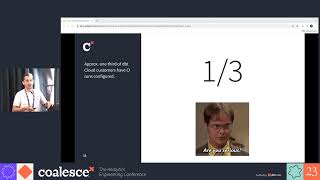
A significant proportion of dbt Cloud users do not have a dbt CI job set up. Among those who do, many don’t leverage powerful functionality like state comparison and deferral to implement Slim CI, likely causing teams to miss errors and building unnecessary tables. Setting up Slim CI in dbt Cloud can be especially challenging for larger-scale data organizations who have multiple data environments, git branches, and targets. Watch this session to learn how you can build and evolve a strong, lasting data environment using Slim CI.

Speakers: Leo Folsom, Solutions Engineer, Datafold

Register for Coalesce at https://coalesce.getdbt.com

The Future is Open: Data Streaming in an Omni-Cloud Reality

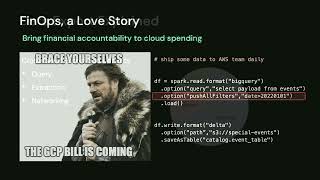
This session begins with data warehouse trivia and lessons learned from production implementations of multicloud data architecture. You will learn to design future-proof low latency data systems that focus on openness and interoperability. You will also gain a gentle introduction to Cloud FinOps principles that can help your organization reduce compute spend and increase efficiency. 

Most enterprises today are multicloud. While an assortment of low-code connectors boasts the ability to make data available for analytics in real time, they post long-lasting challenges:

  • Inefficient EDW targets
  • Inability to evolve schema
  • Forbiddingly expensive data exports due to cloud and vendor lock-in

The alternative is an open data lake that unifies batch and streaming workloads. Bronze landing zones in open format eliminate the data extraction costs required by proprietary EDW. Apache Spark™ Structured Streaming provides a unified ingestion interface. Streaming triggers allow us to switch back and forth between batch and stream with one-line code changes. Streaming aggregation enables us to incrementally compute on data that arrives near each other.

Specific examples are given on how to use Autoloader to discover newly arrived data and ensure exactly once, incremental processing. How DLT can be configured effectively to further simplify streaming jobs and accelerate the development cycle. How to apply SWE best practices to Workflows and integrate with popular Git providers, either using the Databricks Project or Databricks Terraform provider. 

Talk by: Christina Taylor

Here’s more to explore: Big Book of Data Engineering: 2nd Edition: https://dbricks.co/3XpPgNV The Data Team's Guide to the Databricks Lakehouse Platform: https://dbricks.co/46nuDpI

Connect with us: Website: https://databricks.com Twitter: https://twitter.com/databricks LinkedIn: https://www.linkedin.com/company/databricks Instagram: https://www.instagram.com/databricksinc Facebook: https://www.facebook.com/databricksinc

Building an ML Experimentation Platform for Easy Reproducibility | Treeverse

ABOUT THE TALK: Quality ML at scale is only possible when we can reproduce a specific iteration of the ML experiment–and this is where data is key.

In this talk, you will learn how to use a data versioning engine to intuitively and easily version your ML experiments and reproduce any specific iteration of the experiment.

This talk will demo through a live code example: -Creating a basic ML experimentation framework with lakeFS (on Jupyter notebook) -Reproducing ML components from a specific iteration of an experiment Building intuitive, zero-maintenance experiments infrastructure -All with common data engineering stacks & open source tooling.

ABOUT THE SPEAKER: Vino Duraisamy is a developer advocate at lakeFS, an open-source platform that delivers git-like experience to object store based data lakes. She has previously worked at NetApp (on data management applications for NetApp data centers), on data teams of Nike and Apple, where she worked mainly on batch processing workloads as a data engineer, built custom NLP models as an ML engineer and even touched upon MLOps a bit for model deployments.

ABOUT DATA COUNCIL: Data Council (https://www.datacouncil.ai/) is a community and conference series that provides data professionals with the learning and networking opportunities they need to grow their careers.

Make sure to subscribe to our channel for the most up-to-date talks from technical professionals on data related topics including data infrastructure, data engineering, ML systems, analytics and AI from top startups and tech companies.

FOLLOW DATA COUNCIL: Twitter: https://twitter.com/DataCouncilAI LinkedIn: https://www.linkedin.com/company/datacouncil-ai/

How Preset Integrates dbt with Apache Superset to Deliver on Headless BI & Surface Metrics

At Preset, we offer a managed service for Apache Superset, the most popular open source business intelligence platform (by Github stars) in the world. We believe the future of BI is not only rooted in open source but also adopts the best ideas from the software development life cycle. To that end, we've created a workflow that enables you to manage Superset datasets, charts, and dashboards as code and we integrated dbt into our platform. In this talk, I'll showcase the speed and change management benefits that are enabled by this workflow of managing core BI assets using dbt and version control.

Check the slides here: https://docs.google.com/presentation/d/1SjbXOgJnuAnmu3B3cY1YAEOMZdARH72Siwneq2yRjfU/edit?usp=sharing

Coalesce 2023 is coming! Register for free at https://coalesce.getdbt.com/.

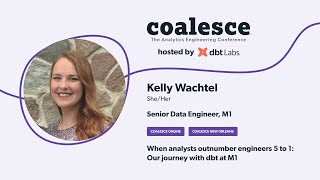
When analysts outnumber engineers 5 to 1: Our journey with dbt at M1

How do you train and enable 20 data analysts to use dbt Core in a short amount of time?

At M1, engineering and analytics are far apart on the org chart, but work hand-in-hand every day. M1 engineering has a culture that celebrates open source, where every data engineer is trained and empowered to work all the way down the infrastructure stack, using tools like Terraform and Kubernetes. The analytics team is comprised of strong SQL writers who use Tableau to create visualizations used company wide. When M1 knew they needed a tool like dbt for change management and data documentation generation, they had to figure out how to bridge the gap between engineering and analytics to enable analysts to contribute with minimal engineering intervention. Join Kelly Wachtel, a senior data engineer at M1, explain how they trained about 20 analysts to use git and dbt Core over the past year, and strengthened their collaboration between their data engineering and analytics teams.

Check the slides here: https://docs.google.com/presentation/d/1CWI97EMyLIz6tptLPKt4VuMjJzV_X3oO/edit?usp=sharing&ouid=110293204340061069659&rtpof=true&sd=true

Coalesce 2023 is coming! Register for free at https://coalesce.getdbt.com/.

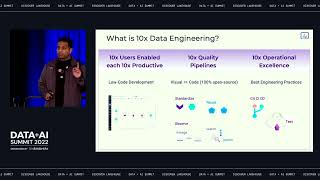
A Low-Code Approach to 10x Data Engineering

Can we take Data Engineering on Spark 10x beyond where it is today?

Yes, we can enable 10x more users on Spark, and make them 10x more productive from day 1. Data engineering can run at scale, and it can still be 10x simpler and faster to develop, deploy, and manage pipelines.

Low code is the key. A modern data engineering platform built on low code will enable all data users, from new graduates to experts, to visually develop high-quality pipelines. With Visual = Code, the visual elements will be stored as PySpark code on Git and deployed using the best software practices taken from DevOps. Search and lineage help data engineers and their customers in analytics understand how each column value was produced, when it was updated, and the associated quality metric.

See how a complete, low-code data engineering platform can reduce complexity and effort, enabling you to rapidly deploy, scale, and use Spark, making data and analytics a strategic asset in your company.

Connect with us: Website: https://databricks.com Facebook: https://www.facebook.com/databricksinc Twitter: https://twitter.com/databricks LinkedIn: https://www.linkedin.com/company/data... Instagram: https://www.instagram.com/databricksinc/

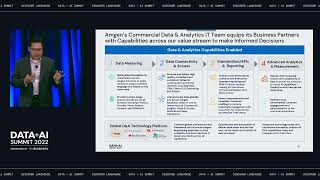
Amgen’s Journey To Building a Global 360 View of its Customers with the Lakehouse

Serving patients in over 100 countries, Amgen is a leading global biotech company focused on developing therapies that have the power to save lives. Delivering on this mission requires our commercial teams to regularly meet with healthcare providers to discuss new treatments that can help patients in need. With the onset of the pandemic, where face-to-face interactions with doctors and other Healthcare Providers (HCPs) were severely impacted, Amgen had to rethink these interactions. With that in mind, the Amgen Commercial Data and Analytics team leveraged a modern data and AI architecture built on the Databricks Lakehouse to help accelerate its digital and data insights capabilities. This foundation enabled Amgen’s teams to develop a comprehensive, customer-centric view to support flexible go-to-market models and provide personalized experiences to our customers. In this presentation, we will share our recent journey of how we took an agile approach to bringing together over 2.2 petabytes of internally generated and externally sourced vendor data , and onboard into our AWS Cloud and Databricks environments to enable a standardized, scalable and robust capabilities to meet the business requirements in our fast-changing life sciences environment. We will share use cases of how we harmonized and managed our diverse sets of data to deliver efficiency, simplification, and performance outcomes for the business. We will cover the following aspects of our journey along with best practices we learned over time: • Our architecture to support Amgen’s Commercial Data & Analytics constant processing around the globe • Engineering best practices for building large scale Data Lakes and Analytics platforms such as Team organization, Data Ingestion and Data Quality Frameworks, DevOps Toolkit and Maturity Frameworks, and more • Databricks capabilities adopted such as Delta Lake, Workspace policies, SQL workspace endpoints, and MLflow for model registry and deployment. Also, various tools were built for Databricks workspace administration • Databricks capabilities being explored for future, such as Multi-task Orchestration, Container-based Apache Spark Processing, Feature Store, Repos for Git integration, etc. • The types of commercial analytics use cases we are building on the Databricks Lakehouse platform Attendees building global and Enterprise scale data engineering solutions to meet diverse sets of business requirements will benefit from learning about our journey. Technologists will learn how we addressed specific Business problems via reusable capabilities built to maximize value.

Connect with us: Website: https://databricks.com Facebook: https://www.facebook.com/databricksinc Twitter: https://twitter.com/databricks LinkedIn: https://www.linkedin.com/company/data... Instagram: https://www.instagram.com/databricksinc/

Rethinking Orchestration as Reconciliation: Software-Defined Assets in Dagster

This talk discusses “software-defined assets”, a declarative approach to orchestration and data management that makes it drastically easier to trust and evolve datasets and ML models. Dagster is an open source orchestrator built for maintaining software-defined assets.

In traditional data platforms, code and data are only loosely coupled. As a consequence, deploying changes to data feels dangerous, backfills are error-prone and irreversible, and it’s difficult to trust data, because you don’t know where it comes from or how it’s intended to be maintained. Each time you run a job that mutates a data asset, you add a new variable to account for when debugging problems.

Dagster proposes an alternative approach to data management that tightly couples data assets to code - each table or ML model corresponds to the function that’s responsible for generating it. This results in a “Data as Code” approach that mimics the “Infrastructure as Code” approach that’s central to modern DevOps. Your git repo becomes your source of truth on your data, so pushing data changes feels as safe as pushing code changes. Backfills become easy to reason about. You trust your data assets because you know how they’re computed and can reproduce them at any time. The role of the orchestrator is to ensure that physical assets in the data warehouse match the logical assets that are defined in code, so each job run is a step towards order.

Software-defined assets is a natural approach to orchestration for the modern data stack, in part because dbt models are a type of software-defined asset.

Attendees of this session will learn how to build and maintain lakehouses of software-defined assets with Dagster.

Connect with us: Website: https://databricks.com Facebook: https://www.facebook.com/databricksinc Twitter: https://twitter.com/databricks LinkedIn: https://www.linkedin.com/company/data... Instagram: https://www.instagram.com/databricksinc/