talk-data.com talk-data.com

Topic

API

Application Programming Interface (API)

integration software_development data_exchange

856

tagged

Activity Trend

65 peak/qtr
2020-Q1 2026-Q1

Activities

856 activities · Newest first

Data & AI Products on Databricks: Making Data Engineering & Consumption Self-Service Data Platforms

Our client, a large IT and business consulting firm, embarked on a journey to create “Data As a Product” for both their internal and external stakeholders. In this project, Infosys took a data platform approach and leveraged Delta Sharing, API endpoints, and Unity Catalog to effectively create a realization of Data and AI Products (Data Mesh) architecture. This session presents the three primary design patterns used, providing valuable insights for your evolution toward a no-code/low-code approach.

Talk by: Ankit Sharma

Connect with us: Website: https://databricks.com Twitter: https://twitter.com/databricks LinkedIn: https://www.linkedin.com/company/databricks Instagram: https://www.instagram.com/databricksinc Facebook: https://www.facebook.com/databricksinc

Use Apache Spark™ from Anywhere: Remote Connectivity with Spark Connect

Over the past decade, developers, researchers, and the community at large have successfully built tens of thousands of data applications using Apache Spark™. Since then, use cases and requirements of data applications have evolved. Today, every application, from web services that run in application servers, interactive environments such as notebooks and IDEs, to phones and edge devices such as smart home devices, want to leverage the power of data. However, Spark's driver architecture is monolithic, running client applications on top of a scheduler, optimizer and analyzer. This architecture makes it hard to address these new requirements as there is no built-in capability to remotely connect to a Spark cluster from languages other than SQL.

Spark Connect introduces a decoupled client-server architecture for Apache Spark that allows remote connectivity to Spark clusters using the DataFrame API and unresolved logical plans as the protocol. The separation between client and server allows Spark and its open ecosystem to be leveraged from everywhere. It can be embedded in modern data applications, in IDEs, notebooks and programming languages. This session highlights how simple it is to connect to Spark using Spark Connect from any data applications or IDEs. We will do a deep dive into the architecture of Spark Connect and provide an outlook on how the community can participate in the extension of Spark Connect for new programming languages and frameworks bringing the power of Spark everywhere.

Talk by: Martin Grund and Stefania Leone

Connect with us: Website: https://databricks.com Twitter: https://twitter.com/databricks LinkedIn: https://www.linkedin.com/company/databricks Instagram: https://www.instagram.com/databricksinc Facebook: https://www.facebook.com/databricksinc

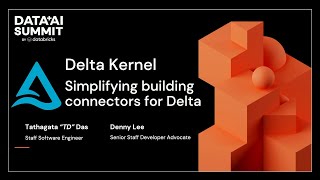
Delta Kernel: Simplifying Building Connectors for Delta

Since the release of Delta 2.0, the project has been growing at a breakneck speed. In this session, we will cover all the latest capabilities that makes Delta Lake the best format for the lakehouse. Based on lessons learned from this past year, we will introduce Project Aqueduct and how we will simplify building Delta Lake APIs from Rust and Go to Trino, Flink, and PySpark.

Talk by: Tathagata Das and Denny Lee

Connect with us: Website: https://databricks.com Twitter: https://twitter.com/databricks LinkedIn: https://www.linkedin.com/company/databricks Instagram: https://www.instagram.com/databricksinc Facebook: https://www.facebook.com/databricksinc

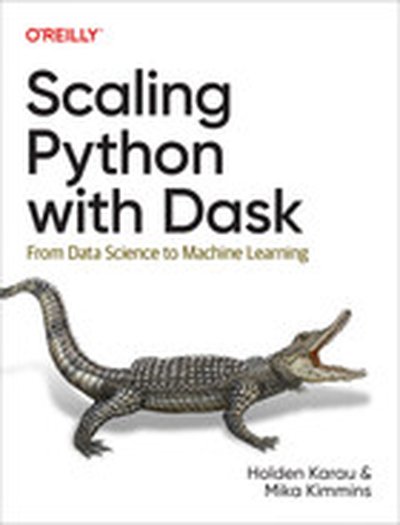
Scaling Python with Dask

Modern systems contain multi-core CPUs and GPUs that have the potential for parallel computing. But many scientific Python tools were not designed to leverage this parallelism. With this short but thorough resource, data scientists and Python programmers will learn how the Dask open source library for parallel computing provides APIs that make it easy to parallelize PyData libraries including NumPy, pandas, and scikit-learn. Authors Holden Karau and Mika Kimmins show you how to use Dask computations in local systems and then scale to the cloud for heavier workloads. This practical book explains why Dask is popular among industry experts and academics and is used by organizations that include Walmart, Capital One, Harvard Medical School, and NASA. With this book, you'll learn: What Dask is, where you can use it, and how it compares with other tools How to use Dask for batch data parallel processing Key distributed system concepts for working with Dask Methods for using Dask with higher-level APIs and building blocks How to work with integrated libraries such as scikit-learn, pandas, and PyTorch How to use Dask with GPUs

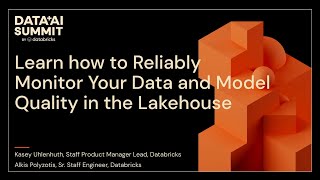
Learn How to Reliably Monitor Your Data and Model Quality in the Lakehouse

Developing and upkeep of production data engineering and machine learning pipelines is a challenging process for many data teams. Even more challenging is monitoring the quality of your data and models once they go into production. Building upon untrustworthy data can cause many complications for data teams. Without a monitoring service, it is challenging to proactively discover when your ML models degrade over time, and the root causes behind it. Furthermore, with a lack of lineage tracking, it is even more painful to debug errors in your models and data. Databricks Lakehouse Monitoring offers a unified service to monitor the quality of all your data and ML assets.

In this session, you’ll learn how to:

  • Use one unified tool to monitor the quality of any data product: data or AI 
  • Quickly diagnose errors in your data products with root cause analysis
  • Set up a monitor with low friction, requiring only a button click or a single API call to start and automatically generate out-of-the-box metrics
  • Enable self-serve experiences for data analysts by providing reliability status for every data asset

Talk by: Kasey Uhlenhuth and Alkis Polyzotis

Connect with us: Website: https://databricks.com Twitter: https://twitter.com/databricks LinkedIn: https://www.linkedin.com/company/databricks Instagram: https://www.instagram.com/databricksinc Facebook: https://www.facebook.com/databricksinc

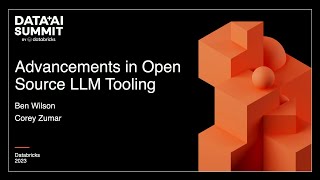
Advancements in Open Source LLM Tooling, Including MLflow

MLflow is one of the most used open source machine learning frameworks with over 13 million monthly downloads. With the recent advancements in generative AI, MLflow has been rapidly integrating support for a lot of the popular AI tools being used such as Hugging Face, LangChain, and OpenAI. This means that it’s becoming easier than ever to build AI pipelines with your data as the foundation, yet expanding your capabilities with the incredible advancements of the AI community.

Come to this session to learn how MLflow can help you:

  • Easily grab open source models from Hugging Face and use Transformers pipelines in MLflow
  • Integrate LangChain for more advanced services and to add context into your model pipelines
  • Bring in OpenAI APIs as part of your pipelines
  • Quickly track and deploy models on the lakehouse using MLflow

Talk by: Corey Zumar and Ben Wilson

Connect with us: Website: https://databricks.com Twitter: https://twitter.com/databricks LinkedIn: https://www.linkedin.com/company/databricks Instagram: https://www.instagram.com/databricksinc Facebook: https://www.facebook.com/databricksinc

Summary

Real-time data processing has steadily been gaining adoption due to advances in the accessibility of the technologies involved. Despite that, it is still a complex set of capabilities. To bring streaming data in reach of application engineers Matteo Pelati helped to create Dozer. In this episode he explains how investing in high performance and operationally simplified streaming with a familiar API can yield significant benefits for software and data teams together.

Announcements

Hello and welcome to the Data Engineering Podcast, the show about modern data management Introducing RudderStack Profiles. RudderStack Profiles takes the SaaS guesswork and SQL grunt work out of building complete customer profiles so you can quickly ship actionable, enriched data to every downstream team. You specify the customer traits, then Profiles runs the joins and computations for you to create complete customer profiles. Get all of the details and try the new product today at dataengineeringpodcast.com/rudderstack Modern data teams are using Hex to 10x their data impact. Hex combines a notebook style UI with an interactive report builder. This allows data teams to both dive deep to find insights and then share their work in an easy-to-read format to the whole org. In Hex you can use SQL, Python, R, and no-code visualization together to explore, transform, and model data. Hex also has AI built directly into the workflow to help you generate, edit, explain and document your code. The best data teams in the world such as the ones at Notion, AngelList, and Anthropic use Hex for ad hoc investigations, creating machine learning models, and building operational dashboards for the rest of their company. Hex makes it easy for data analysts and data scientists to collaborate together and produce work that has an impact. Make your data team unstoppable with Hex. Sign up today at dataengineeringpodcast.com/hex to get a 30-day free trial for your team! Your host is Tobias Macey and today I'm interviewing Matteo Pelati about Dozer, an open source engine that includes data ingestion, transformation, and API generation for real-time sources

Interview

Introduction How did you get involved in the area of data management? Can you describe what Dozer is and the story behind it?

What was your decision process for building Dozer as open source?

As you note in the documentation, Dozer has overlap with a number of technologies that are aimed at different use cases. What was missing from each of them and the center of their Venn diagram that prompted you to build Dozer? In addition to working in an interesting technological cross-section, you are also targeting a disparate group of personas. Who are you building Dozer for and what were the motivations for that vision?

What are the different use cases that you are focused on supporting? What are the features of Dozer that enable engineers to address those uses, and what makes it preferable to existing alternative approaches?

Can you describe how Dozer is implemented?

How have the design and goals of the platform changed since you first started working on it? What are the architectural "-ilities" that you are trying to optimize for?

What is involved in getting Dozer deployed and integrated into an existing application/data infrastructure? How can teams who are using Dozer extend/integrate with Dozer?

What does the development/deployment workflow look like for teams who are building on top of Dozer?

What is your governance model for Dozer and balancing the open source project against your business goals? What are the most interesting, innovative, or unexpected ways that you have seen Dozer used? What are the most interesting, unexpected, or challenging lessons that you have learned while working on Dozer? When is Dozer the wrong choice? What do you have planned for the future of Dozer?

Contact Info

LinkedIn @pelatimtt on Twitter

Parting Question

From your perspective, what is the bigge

Send us a text Welcome to the Making Data Simple Podcast, where we delve into the world of data empowerment and healthcare innovation with esteemed guest Carolyn Ward, Director of Clinical Strategy at Particle Health. Join us as we explore the transformative power of a modern API platform, ensuring simple and secure access to actionable patient data. Dive deep into discussions on patient engagement, the significance of healthcare interoperability, the role of AI in health data management, and the pressing issue of physician burnout. Gain valuable insights from Carolyn's expertise as we unravel the path towards empowering patients and revolutionizing healthcare through data. Tune in to stay informed and inspired by the possibilities of a data-driven healthcare ecosystem.

Carolyn Ward, Director of Clinical Strategy at Particle Health, is ensuring simple and secure access to actionable patient data through a modern API platform.  Carolyn talks patient engagement and empowerment, health care interoperability, AI in health data management, and physician burnout. 02:23 Meet Carolyn Ward05:22 How to use patient data08:29 How many cups of coffee is ok? 10:30 Tailoring diagnosis to the individual 15:40 Why is healthcare moving so slow?18:04 Particle Health29:38 Target client and monetization30:52 Handing PHI34:46 The tech behind Particle Health38:15 Integrating wearables, claims, laboratories 41:27 The role of AILinkedIn: linkedin.com/in/carolynleeward Website: https://www.particlehealth.com/ Want to be featured as a guest on Making Data Simple?  Reach out to us at [email protected] and tell us why you should be next.  The Making Data Simple Podcast is hosted by Al Martin, WW VP Technical Sales, IBM, where we explore trending technologies, business innovation, and leadership ... while keeping it simple & fun.  Want to be featured as a guest on Making Data Simple? Reach out to us at [email protected] and tell us why you should be next. The Making Data Simple Podcast is hosted by Al Martin, WW VP Technical Sales, IBM, where we explore trending technologies, business innovation, and leadership ... while keeping it simple & fun.

Cloudera Data Engineering (CDE) is a serverless service for Cloudera Data Platform that allows you to submit various Spark jobs and Airflow DAGs to an auto-scaling cluster. Running your workloads as Python DAG files may be the usual, but not the most convenient way for some users as it involves a lot of background around syntaxes, the programming language, aesthetics of Airflow, etc. The DAG Authoring UI is a tool built on top of Airflow APIs to allow one to use a graphical user interface to create, manage, and destroy complex DAGs. The DAG authoring UI will give one the ability to perform tasks on Airflow without really having to know DAG structure, Python programming language, and the internals of Airflow. CDE has identified multiple operators to perform various tasks on Airflow by carefully categorising the use cases. The operators range from BashOperator, PythonOperator, CDEJobRunOperator, CDWJobRunOperator Most use cases can be run as combinations of the operators provided.

For the dag owner, testing Airflow DAGs can be complicated and tedious. Kubectl cp your dag from local to pod, exec into the pod, and run a command? Install breeze? Why pull the Airflow image and start up the webserver / scheduler / triggerer if all we want is to test the addition of a new task? It doesn’t have to be this hard. At Etsy, we’ve simplified testing dags for the dag owner with dagtest. Dagtest is a Python package that we house on our internal PyPi. It is a small client binary that makes HTTP requests to a test API. The test API is a simple Flask server that receives these requests and builds pods to run airflow dags backfill commands based on the options provided via dagtest. The simplest of these is a dry-run. Typically, users run test runs where the dag executes E2E for a single ds. Equally important is the environment setup. We use an adhoc Airflow instance in a separate GCP environment with an SA that cannot write to Production buckets. This talk will discuss both.

Airflow is a powerful tool for orchestrating complex data workflows, which have undergone significant changes over the past two years. Since the Airflow release cycle has accelerated, you may struggle to keep up with the continuous flow of new features and improvements, which can lead to miss opportunities for addressing new use cases or solving your existing ones more efficiently. This presentation is intended to give you a solid update on the possibilities of Airflow and address misconceptions you may have heard or still believe that used to be valid but no longer are. At the end of this session, you will be able to use the essential features of Airflow, such as the Taskflow API, Datasets, or Dynamic Task Mapping, and you will know precisely what Airflow can and can’t do today. Fasten your seatbelt, take a deep breath, and let’s go 🚀

We talked about:

Simon's background What MLOps is and what it isn't Skills needed to build an ML platform that serves 100s of models Ranking the importance of skills The point where you should think about building an ML platform The importance of processes in ML platforms Weighing your options with SaaS platforms The exploratory setup, experiment tracking, and model registry What comes after deployment? Stitching tools together to create an ML platform Keeping data governance in mind when building a platform What comes first – the model or the platform? Do MLOps engineers need to have deep knowledge of how models work? Is API design important for MLOps? Simon's recommendations for furthering MLOps knowledge

Links:

LinkedIn: https://www.linkedin.com/in/simonstiebellehner/ Github: https://github.com/stiebels Medium: https://medium.com/@sistel

Free MLOps course: https://github.com/DataTalksClub/mlops-zoomcamp

Join DataTalks.Club: https://datatalks.club/slack.html

Our events: https://datatalks.club/events.html

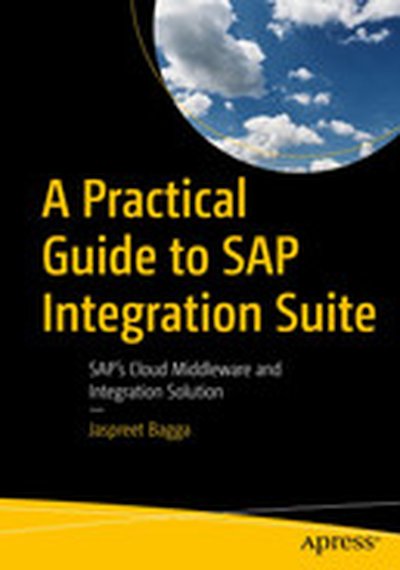
A Practical Guide to SAP Integration Suite: SAP’s Cloud Middleware and Integration Solution

This book covers the basics of SAP’s Integration Suite, including a broad overview of its capabilities, installation, and real-life examples to illustrate how it can be used to integrate, develop, administer, and monitor applications in the cloud. As you progress through the book, you will see how SAP Integration Suite works as an open, enterprise-grade platform that is a fully vendor-managed, multi-cloud offering that will help you expedite your SAP and third-party integration scenarios. The entire value chain is explored in detail, including usage of APIs and runtime control. Author Jaspreet Bagga demonstrates how SAP’s prebuilt integration packages facilitate quicker, more comprehensive integrations, and how they support a variety of integration patterns. You’ll learn how to leverage the platform to enable seamless cloud and on-premises applications connectivity, develop custom scenarios, mix master data, blend business-to-business (B2B) and electronic data interchange (EDI) processes, including trading partner management. Also covered are business-to-government (B2G) scenarios, orchestrating data and pipelines, and mixing event-driven integration. Upon completing this book, you will have a thorough understanding of why SAP Integration Suite is the middleware of SAP’s integration strategy, and be able to effectively use it in your own integration scenarios. What You Will Learn Understand SAP Integration Suite and its core capabilities Know how integration technologies, such as architecture and supplementary intelligent technologies, work within the SAP Integration Suite Discover services for pre-packaged accelerators: SAP API Management, the Integration Advisor, and the SAP API Business Hub Utilize integration features to link your on-premises or cloud-based systems Understand the capabilities of the newly released Migration Assessment Who This Book Is forWeb developers and application leads who want to learn SAP Integration Suite.

Summary

A significant portion of the time spent by data engineering teams is on managing the workflows and operations of their pipelines. DataOps has arisen as a parallel set of practices to that of DevOps teams as a means of reducing wasted effort. Agile Data Engine is a platform designed to handle the infrastructure side of the DataOps equation, as well as providing the insights that you need to manage the human side of the workflow. In this episode Tevje Olin explains how the platform is implemented, the features that it provides to reduce the amount of effort required to keep your pipelines running, and how you can start using it in your own team.

Announcements

Hello and welcome to the Data Engineering Podcast, the show about modern data management RudderStack helps you build a customer data platform on your warehouse or data lake. Instead of trapping data in a black box, they enable you to easily collect customer data from the entire stack and build an identity graph on your warehouse, giving you full visibility and control. Their SDKs make event streaming from any app or website easy, and their extensive library of integrations enable you to automatically send data to hundreds of downstream tools. Sign up free at dataengineeringpodcast.com/rudderstack Your host is Tobias Macey and today I'm interviewing Tevje Olin about Agile Data Engine, a platform that combines data modeling, transformations, continuous delivery and workload orchestration to help you manage your data products and the whole lifecycle of your warehouse

Interview

Introduction How did you get involved in the area of data management? Can you describe what Agile Data Engine is and the story behind it? What are some of the tools and architectures that an organization might be able to replace with Agile Data Engine?

How does the unified experience of Agile Data Engine change the way that teams think about the lifecycle of their data? What are some of the types of experiments that are enabled by reduced operational overhead?

What does CI/CD look like for a data warehouse?

How is it different from CI/CD for software applications?

Can you describe how Agile Data Engine is architected?

How have the design and goals of the system changed since you first started working on it? What are the components that you needed to develop in-house to enable your platform goals?

What are the changes in the broader data ecosystem that have had the most influence on your product goals and customer adoption? Can you describe the workflow for a team that is using Agile Data Engine to power their business analytics?

What are some of the insights that you generate to help your customers understand how to improve their processes or identify new opportunities?

In your "about" page it mentions the unique approaches that you take for warehouse automation. How do your practices differ from the rest of the industry? How have changes in the adoption/implementation of ML and AI impacted the ways that your customers exercise your platform? What are the most interesting, innovative, or unexpected ways that you have seen the Agile Data Engine platform used? What are the most interesting, unexpected, or challenging lessons that you have learned while working on Agile Data Engine? When is Agile Data Engine the wrong choice? What do you have planned for the future of Agile Data Engine?

Guest Contact Info

LinkedIn

Parting Question

From your perspective, what is the biggest gap in the tooling or technology for data management today?

About Agile Data Engine

Agile Data Engine unlocks the potential of your data to drive business value - in a rapidly changing world. Agile Data Engine is a DataOps Management platform for designing, deploying, operating and managing data products, and managing the whole lifecycle of a data warehouse. It combines data modeling, transformations, continuous delivery and workload orchestration into the same platform.

Links

Agile Data Engine Bill Inmon Ralph Kimball Snowflake Redshift BigQuery Azure Synapse Airflow

The intro and outro music is from The Hug by The Freak Fandango Orchestra / CC BY-SA Sponsored By: Rudderstack: Rudderstack

RudderStack provides all your customer data pipelines in one platform. You can collect, transform, and route data across your entire stack with its event streaming, ETL, and reverse ETL pipelines.

RudderStack’s warehouse-first approach means it does not store sensitive information, and it allows you to leverage your existing data warehouse/data lake infrastructure to build a single source of truth for every team.

RudderStack also supports real-time use cases. You can Implement RudderStack SDKs once, then automatically send events to your warehouse and 150+ business tools, and you’ll never have to worry about API changes again.

Visit dataengineeringpodcast.com/rudderstack to sign up for free today, and snag a free T-Shirt just for being a Data Engineering Podcast listener.Support Data Engineering Podcast

Summary

Batch vs. streaming is a long running debate in the world of data integration and transformation. Proponents of the streaming paradigm argue that stream processing engines can easily handle batched workloads, but the reverse isn't true. The batch world has been the default for years because of the complexities of running a reliable streaming system at scale. In order to remove that barrier, the team at Estuary have built the Gazette and Flow systems from the ground up to resolve the pain points of other streaming engines, while providing an intuitive interface for data and application engineers to build their streaming workflows. In this episode David Yaffe and Johnny Graettinger share the story behind the business and technology and how you can start using it today to build a real-time data lake without all of the headache.

Announcements

Hello and welcome to the Data Engineering Podcast, the show about modern data management RudderStack helps you build a customer data platform on your warehouse or data lake. Instead of trapping data in a black box, they enable you to easily collect customer data from the entire stack and build an identity graph on your warehouse, giving you full visibility and control. Their SDKs make event streaming from any app or website easy, and their extensive library of integrations enable you to automatically send data to hundreds of downstream tools. Sign up free at dataengineeringpodcast.com/rudderstack Your host is Tobias Macey and today I'm interviewing David Yaffe and Johnny Graettinger about using streaming data to build a real-time data lake and how Estuary gives you a single path to integrating and transforming your various sources

Interview

Introduction How did you get involved in the area of data management? Can you describe what Estuary is and the story behind it? Stream processing technologies have been around for around a decade. How would you characterize the current state of the ecosystem?

What was missing in the ecosystem of streaming engines that motivated you to create a new one from scratch?

With the growth in tools that are focused on batch-oriented data integration and transformation, what are the reasons that an organization should still invest in streaming?

What is the comparative level of difficulty and support for these disparate paradigms?

What is the impact of continuous data flows on dags/orchestration of transforms? What role do modern table formats have on the viability of real-time data lakes? Can you describe the architecture of your Flow platform?

What are the core capabilities that you are optimizing for in its design?

What is involved in getting Flow/Estuary deployed and integrated with an organization's data systems? What does the workflow look like for a team using Estuary?

How does it impact the overall system architecture for a data platform as compared to other prevalent paradigms?

How do you manage the translation of poll vs. push availability and best practices for API and other non-CDC sources? What are the most interesting, innovative, or unexpected ways that you have seen Estuary used? What are the most interesting, unexpected, or challenging lessons that you have learned while working on Estuary? When is Estuary the wrong choice? What do you have planned for the future of Estuary?

Contact Info

Dave Y Johnny G

Parting Question

From your perspective, what is the biggest gap in the tooling or technology for data management today?

Closing Announcements

Thank you for listening! Don't forget to check out our other shows. Podcast.init covers the Python language, its community, and the innovative ways it is being used. The Machine Learning Podcast helps you go from idea to production with machine learning. Visit the site to subscribe to the show, sign up for the mailing list, and read the show notes. If you've learned something or tried out a project from the show then tell us about it! Email hosts@dataengineeringpodcas

Summary

All of the advancements in our technology is based around the principles of abstraction. These are valuable until they break down, which is an inevitable occurrence. In this episode the host Tobias Macey shares his reflections on recent experiences where the abstractions leaked and some observances on how to deal with that situation in a data platform architecture.

Announcements

Hello and welcome to the Data Engineering Podcast, the show about modern data management RudderStack helps you build a customer data platform on your warehouse or data lake. Instead of trapping data in a black box, they enable you to easily collect customer data from the entire stack and build an identity graph on your warehouse, giving you full visibility and control. Their SDKs make event streaming from any app or website easy, and their extensive library of integrations enable you to automatically send data to hundreds of downstream tools. Sign up free at dataengineeringpodcast.com/rudderstack Your host is Tobias Macey and today I'm sharing some thoughts and observances about abstractions and impedance mismatches from my experience building a data lakehouse with an ELT workflow

Interview

Introduction impact of community tech debt

hive metastore new work being done but not widely adopted

tensions between automation and correctness data type mapping

integer types complex types naming things (keys/column names from APIs to databases)

disaggregated databases - pros and cons

flexibility and cost control not as much tooling invested vs. Snowflake/BigQuery/Redshift

data modeling

dimensional modeling vs. answering today's questions

What are the most interesting, unexpected, or challenging lessons that you have learned while working on your data platform? When is ELT the wrong choice? What do you have planned for the future of your data platform?

Contact Info

LinkedIn

Parting Question

From your perspective, what is the biggest gap in the tooling or technology for data management today?

Closing Announcements

Thank you for listening! Don't forget to check out our other shows. Podcast.init covers the Python language, its community, and the innovative ways it is being used. The Machine Learning Podcast helps you go from idea to production with machine learning. Visit the site to subscribe to the show, sign up for the mailing list, and read the show notes. If you've learned something or tried out a project from the show then tell us about it! Email [email protected]) with your story. To help other people find the show please leave a review on Apple Podcasts and tell your friends and co-workers

Links

dbt Airbyte

Podcast Episode

Dagster

Podcast Episode

Trino

Podcast Episode

ELT Data Lakehouse Snowflake BigQuery Redshift Technical Debt Hive Metastore AWS Glue

The intro and outro music is from The Hug by The Freak Fandango Orchestra / CC BY-SA Sponsored By: Rudderstack: Rudderstack

RudderStack provides all your customer data pipelines in one platform. You can collect, transform, and route data across your entire stack with its event streaming, ETL, and reverse ETL pipelines.

RudderStack’s warehouse-first approach means it does not store sensitive information, and it allows you to leverage your existing data warehouse/data lake infrastructure to build a single source of truth for every team.

RudderStack also supports real-time use cases. You can Implement RudderStack SDKs once, then automatically send events to your warehouse and 150+ business tools, and you’ll never have to worry about API changes again.

Visit dataengineeringpodcast.com/rudderstack to sign up for free today, and snag a free T-Shirt just for being a Data Engineering Podcast listener.Support Data Engineering Podcast
Continuous Data Pipeline for Real time Benchmarking & Data Set Augmentation | Teleskope

ABOUT THE TALK: Building and curating representative datasets is crucial for accurate ML systems. Monitoring metrics post-deployment helps improve the model. Unstructured language models may face data shifts, leading to unpredictable inferences. Open-source APIs and annotation tools streamline annotation and reduce analyst workload.

This talk discusses generating datasets and real-time precision/recall splits to detect data shifts, prioritize data collection, and retrain models.

ABOUT THE SPEAKER: Ivan Aguilar is a data scientist at Teleskope focused on building scalable models for detecting PII/PHI/Secrets and other compliance related entities within customers' clouds. Prior to joining Teleskope, Ivan was a ML Engineer at Forge.AI, a Boston based shop working on information extraction, content extraction, and other NLP related tasks.

ABOUT DATA COUNCIL: Data Council (https://www.datacouncil.ai/) is a community and conference series that provides data professionals with the learning and networking opportunities they need to grow their careers.

Make sure to subscribe to our channel for the most up-to-date talks from technical professionals on data related topics including data infrastructure, data engineering, ML systems, analytics and AI from top startups and tech companies.

FOLLOW DATA COUNCIL: Twitter: https://twitter.com/DataCouncilAI LinkedIn: https://www.linkedin.com/company/datacouncil-ai/

Conversation Simulator: A Real Life Case Leveraging OpenAI's API | Crisis Text Line

ABOUT THE TALK: While we will never replace human to human interaction for crisis intervention, there are plenty of opportunities to build intelligence with AI/ML models that crisis responders could greatly benefit from.

In this talk Maddie Schults and Mateo Garcia introduce their conversation simulator, a tool that we built leveraging openAI's API that allows them to train crisis responders on how to support people in crisis with close to real life situations and can help reduce anxiety for new crisis responders as they log on the platform for the first time.

ABOUT THE SPEAKERS: Maddie Schults is the General Manager at Crisis Text Line. She is a product leader and technologist with over 20 years of experience envisioning, building and launching enterprise software products. At Crisis Text Line, Maddie is responsible for building the Global Product for crisis care intervention and its adoption globally in different countries and languages.

Mateo Garcia is Lead Data Scientist at Crisis Text Line, where he oversees all the Analytics & Data Science efforts. He is a data leader with +7 industry experience scaling data teams from the ground up and building data products at different start-ups and consulting firms.

ABOUT DATA COUNCIL: Data Council (https://www.datacouncil.ai/) is a community and conference series that provides data professionals with the learning and networking opportunities they need to grow their careers.

Make sure to subscribe to our channel for the most up-to-date talks from technical professionals on data related topics including data infrastructure, data engineering, ML systems, analytics and AI from top startups and tech companies.

FOLLOW DATA COUNCIL: Twitter: https://twitter.com/DataCouncilAI LinkedIn: https://www.linkedin.com/company/datacouncil-ai/

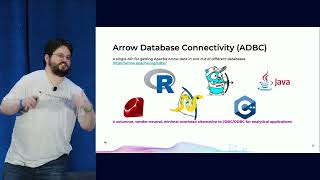
Making Moves with Arrow Data: Introducing Arrow Database Connectivity (ADBC) | Voltron Data

ABOUT THE TALK: In this talk, we'll dive into one of the newest Apache Arrow subprojects, Arrow Database Connectivity (ADBC), an API specification for Arrow-based database access.

Over the course of this session, you’ll get a crash course in ADBC and learn how it communicates with different data APIs (like Arrow Flight SQL and Postgres) using Arrow-native in-memory data. By the end, you’ll understand the use cases it can conquer and know where to access the resources you need to get started.

This talk will cover goals, use-cases, and examples of using ADBC to communicate with different Data APIs (such as Flight SQL or postgres) with Arrow Native in-memory data.

ABOUT THE SPEAKER: Matthew Topol is a committer for the Apache Arrow project, frequently enhancing the Golang Arrow and Parquet libraries among other enhancements and helping to grow the Arrow Community. Recently, Matt has joined Voltron Data in order to work on the Apache Arrow libraries full time and grow the Arrow Golang community. In June 2022, Matt's first book was published, which is the first (and currently only) book on Apache Arrow titled "In-Memory Analytics with Apache Arrow".

ABOUT DATA COUNCIL: Data Council (https://www.datacouncil.ai/) is a community and conference series that provides data professionals with the learning and networking opportunities they need to grow their careers.

Make sure to subscribe to our channel for the most up-to-date talks from technical professionals on data related topics including data infrastructure, data engineering, ML systems, analytics and AI from top startups and tech companies.

FOLLOW DATA COUNCIL: Twitter: https://twitter.com/DataCouncilAI LinkedIn: https://www.linkedin.com/company/datacouncil-ai/

HuggingFace + Ray AIR Integration: A Python Developer’s Guide to Scaling Transformers | AnyScale

ABOUT THE TALK: Hugging Face Transformers is a popular open-source project with cutting-edge Machine Learning (ML). Still, meeting the computational requirements for advanced models it provides often requires scaling beyond a single machine. This session explores the integration between Hugging Face and Ray AI Runtime (AIR), allowing users to scale their model training and data loading seamlessly. We will dive deep into the implementation and API and explore how we can use Ray AIR to create an end-to-end Hugging Face workflow, from data ingest through fine-tuning and HPO to inference and serving.

ABOUT THE SPEAKERS: Jules S. Damji is a lead developer advocate at Anyscale Inc, an MLflow contributor, and co-author of Learning Spark, 2nd Edition. He is a hands-on developer with over 25 years of experience and has worked at leading companies, such as Sun Microsystems, Netscape, @Home, Opsware/LoudCloud, VeriSign, ProQuest, Hortonworks, and Databricks, building large-scale distributed systems.

Antoni Baum is a software engineer at Anyscale, working on Ray Tune, XGBoost-Ray, Ray AIR, and other ML libraries. In his spare time, he contributes to various open source projects, trying to make machine learning more accessible and approachable.

ABOUT DATA COUNCIL: Data Council (https://www.datacouncil.ai/) is a community and conference series that provides data professionals with the learning and networking opportunities they need to grow their careers.

Make sure to subscribe to our channel for the most up-to-date talks from technical professionals on data related topics including data infrastructure, data engineering, ML systems, analytics and AI from top startups and tech companies.

FOLLOW DATA COUNCIL: Twitter: https://twitter.com/DataCouncilAI LinkedIn: https://www.linkedin.com/company/datacouncil-ai/