talk-data.com talk-data.com

Topic

Spark

Apache Spark

big_data distributed_computing analytics

581

tagged

Activity Trend

71 peak/qtr
2020-Q1 2026-Q1

Activities

581 activities · Newest first

Lakehouse / Spark AMA

Have some great questions about Apache Spark™ and Lakehouses?  Well, come by and ask the experts your questions!

Talk by: Martin Grund, Hyukjin Kwon, and Wenchen Fan

Connect with us: Website: https://databricks.com Twitter: https://twitter.com/databricks LinkedIn: https://www.linkedin.com/company/databricks Instagram: https://www.instagram.com/databricksinc Facebook: https://www.facebook.com/databricksinc

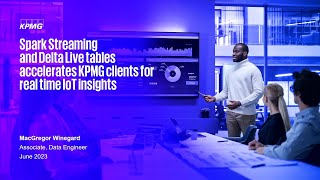
Apache Spark™ Streaming and Delta Live Tables Accelerates KPMG Clients For Real Time IoT Insights

Unplanned downtime in manufacturing costs firms up to a trillion dollars annually. Time that materials spend sitting on a production line is lost revenue. Even just 15 hours of downtime a week adds up to over 800 hours of downtime yearly. The use of Internet of Things or IoT devices can cut this time down by providing details of machine metrics. However, IoT predictive maintenance is challenged by the lack of effective, scalable infrastructure and machine learning solutions. IoT data can be the size of multiple terabytes per day and can come in a variety of formats. Furthermore, without any insights and analysis, this data becomes just another table.

The KPMG Databricks IoT Accelerator is a comprehensive solution enabling manufacturing plant operators to have a bird’s eye view of their machines’ health and empowers proactive machine maintenance across their portfolio of IoT devices. The Databricks Accelerator ingests IoT streaming data at scale and implements the Databricks Medallion architecture while leveraging Delta Live Tables to clean and process data. Real time machine learning models are developed from IoT machine measurements and are managed in MLflow. The AI predictions and IoT device readings are compiled in the gold table powering downstream dashboards like Tableau. Dashboards inform machine operators of not only machines’ ailments, but action they can take to mitigate issues before they arise. Operators can see fault history to aid in understanding failure trends, and can filter dashboards by fault type, machine, or specific sensor reading. 

Talk by: MacGregor Winegard

Connect with us: Website: https://databricks.com Twitter: https://twitter.com/databricks LinkedIn: https://www.linkedin.com/company/databricks Instagram: https://www.instagram.com/databricksinc Facebook: https://www.facebook.com/databricksin

Structured Streaming: Demystifying Arbitrary Stateful Operations

Let’s face it -- data is messy. And your company’s business requirements? Even messier. You’re staring at your screen, knowing there is a tool that will let you give your business partners the information they need as quickly as they need it. There’s even a Python version of it now. But…it looks kind of scary. You’ve never used it before, and you don’t know where to start. Yes, we’re talking about the dreaded flatMapGroupsWithState. But fear not - we’ve got you covered.

In this session, we’ll take a real-word use case and use it to show you how to break down flatMapGroupsWithState into its basic building blocks. We’ll explain each piece in both Scala and the newly-released Python, and at the end we’ll illustrate how it all comes together to enable the implementation of arbitrary stateful operations with Spark Structured Streaming.

Talk by: Angela Chu

Connect with us: Website: https://databricks.com Twitter: https://twitter.com/databricks LinkedIn: https://www.linkedin.com/company/databricks Instagram: https://www.instagram.com/databricksinc Facebook: https://www.facebook.com/databricksinc

Using NLP to Evaluate 100 Million Global Webpages Daily to Contextually Target Consumers

This session will cover the challenges and the solution that The Trade Desk went through to scale their ML models for NLP for 100 million web pages per day.

TTD's contextual targeting team needs to analyze 100 million web pages per day. Fifty percent of the webpages are non-English. Half of the content was not being properly analyzed and targeted intelligently. TTD attempted to build a model using Spark NLP, however the package could not scale and was not cost-effective. GPU utilization was low and the solution was cost prohibitive. TTD engaged with Databricks in early 2022 to build an NLP model on Databricks. Our teams partnered closely together. We were able to build a solution using distributed inference (150-200 GPUs running at 80%+ utilization); Each day, Databricks translated two hundred times faster across 50 million web pages that are in for over 35 + languages and at a fraction of the cost. This solution enables TTD teams to standardize on English for contextual targeting ML models. TTD can now be a one-stop shop for their customers' global advertising needs.

The Trade Desk is headquartered in Ventura, California. It is the largest independent demand-side platform in the world, competing against Google, Facebook, and others. Unlike traditional marketing, programmatic marketing is operated by real-time, split-second decisions based on user identity, device information, and other data points. It enables highly personalized consumer experiences and improves return-on-investment for companies and advertisers.

Talk by: Xuefu Wang and Mark Lee

Connect with us: Website: https://databricks.com Twitter: https://twitter.com/databricks LinkedIn: https://www.linkedin.com/company/databricks Instagram: https://www.instagram.com/databricksinc Facebook: https://www.facebook.com/databricksinc

Deep Dive into the New Features of Apache Spark™ 3.4

Join us for this Technical Deep Dive session. In 2022, Apache Spark™ was awarded the prestigious SIGMOD Systems Award, because Spark is the de facto standard for data processing.

In this session, we will share the latest progress in Apache Spark community. With tremendous contribution from the open source community, Spark 3.4 managed to resolve in excess of 2,400 Jira tickets. We will talk about the major features and improvements in Spark 3.4. The major updates are Spark Connect, numerous PySpark and SQL language features, engine performance enhancements, as well as operational improvements in Spark UX and error handling.

Talk by: Xiao Li and Daniel Tenedorio

Connect with us: Website: https://databricks.com Twitter: https://twitter.com/databricks LinkedIn: https://www.linkedin.com/company/databricks Instagram: https://www.instagram.com/databricksinc Facebook: https://www.facebook.com/databricksinc

Databricks Connect Powered by Spark Connect: Develop and Debug Spark From Any Developer Tool

Spark developers want to develop and debug their code using their tools of choice and development best practices while ensuring high-production fidelity on the target remote cluster. However, Spark's driver architecture is monolithic, with no built-in capability to directly connect to a remote Spark cluster from languages other than SQL. This makes it hard to enable such interactive developer experiences from a user’s local IDE of choice. Spark Connect’s decoupled client-server architecture introduces remote connectivity to Spark clusters and with that, enables interactive development experience - Spark and its open ecosystem can be leveraged from everywhere.

In this session, we show how we leverage Spark Connect to build a completely redesigned version of Databricks Connect, a first-class IDE-based developer experience that offers interactive debugging from any IDE. We show how developers can easily ensure consistency between their local and remote environments. We walk the audience through real-live examples of how to locally debug code running on Databrick. We also show how Databricks Connect integrates into the Databricks Visual Studio Code extension for an even better developer experience.

Talk by: Martin Grund and Stefania Leone

Connect with us: Website: https://databricks.com Twitter: https://twitter.com/databricks LinkedIn: https://www.linkedin.com/company/databricks Instagram: https://www.instagram.com/databricksinc Facebook: https://www.facebook.com/databricksinc

Photon for Dummies: How Does this New Execution Engine Actually Work?

Did you finish the Photon whitepaper and think, wait, what? I know I did; it’s my job to understand it, explain it, and then use it. If your role involves using Apache Spark™ on Databricks, then you need to know about Photon and where to use it. Join me, chief dummy, nay "supreme" dummy, as I break down this whitepaper into easy to understand explanations that don’t require a computer science degree. Together we will unravel mysteries such as:

  • Why is a Java Virtual Machine the current bottleneck for Spark enhancements?
  • What does vectorized even mean? And how was it done before?
  • Why is the relationship status between Spark and Photon "complicated?"

In this session, we’ll start with the basics of Apache Spark, the details we pretend to know, and where those performance cracks are starting to show through. Only then will we start to look at Photon, how it’s different, where the clever design choices are and how you can make the most of this in your own workloads. I’ve spent over 50 hours going over the paper in excruciating detail; every reference, and in some instances, the references of the references so that you don’t have to.

Talk by: Holly Smith

Connect with us: Website: https://databricks.com Twitter: https://twitter.com/databricks LinkedIn: https://www.linkedin.com/company/databricks Instagram: https://www.instagram.com/databricksinc Facebook: https://www.facebook.com/databricksinc

Top Mistakes to Avoid in Streaming Applications

Are you a data engineer seeking to enhance the performance of your streaming applications? Join our session where we will share valuable insights and best practices gained from handling diverse customer streaming use cases using Apache Spark™ Structured Streaming.

In this session, we will delve into the common pitfalls that can hinder your streaming workflows. Learn practical tips and techniques to overcome these challenges during different stages of application development. By avoiding these errors, you can unlock faster performance, improved data reliability, and smoother data processing.

Don't miss out on this opportunity to level up your streaming skills and excel in your data engineering journey. Join us to gain valuable knowledge and practical techniques that will empower you to optimize your streaming applications and drive exceptional results.

Talk by: Vikas Reddy Aravabhumi

Connect with us: Website: https://databricks.com Twitter: https://twitter.com/databricks LinkedIn: https://www.linkedin.com/company/databricks Instagram: https://www.instagram.com/databricksinc Facebook: https://www.facebook.com/databricksinc

The English SDK for Apache Spark™

In the fast-paced world of data science and AI, we will explore how large language models (LLMs) can elevate the development process of Apache Spark applications.

We'll demonstrate how LLMs can simplify SQL query creation, data ingestion, and DataFrame transformations, leading to faster development and clearer code that's easier to review and understand. We'll also show how LLMs can assist in creating visualizations and clarifying data insights, making complex data easy to understand.

Furthermore, we'll discuss how LLMs can be used to create user-defined data sources and functions, offering a higher level of adaptability in Apache Spark applications.

Our session, filled with practical examples, highlights the innovative role of LLMs in the realm of Apache Spark development. We invite you to join us in this exploration of how these advanced language models can drive innovation and boost efficiency in the sphere of data science and AI.

Talk by: Gengliang Wang and Allison Wang

Connect with us: Website: https://databricks.com Twitter: https://twitter.com/databricks LinkedIn: https://www.linkedin.com/company/databricks Instagram: https://www.instagram.com/databricksinc Facebook: https://www.facebook.com/databricksinc

Live from the Lakehouse: Ethics in AI with Adi Polak & gaining from open source with Vini Jaiswal

Hear from two guests. First, Adi Polak (VP of Developer Experience, Treeverse, and author of #1 new release - Scaling ML with Spark) on how AI helps us be more productive. Second guest, Vini Jaiswal (Principal Developer Advocate, ByteDance) on gaining with the open source community, overcoming scalability challenges, and taking innovation to the next stage. Hosted by Pearl Ubaru (Sr Technical Marketing Engineer, Databricks)

Introduced in Airflow 2.4, Datasets are a foundational feature for authoring modular data pipelines. As DAGs grow to encompass a larger number of data sources and encompass multiple data transformation steps, they typically become less predictable in the timeliness of execution and less efficient. This talk focuses on leveraging Datasets to enable predictable and more efficient DAGs, by leveraging patterns from microservice architectures. Just as large monolithic applications were decomposed into micro-services to deliver more efficient scalability and faster development cycles, micropipelines have the same potential to radically transform data pipeline efficiency and development velocity. Using a simple financial analysis pipeline example, with data aggregation being done in Snowflake and prediction analysis in Spark, this talk outlines how to retain timelines of data pipelines while expanding data sets.

Cloudera Data Engineering (CDE) is a serverless service for Cloudera Data Platform that allows you to submit various Spark jobs and Airflow DAGs to an auto-scaling cluster. Running your workloads as Python DAG files may be the usual, but not the most convenient way for some users as it involves a lot of background around syntaxes, the programming language, aesthetics of Airflow, etc. The DAG Authoring UI is a tool built on top of Airflow APIs to allow one to use a graphical user interface to create, manage, and destroy complex DAGs. The DAG authoring UI will give one the ability to perform tasks on Airflow without really having to know DAG structure, Python programming language, and the internals of Airflow. CDE has identified multiple operators to perform various tasks on Airflow by carefully categorising the use cases. The operators range from BashOperator, PythonOperator, CDEJobRunOperator, CDWJobRunOperator Most use cases can be run as combinations of the operators provided.

HuggingFace + Ray AIR Integration: A Python Developer’s Guide to Scaling Transformers | AnyScale

ABOUT THE TALK: Hugging Face Transformers is a popular open-source project with cutting-edge Machine Learning (ML). Still, meeting the computational requirements for advanced models it provides often requires scaling beyond a single machine. This session explores the integration between Hugging Face and Ray AI Runtime (AIR), allowing users to scale their model training and data loading seamlessly. We will dive deep into the implementation and API and explore how we can use Ray AIR to create an end-to-end Hugging Face workflow, from data ingest through fine-tuning and HPO to inference and serving.

ABOUT THE SPEAKERS: Jules S. Damji is a lead developer advocate at Anyscale Inc, an MLflow contributor, and co-author of Learning Spark, 2nd Edition. He is a hands-on developer with over 25 years of experience and has worked at leading companies, such as Sun Microsystems, Netscape, @Home, Opsware/LoudCloud, VeriSign, ProQuest, Hortonworks, and Databricks, building large-scale distributed systems.

Antoni Baum is a software engineer at Anyscale, working on Ray Tune, XGBoost-Ray, Ray AIR, and other ML libraries. In his spare time, he contributes to various open source projects, trying to make machine learning more accessible and approachable.

ABOUT DATA COUNCIL: Data Council (https://www.datacouncil.ai/) is a community and conference series that provides data professionals with the learning and networking opportunities they need to grow their careers.

Make sure to subscribe to our channel for the most up-to-date talks from technical professionals on data related topics including data infrastructure, data engineering, ML systems, analytics and AI from top startups and tech companies.

FOLLOW DATA COUNCIL: Twitter: https://twitter.com/DataCouncilAI LinkedIn: https://www.linkedin.com/company/datacouncil-ai/

Feed The Alligators With the Lights On: How Data Engineers Can See Who Really Uses Data | Stemma

ABOUT THE TALK: At Lyft, Mark Grover built the Amundsen data catalog so data scientists could navigate hundreds of thousands of tables to distinguish trustworthy data from sandboxed, out-of-date data. When he took Amundsen open source, he helped dozens of data teams support a variety of demands to make data discoverable and self-serve. Mark frequently sees processes that seem “good enough” come back to bite data teams. In this talk, Mark takes us deep into query logs and APIs to see where all of that metadata lives, and he'll demonstrate how to use it so you don’t lose any fingers during your next data change.

ABOUT THE SPEAKER: Mark Grover is the co-founder/CEO of Stemma - a modern data catalog for building self-serve data culture used by Grafana, iRobot, SoFi, Convoy and many others. He is the co-creator of the leading open-source data catalog, Amundsen, used by Lyft, Instacart, Square, ING, Snap and many more! ​Mark was previously a developer on Apache Spark at Cloudera and is a committer and PMC member on a few open-source Apache project. He is a co-author of Hadoop Application Architectures.

ABOUT DATA COUNCIL: Data Council (https://www.datacouncil.ai/) is a community and conference series that provides data professionals with the learning and networking opportunities they need to grow their careers.

Make sure to subscribe to our channel for the most up-to-date talks from technical professionals on data related topics including data infrastructure, data engineering, ML systems, analytics and AI from top startups and tech companies.

FOLLOW DATA COUNCIL: Twitter: https://twitter.com/DataCouncilAI LinkedIn: https://www.linkedin.com/company/datacouncil-ai/
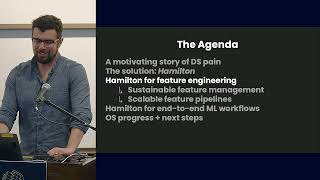
Scalable & Sustainable Feature Engineering with Hamilton | DAGWorks

ABOUT THE TALK: Hamilton is a novel open-source framework for developing and maintaining scalable feature engineering dataflows.

We introduce the framework, discuss its motivations and initial successes at Stitch Fix, showcase its lightweight data lineage and catalog abilities, and share recent extensions that seamlessly integrate it with distributed compute offerings, such as Dask, Ray, and Spark.

ABOUT THE SPEAKER: Elijah Ben Izzy has always enjoyed working at the intersection of math and engineering. He has more recently focused on building tools to make data scientists and researchers more productive.

He built infrastructure to help quantitative researchers efficiently turn ideas into production trading models at Two Sigma and ran the Model Lifecycle team at Stitch Fix.

He is now the CTO at DAGWorks, which aims to solve the problem of building and maintaining complex ETLs for machine learning.

ABOUT DATA COUNCIL: Data Council (https://www.datacouncil.ai/) is a community and conference series that provides data professionals with the learning and networking opportunities they need to grow their careers.

Make sure to subscribe to our channel for the most up-to-date talks from technical professionals on data related topics including data infrastructure, data engineering, ML systems, analytics and AI from top startups and tech companies.

FOLLOW DATA COUNCIL: Twitter: https://twitter.com/DataCouncilAI LinkedIn: https://www.linkedin.com/company/datacouncil-ai/
The Python data ecosystem has matured during the last decade and there are less and less reasons to rely only large batch process executed in a Spark cluster, but with every large ecosystem, putting together the key pieces of technology takes some effort. There are now better storage technologies, streaming execution engines, query planners, and low level compute libraries. And modern hardware is way more powerful than what you'd probably expect. In this workshop we will explore some global-warming-reducing techniques to build more efficient data transformation pipelines in Python, and a little bit of Rust.

Get ready to level up your big data processing skills! Join us for an introductory talk on Apache Spark, the distributed computing system used by tech giants like Netflix and Amazon. We'll cover PySpark DataFrames and how to use them. Whether you're a Python developer new to big data or looking to explore new technologies, this talk is for you. You'll gain foundational knowledge about Apache Spark and its capabilities, and learn how to leverage DataFrames and SQL APIs to efficiently process large amounts of data. Don't miss out on this opportunity to up your big data game!

Over the past decade, developers, researchers, and the community have successfully built tens of thousands of data applications using Spark. Since then, use cases and requirements of data applications have evolved: Today, every application, from web services that run in application servers, interactive environments such as notebooks and IDEs, to phones and edge devices such as smart home devices, want to leverage the power of data.

However, Spark's driver architecture is monolithic, running client applications on top of a scheduler, optimizer and analyzer. This architecture makes it hard to address these new requirements: there is no built-in capability to remotely connect to a Spark cluster from languages other than SQL.

Spark Connect introduces a decoupled client-server architecture for Apache Spark that allows remote connectivity to Spark clusters using the DataFrame API and unresolved logical plans as the protocol. The separation between client and server allows Spark and its open ecosystem to be leveraged from everywhere. It can be embedded in modern data applications, in IDEs, Notebooks and programming languages.

This talk highlights how simple it is to connect to Spark using Spark Connect from any data applications or IDEs. We will do a deep dive into the architecture of Spark Connect and give an outlook of how the community can participate in the extension of Spark Connect for new programming languages and frameworks - to bring the power of Spark everywhere.

Scaling Machine Learning with Spark

Learn how to build end-to-end scalable machine learning solutions with Apache Spark. With this practical guide, author Adi Polak introduces data and ML practitioners to creative solutions that supersede today's traditional methods. You'll learn a more holistic approach that takes you beyond specific requirements and organizational goals--allowing data and ML practitioners to collaborate and understand each other better. Scaling Machine Learning with Spark examines several technologies for building end-to-end distributed ML workflows based on the Apache Spark ecosystem with Spark MLlib, MLflow, TensorFlow, and PyTorch. If you're a data scientist who works with machine learning, this book shows you when and why to use each technology. You will: Explore machine learning, including distributed computing concepts and terminology Manage the ML lifecycle with MLflow Ingest data and perform basic preprocessing with Spark Explore feature engineering, and use Spark to extract features Train a model with MLlib and build a pipeline to reproduce it Build a data system to combine the power of Spark with deep learning Get a step-by-step example of working with distributed TensorFlow Use PyTorch to scale machine learning and its internal architecture

Summary

With all of the messaging about treating data as a product it is becoming difficult to know what that even means. Vishal Singh is the head of products at Starburst which means that he has to spend all of his time thinking and talking about the details of product thinking and its application to data. In this episode he shares his thoughts on the strategic and tactical elements of moving your work as a data professional from being task-oriented to being product-oriented and the long term improvements in your productivity that it provides.

Announcements

Hello and welcome to the Data Engineering Podcast, the show about modern data management When you're ready to build your next pipeline, or want to test out the projects you hear about on the show, you'll need somewhere to deploy it, so check out our friends at Linode. With their new managed database service you can launch a production ready MySQL, Postgres, or MongoDB cluster in minutes, with automated backups, 40 Gbps connections from your application hosts, and high throughput SSDs. Go to dataengineeringpodcast.com/linode today and get a $100 credit to launch a database, create a Kubernetes cluster, or take advantage of all of their other services. And don't forget to thank them for their continued support of this show! Modern data teams are dealing with a lot of complexity in their data pipelines and analytical code. Monitoring data quality, tracing incidents, and testing changes can be daunting and often takes hours to days or even weeks. By the time errors have made their way into production, it’s often too late and damage is done. Datafold built automated regression testing to help data and analytics engineers deal with data quality in their pull requests. Datafold shows how a change in SQL code affects your data, both on a statistical level and down to individual rows and values before it gets merged to production. No more shipping and praying, you can now know exactly what will change in your database! Datafold integrates with all major data warehouses as well as frameworks such as Airflow & dbt and seamlessly plugs into CI workflows. Visit dataengineeringpodcast.com/datafold today to book a demo with Datafold. RudderStack helps you build a customer data platform on your warehouse or data lake. Instead of trapping data in a black box, they enable you to easily collect customer data from the entire stack and build an identity graph on your warehouse, giving you full visibility and control. Their SDKs make event streaming from any app or website easy, and their extensive library of integrations enable you to automatically send data to hundreds of downstream tools. Sign up free at dataengineeringpodcast.com/rudder Build Data Pipelines. Not DAGs. That’s the spirit behind Upsolver SQLake, a new self-service data pipeline platform that lets you build batch and streaming pipelines without falling into the black hole of DAG-based orchestration. All you do is write a query in SQL to declare your transformation, and SQLake will turn it into a continuous pipeline that scales to petabytes and delivers up to the minute fresh data. SQLake supports a broad set of transformations, including high-cardinality joins, aggregations, upserts and window operations. Output data can be streamed into a data lake for query engines like Presto, Trino or Spark SQL, a data warehouse like Snowflake or Redshift., or any other destination you choose. Pricing for SQLake is simple. You pay $99 per terabyte ingested into your data lake using SQLake, and run unlimited transformation pipelines for free. That way data engineers and data users can process to their heart’s content without worrying about their cloud bill. For data engineering podcast listeners, we’re offering a 30 day trial with unlimited data, so go to dataengineeringpodcast.com/upsolver today and see for yourself how to avoid DAG hell. Your host is Tobias Macey and today I'm interviewing Vishal Singh about his experience