Doing Statistical Analysis looks at three kinds of statistical research questions – descriptive, associational and inferential – and shows students how to conduct statistical analyses and interpret the results.
 talk-data.com
Topic
5765
tagged
Doing Statistical Analysis looks at three kinds of statistical research questions – descriptive, associational and inferential – and shows students how to conduct statistical analyses and interpret the results.
Microsoft Power Platform Solution Architect's Handbook is your definitive resource for mastering Enterprise-grade solution architecture using Microsoft Power Platform. By covering both practical examples and theoretical best practices, this book ensures you are well-prepared to tackle real-world challenges and excel in the PL-600 certification exam. What this Book will help me do Master the essential practices of solution architecture for optimal design. Develop secure integrations and data strategies for cutting-edge applications. Learn sophisticated lifecycle and compliance management using Azure DevOps. Build impactful, compliant, and flexible solutions using Power Platform. Prepare effectively for the PL-600 certification exam and excel in your field. Author(s) Hugo Herrera is a respected technology expert specializing in solution architecture and enterprise-grade IT solutions, particularly with Microsoft Power Platform. Drawing from years of experience, Hugo emphasizes practical, actionable strategies to elevate professionals. Through this book, Hugo shares his deep expertise and makes complex concepts accessible. Who is it for? This book is perfect for solution architects, enterprise architects, IT consultants, and analysts focused on Microsoft Power Platform and related technologies. It provides insight and tools for professionals looking to enhance their competencies, advance their careers, and prepare for the PL-600 exam. The reader should have a solid understanding of Power Platform fundamentals.
This book will guide you through mastering Delta, a robust and versatile protocol for data engineering and analytics. You'll discover how Delta simplifies data workflows, supports both batch and streaming data, and is optimized for analytics applications in various industries. By the end, you will know how to create high-performing, analytics-ready data pipelines. What this Book will help me do Understand Delta's unique offering for unifying batch and streaming data processing. Learn approaches to address data governance, reliability, and scalability challenges. Gain technical expertise in building data pipelines optimized for analytics and machine learning use. Master core concepts like data modeling, distributed computing, and Delta's schema evolution features. Develop and deploy production-grade data engineering solutions leveraging Delta for business intelligence. Author(s) Anindita Mahapatra is an experienced data engineer and author with years of expertise in working on Delta and data-driven solutions. Her hands-on approach to explaining complex data concepts makes this book an invaluable resource for professionals in data engineering and analytics. Who is it for? Ideal for data engineers, data analysts, and anyone involved in AI/BI workflows, this book suits learners with some basic knowledge of SQL and Python. Whether you're an experienced professional or looking to upgrade your skills with Delta, this book will provide practical insights and actionable knowledge.
Unlocking the value of modern data is critical for data-driven companies. This report provides a concise, practical guide to building a data architecture that efficiently delivers big, complex, and streaming data to both internal users and customers. Authors Ori Rafael, Roy Hasson, and Rick Bilodeau from Upsolver examine how modern data pipelines can improve business outcomes. Tech leaders and data engineers will explore the role these pipelines play in the data architecture and learn how to intelligently consider tradeoffs between different data architecture patterns and data pipeline development approaches. You will: Examine how recent changes in data, data management systems, and data consumption patterns have made data pipelines challenging to engineer Learn how three data architecture patterns (event sourcing, stateful streaming, and declarative data pipelines) can help you upgrade your practices to address modern data Compare five approaches for building modern data pipelines, including pure data replication, ELT over a data warehouse, Apache Spark over data lakes, declarative pipelines over data lakes, and declarative data lake staging to a data warehouse
This IBM® Redbooks® Product Guide publication describes the IBM FlashSystem® 5200 solution, which is a next-generation IBM FlashSystem control enclosure. It is an NVMe end-to-end platform that is targeted at the entry and midrange market and delivers the full capabilities of IBM FlashCore® technology. It also provides a rich set of software-defined storage (SDS) features that are delivered by IBM Spectrum® Virtualize, including the following features: Data reduction and deduplication Dynamic tiering Thin provisioning Snapshots Cloning Replication Data copy services Transparent Cloud Tiering IBM HyperSwap® including 3-site replication for high availability (HA) Scale-out and scale-up configurations further enhance capacity and throughput for better availability. The IBM FlashSystem 5200 is a high-performance storage solution that is based on a revolutionary 1U form factor. It consists of 12 NVMe Flash Devices in a 1U storage enclosure drawer with full redundant canister components and no single point of failure. It is designed for businesses of all sizes, including small, remote, branch offices and regional clients. It is a smarter, self-optimizing solution that requires less management, which enables organizations to overcome their storage challenges. Flash has come of age and price point reductions mean that lower parts of the storage market are seeing the value of moving over to flash and NVMe--based solutions. The IBM FlashSystem 5200 advances this transition by providing incredibly dense tiers of flash in a more affordable package. With the benefit of IBM FlashCore Module compression and new QLC flash-based technology becoming available, a compelling argument exists to move away from Nearline SAS storage and on to NVMe. With the release of IBM FlashSystem 5200 Software V8.4, extra functions and features are available, including support for new Distributed RAID1 (DRAID1) features, GUI enhancements, Redirect-on-write for Data Reduction Pool (DRP) snapshots, and 3-site replication capabilities. This book is aimed at pre-sales and post-sales technical support and marketing and storage administrators.
If you work with SQL Server, dbatools is a lifesaver. This book will show you how to use this free and open source PowerShell module to automate just about every SQL server task you can imagine—all in just one month! In Learn dbatools in a Month of Lunches you will learn how to: Perform instance-to-instance and customized migrations Automate security audits, tempdb configuration, alerting, and reporting Schedule and monitor PowerShell tasks in SQL Server Agent Bulk-import any type of data into SQL Server Install dbatools in secure environments Written by a group of expert authors including dbatools creator Chrissy LeMaire, Learn dbatools in a Month of Lunches teaches you techniques that will make you more effective—and efficient—than you ever thought possible. In twenty-eight lunchbreak lessons, you’ll learn the most important use cases of dbatools and the favorite functions of its core developers. Stabilize and standardize your SQL server environment, and simplify your tasks by building automation, alerting, and reporting with this powerful tool. About the Technology For SQL Server DBAs, automation is the key to efficiency. Using the open-source dbatools PowerShell module, you can easily execute tasks on thousands of database servers at once—all from the command line. dbatools gives you over 500 pre-built commands, with countless new options for managing SQL Server at scale. There’s nothing else like it. About the Book Learn dbatools in a Month of Lunches teaches you how to automate SQL Server using the dbatools PowerShell module. Each 30-minute lesson introduces a new automation that will make your daily duties easier. Following the expert advice of dbatools creator Chrissy LeMaire and other top community contributors, you’ll learn to script everything from backups to disaster recovery. What's Inside Performing instance-to-instance and customized migrations Automating security audits, best practices, and standardized configurations Administering SQL Server Agent including running PowerShell scripts effectively Bulk-importing many types of data into SQL Server Executing advanced tasks and increasing efficiency for everyday administration About the Reader For DBAs, accidental DBAs, and systems engineers who manage SQL Server. About the Authors Chrissy LeMaire is a GitHub Star and the creator of dbatools. Rob Sewell is a data engineer and a passionate automator. Jess Pomfret and Cláudio Silva are data platform architects. All are Microsoft MVPs. Quotes All SQL Server professionals should learn dbatools. With its combination of knowledge transfer, anecdotes, and hands-on labs, this book is the perfect way. - From the Foreword by Anna Hoffman, Databases Product Management, Microsoft Excellent guide for dbatools with lots of practical tips! Required reading for anyone interested in dbatools. - Ruben Vandeginste, PeopleWare A must-have for any SQL server developer. - Raushan Kumar Jha, Microsoft If you want to automate all vital aspects of SQL Server, wait no more! Learn dbatools in a month, with guidance from the best minds in the business. - Ranjit Sahai, RAM Consulting
API Strategy for Decision Makers provides actionable best practices for building winning API products. Whether you're with an API-first company or with an existing enterprise software company looking to expand your API offerings, this report shows you how to grow your API product into a center of revenue and metrics to measure against. Authors Mike Amundsen and Derric Gilling draw on real-life examples to guide you through the important considerations for successfully developing and executing on your API strategy. By identifying winning business cases, sharing best practices for adoption and monetization, and showing you how to create a great API experience, this report presents a detailed overview for every C-suite executive and product owner managing an API platform. With this report, you'll: Learn how to apply common product management techniques to better manage your APIs as products Discover how to define a strategy from initial adoption, monetization, and deprecation of your APIs Determine how to position your API products in your company's portfolio as well as the wider market Dig deep into the step-by-step process of making your API strategy come to life Explore the power of API observability, monitoring, and analytics as a means to quantify, track, and optimize your API strategy
Produce high-quality, visually attractive analysis quickly and effectively with Microsoft’s key BI tool. This book teaches analysts, managers, power users, and developers how to harness the power of Microsoft’s self-service business intelligence flagship product to deliver compelling and interactive insight with remarkable ease. It then shows you the essential techniques needed to go from source data to dashboards that seize your audience’s attention and provide them with clear and accurate information. As well as producing elegant and visually arresting output, you learn how to enhance the user experience through adding polished interactivity. This book shows you how to make interactive dashboards that allow you to guide users through the meaning of the data that they are exploring. Drill down features are also covered that allow you and your audience to dig deeper and uncover new insights by exploring anomalous and interesting data points. Reading this book builds your skills around creating meaningful and elegant dashboards using a range of compelling visuals. It shows you how to apply simple techniques to convert data into business insight. The book covers tablet and smartphone layouts for delivering business value in today’s highly mobile world. You’ll learn about formatting for effect to make your data tell its story, and you’ll be a master at creating visually arresting output on multiple devices that grabs attention, builds influence, and drives change. What You Will Learn Produce designer output that will astound your bosses and peers Make new insights as you chop and tweak your data as never before Create high-quality analyses in record time Create interdependent charts, maps, and tables Deliver visually stunning information Drill down through data to provide unique understandings Outshinecompeting products and enhance existing skills Adapt your dashboard delivery to mobile devices Who This Book Is For For any Power BI user who wants to strengthen their ability to deliver compelling analytics via Microsoft’s widely adopted analytics platform. For those new to Power BI who want to learn the full extent of what the platform is capable of. For power users such as BI analysts, data architects, IT managers, accountants, and C-suite members who want to drive change in their organizations.
Design and implement a modern data lakehouse on the Azure Data Platform using Delta Lake, Apache Spark, Azure Databricks, Azure Synapse Analytics, and Snowflake. This book teaches you the intricate details of the Data Lakehouse Paradigm and how to efficiently design a cloud-based data lakehouse using highly performant and cutting-edge Apache Spark capabilities using Azure Databricks, Azure Synapse Analytics, and Snowflake. You will learn to write efficient PySpark code for batch and streaming ELT jobs on Azure. And you will follow along with practical, scenario-based examples showing how to apply the capabilities of Delta Lake and Apache Spark to optimize performance, and secure, share, and manage a high volume, high velocity, and high variety of data in your lakehouse with ease. The patterns of success that you acquire from reading this book will help you hone your skills to build high-performing and scalable ACID-compliant lakehouses using flexible and cost-efficient decoupled storage and compute capabilities. Extensive coverage of Delta Lake ensures that you are aware of and can benefit from all that this new, open source storage layer can offer. In addition to the deep examples on Databricks in the book, there is coverage of alternative platforms such as Synapse Analytics and Snowflake so that you can make the right platform choice for your needs. After reading this book, you will be able to implement Delta Lake capabilities, including Schema Evolution, Change Feed, Live Tables, Sharing, and Clones to enable better business intelligence and advanced analytics on your data within the Azure Data Platform. What You Will Learn Implement the Data Lakehouse Paradigm on Microsoft’s Azure cloud platform Benefit from the new Delta Lake open-source storage layer for data lakehouses Take advantage of schema evolution, change feeds, live tables, and more Writefunctional PySpark code for data lakehouse ELT jobs Optimize Apache Spark performance through partitioning, indexing, and other tuning options Choose between alternatives such as Databricks, Synapse Analytics, and Snowflake Who This Book Is For Data, analytics, and AI professionals at all levels, including data architect and data engineer practitioners. Also for data professionals seeking patterns of success by which to remain relevant as they learn to build scalable data lakehouses for their organizations and customers who are migrating into the modern Azure Data Platform.
Get going with tidymodels, a collection of R packages for modeling and machine learning. Whether you're just starting out or have years of experience with modeling, this practical introduction shows data analysts, business analysts, and data scientists how the tidymodels framework offers a consistent, flexible approach for your work. RStudio engineers Max Kuhn and Julia Silge demonstrate ways to create models by focusing on an R dialect called the tidyverse. Software that adopts tidyverse principles shares both a high-level design philosophy and low-level grammar and data structures, so learning one piece of the ecosystem makes it easier to learn the next. You'll understand why the tidymodels framework has been built to be used by a broad range of people. With this book, you will: Learn the steps necessary to build a model from beginning to end Understand how to use different modeling and feature engineering approaches fluently Examine the options for avoiding common pitfalls of modeling, such as overfitting Learn practical methods to prepare your data for modeling Tune models for optimal performance Use good statistical practices to compare, evaluate, and choose among models
This IBM® Redbooks® publication covers IBM TS7700 R5.2. The IBM TS7700 is part of a family of IBM Enterprise tape products. This book is intended for system architects and storage administrators who want to integrate their storage systems for optimal operation. Building on 25 years of experience, the R5.2 release includes many features that enable improved performance, usability, and security. Highlights include IBM TS7700 Advanced Object Store, an all flash TS7770, grid resiliency enhancements, and Logical WORM retention. By using the same hierarchical storage techniques, the TS7700 (TS7770 and TS7760) can also off load to object storage. Because object storage is cloud-based and accessible from different regions, the TS7700 Cloud Storage Tier support essentially allows the cloud to be an extension of the grid. As of this writing, the TS7700C supports the ability to off load to IBM Cloud® Object Storage, Amazon S3, and RSTOR. This publication explains features and concepts that are specific to the IBM TS7700 as of release R5.2. The R5.2 microcode level provides IBM TS7700 Cloud Storage Tier enhancements, IBM DS8000® Object Storage enhancements, Management Interface dual control security, and other smaller enhancements. The R5.2 microcode level can be installed on the IBM TS7770 and IBM TS7760 models only. Note: The latest Release 5.2 was split into two phases: R5.2 Phase 1 (also referred to as and ) R5.2 Phase 2 ( and R) TS7700 provides tape virtualization for the IBM z environment. Off loading to physical tape behind a TS7700 is used by hundreds of organizations around the world. Tape virtualization can help satisfy the following requirements in a data processing environment. New and existing capabilities of the TS7700 5.2.2 release includes the following highlights: Eight-way Grid Cloud, which consists of up to three generations of TS7700 Synchronous and asynchronous replication of virtual tape and TCT objects Grid access to all logical volume and object data that is independent of where it exists An all-flash TS7770 option for improved performance Full Advanced Object Store Grid Cloud support of DS8000 Transparent Cloud Tier Full AES256 encryption for data that is in-flight and at-rest Tight integration with IBM Z® and DFSMS policy management DS8000 Object Store AES256 in-flight encryption and compression Regulatory compliance through Logical WORM and LWORM Retention support Cloud Storage Tier support for archive, logical volume version, and disaster recovery Optional integration with physical tape 16 Gb IBM FICON® throughput that exceeds 5 GBps per TS7700 cluster Grid Resiliency Support with Control Unit Initiated Reconfiguration (CUIR) support IBM Z hosts view up to 3,968 common devices per TS7700 grid TS7770 Cache On-demand feature that is based capacity licensing TS7770 support of SSD within the VED server The TS7700T writes data by policy to physical tape through attachment to high-capacity, high-performance IBM TS1160, IBM TS1150, and IBM TS1140 tape drives that are installed in an IBM TS4500 or TS3500 tape library. The TS7770 models are based on high-performance and redundant IBM POWER9™ technology. They provide improved performance for most IBM Z tape workloads when compared to the previous generations of IBM TS7700.
IBM Z® has a close and unique relationship to its storage. Over the years, improvements to the IBM zSystems® processors and storage software, the disk storage systems, and their communication architecture consistently reinforced this synergy. This IBM® Redpaper™ publication summarizes and highlights the various aspects, advanced functions, and technologies that are often pioneered by IBM and make IBM Z and IBM DS8000® products an ideal combination. This paper is intended for users who have some familiarity with IBM Z and the IBM DS8000 series and want a condensed but comprehensive overview of the synergy items up to the IBM z16 server with IBM z/OS® V2.5 and the IBM DS8900 Release 9.3 firmware.
Dive into 'Data Engineering with Alteryx' to master the principles of DataOps while learning to build robust data pipelines using Alteryx. This book guides you through key practices to enhance data pipeline reliability, efficiency, and accessibility, making it an essential resource for modern data professionals. What this Book will help me do Understand and implement DataOps practices within Alteryx workflows. Design and develop data pipelines with Alteryx Designer for efficient data processing. Learn to manage and publish pipelines using Alteryx Server and Alteryx Connect. Gain advanced skills in Alteryx for handling spatial analytics and machine learning. Master techniques to monitor, secure, and optimize data workflows and access. Author(s) Paul Houghton is an experienced data engineer and author specializing in data engineering and DataOps. With extensive experience using Alteryx tools and workflows, Paul has a passion for teaching and sharing his knowledge through clear and practical guidance. His hands-on approach ensures readers successfully navigate and apply technical concepts to real-world projects. Who is it for? This book is ideal for data engineers, data scientists, and data analysts aiming to build reliable data pipelines with Alteryx. You do not need prior experience with Alteryx, but familiarity with data workflows will enhance your learning experience. If you're focused on aligning with DataOps methodologies, this book is tailored for you.
Dive deep into Microsoft Power BI with the second edition of 'Mastering Microsoft Power BI'. This comprehensive book equips you with the skills to transform business data into actionable insights using Power BI's latest features and techniques. From efficient data retrieval and transformation processes to creating interactive dashboards that tell impactful data stories, you will learn actionable knowledge every step of the way. What this Book will help me do Learn to master data collection and modeling using the Power Query M language Gain expertise in designing DirectQuery, import, and composite data models Understand how to create advanced analytics reports using DAX and Power BI visuals Learn to manage the Power BI environment as an administrator with Premium capacity Develop insightful, scalable, and visually impactful dashboards and reports Author(s) Greg Deckler, a seasoned Power BI expert and solution architect, and None Powell, an experienced BI consultant and data visualization specialist, bring their extensive practical knowledge to this book. Together, they share their real-world expertise and proven techniques applying Power BI's diverse capabilities. Who is it for? This book is ideal for business intelligence professionals and intermediate Power BI users. If you're looking to master data visualization, prepare insightful dashboards, and explore Power BI's full potential, this is for you. Basic understanding of BI concepts and familiarity with Power BI will ensure you get the most value.
BIG DATA ANALYTICS AND MACHINE INTELLIGENCE IN BIOMEDICAL AND HEALTH INFORMATICS Provides coverage of developments and state-of-the-art methods in the broad and diversified data analytics field and applicable areas such as big data analytics, data mining, and machine intelligence in biomedical and health informatics. The novel applications of Big Data Analytics and machine intelligence in the biomedical and healthcare sector is an emerging field comprising computer science, medicine, biology, natural environmental engineering, and pattern recognition. Biomedical and health informatics is a new era that brings tremendous opportunities and challenges due to the plentifully available biomedical data and the aim is to ensure high-quality and efficient healthcare by analyzing the data. The 12 chapters in??Big Data Analytics and Machine Intelligence in Biomedical and Health Informatics??cover the latest advances and developments in health informatics, data mining, machine learning, and artificial intelligence. They have been organized with respect to the similarity of topics addressed, ranging from issues pertaining to the Internet of Things (IoT) for biomedical engineering and health informatics, computational intelligence for medical data processing, and Internet of Medical Things??(IoMT). New researchers and practitioners working in the field will benefit from reading the book as they can quickly ascertain the best performing methods and compare the different approaches. Audience Researchers and practitioners working in the fields of biomedicine, health informatics, big data analytics, Internet of Things, and machine learning.
THE GUIDE FOR ANYONE AFRAID TO LEARN STATISTICS & ANALYTICS UPDATED WITH NEW EXAMPLES & EXERCISES This book discusses statistics and analytics using plain language and avoiding mathematical jargon. If you thought you couldn't learn these data analysis subjects because they were too technical or too mathematical, this book is for you! This edition delivers more everyday examples and end-of-chapter exercises and contains updated instructions for using Microsoft Excel. You'll use downloadable data sets and spreadsheet solutions, template-based solutions you can put right to work. Using this book, you will understand the important concepts of statistics and analytics, including learning the basic vocabulary of these subjects. Create tabular and visual summaries and learn to avoid common charting errors Gain experience working with common descriptive statistics measures including the mean, median, and mode; and standard deviation and variance, among others Understand the probability concepts that underlie inferential statistics Learn how to apply hypothesis tests, using Z, t, chi-square, ANOVA, and other techniques Develop skills using regression analysis, the most commonly-used Inferential statistical method Explore results produced by predictive analytics software Choose the right statistical or analytic techniques for any data analysis task Optionally, read the Equation Blackboards, designed for readers who want to learn about the mathematical foundations of selected methods ...
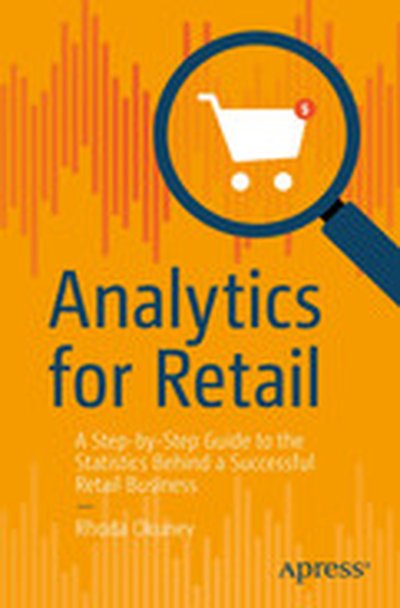
Examine select retail business scenarios to learn basic mathematics, as well as probability and statistics required to analyze big data. This book focuses on useful and imperative applied analytics needed to build a retail business and explains mathematical concepts essential for decision making and communication in retail business environments. Everyone is a buyer or seller of products these days whether through a physical department store, Amazon, or their own business website. This book is a step-by-step guide to understanding and managing the mechanics of markups, markdowns, and basic statistics, math and computers that will help in your retail business. You'll tackle what to do with data once it is has accumulated and see how to arrange the data using descriptive statistics, primarily means, median, and mode, and then how to read the corresponding charts and graphs. Analytics for Retail is your path to creating visualrepresentations that powerfully communicate information and drive decisions. What You'll Learn Review standard statistical concepts to enhance your understanding of retail data Understand the concepts of markups, markdowns and profit margins, and probability Conduct an A/B testing email campaign with all the relevant analytics calculated and explained Who This Book Is For This is a primer book for anyone in the field of retail that needs to learn or refresh their skills or for a reader who wants to move in their company to a more analytical position.
The past few years have seen significant developments in data science, AI, machine learning, and advanced analytics. But the wider adoption of these technologies has also brought greater cost, risk, regulation, and demands on organizational processes, tasks, and teams. This report explains how ModelOps can provide both technical and operational solutions to these problems. Thomas Hill, Mark Palmer, and Larry Derany summarize important considerations, caveats, choices, and best practices to help you be successful with operationalizing AI/ML and analytics in general. Whether your organization is already working with teams on AI and ML, or just getting started, this report presents ten important dimensions of analytic practice and ModelOps that are not widely discussed, or perhaps even known. In part, this report examines: Why ModelOps is the enterprise "operating system" for AI/ML algorithms How to build your organization's IP secret sauce through repeatable processing steps How to anticipate risks rather than react to damage done How ModelOps can help you deliver the many algorithms and model formats available How to plan for success and monitor for value, not just accuracy Why AI will be soon be regulated and how ModelOps helps ensure compliance
Discover the power of in-memory data analytics with "In-Memory Analytics with Apache Arrow." This book delves into Apache Arrow's unique capabilities, enabling you to handle vast amounts of data efficiently and effectively. Learn how Arrow improves performance, offers seamless integration, and simplifies data analysis in diverse computing environments. What this Book will help me do Gain proficiency with the datastore facilities and data types defined by Apache Arrow. Master the Arrow Flight APIs to efficiently transfer data between systems. Learn to leverage in-memory processing advantages offered by Arrow for state-of-the-art analytics. Understand how Arrow interoperates with popular tools like Pandas, Parquet, and Spark. Develop and deploy high-performance data analysis pipelines with Apache Arrow. Author(s) Matthew Topol, the author of the book, is an experienced practitioner in data analytics and Apache Arrow technology. Having contributed to the development and implementation of Arrow-powered systems, he brings a wealth of knowledge to readers. His ability to delve deep into technical concepts while keeping explanations practical makes this book an excellent guide for learners of the subject. Who is it for? This book is ideal for professionals in the data domain including developers, data analysts, and data scientists aiming to enhance their data manipulation capabilities. Beginners with some familiarity with data analysis concepts will find it beneficial, as well as engineers designing analytics utilities. Programming examples accommodate users of C, Go, and Python, making it broadly accessible.
This book is your ultimate companion to mastering Microsoft Power BI and becoming proficient in data analysis and visualization. With a focus on understanding and utilizing Power BI to its fullest extent, this guide also prepares you comprehensively for the PL-300 certification exam. You will go from the basics to advanced techniques enabling you to confidently analyze and present data. What this Book will help me do Understand and connect to various data sources using Power BI. Gain skills in transforming and preparing data for advanced analysis. Develop expertise in designing and optimizing data models. Learn to create insightful reports and dashboards to convey information clearly. Prepare for and succeed in the PL-300 certification exam with practice questions. Author(s) Authors None Edenfield and None Corcoran bring extensive experience in business intelligence and data analytics to this book. They have years of hands-on expertise with Power BI and a passion for teaching analytics in a practical and accessible way. Together, they aim to empower readers to master Power BI and achieve their certification goals. Who is it for? This book is perfect for data analysts, business intelligence professionals, and anyone aiming to deepen their knowledge of Microsoft Power BI. Beginners will find approachable content to quickly get started while experienced users will find detailed topics to refine their expertise. By covering exam preparation and practical applications, this guide benefits a wide range of learners who wish to get certified and excel in data-centric roles.