talk-data.com talk-data.com

Topic

PyTorch

deep_learning machine_learning neural_networks

80

tagged

Activity Trend

16 peak/qtr
2020-Q1 2026-Q1

Activities

80 activities · Newest first

Python Data Analytics: With Pandas, NumPy, and Matplotlib

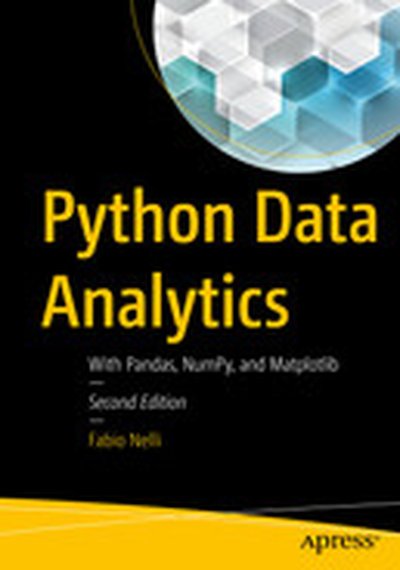
Explore the latest Python tools and techniques to help you tackle the world of data acquisition and analysis. You'll review scientific computing with NumPy, visualization with matplotlib, and machine learning with scikit-learn. This third edition is fully updated for the latest version of Python and its related libraries, and includes coverage of social media data analysis, image analysis with OpenCV, and deep learning libraries. Each chapter includes multiple examples demonstrating how to work with each library. At its heart lies the coverage of pandas, for high-performance, easy-to-use data structures and tools for data manipulation Author Fabio Nelli expertly demonstrates using Python for data processing, management, and information retrieval. Later chapters apply what you've learned to handwriting recognition and extending graphical capabilities with the JavaScript D3 library. Whether you are dealing with sales data, investment data, medical data, web page usage, or other data sets, Python Data Analytics, Third Edition is an invaluable reference with its examples of storing, accessing, and analyzing data. What You'll Learn Understand the core concepts of data analysis and the Python ecosystem Go in depth with pandas for reading, writing, and processing data Use tools and techniques for data visualization and image analysis Examine popular deep learning libraries Keras, Theano,TensorFlow, and PyTorch Who This Book Is For Experienced Python developers who need to learn about Pythonic tools for data analysis

Scaling Deep Learning Using Delta Lake Storage Format on Databricks

Delta Lake is an open-source storage format that can be ideally used for storing large-scale datasets, which can be used for single-node and distributed training of deep learning models. Delta Lake storage format gives deep learning practitioners unique data management capabilities for working with their datasets. The challenge is that, as of now, it’s not possible to use Delta Lake to train PyTorch models directly.

PyTorch community has recently introduced a Torchdata library for efficient data loading. This library supports many formats out of the box, but not Delta Lake. This talk will demonstrate using the Delta Lake storage format for single-node and distributed PyTorch training using the torchdata framework and standalone delta-rs Delta Lake implementation.

Talk by: Michael Shtelma

Connect with us: Website: https://databricks.com Twitter: https://twitter.com/databricks LinkedIn: https://www.linkedin.com/company/databricks Instagram: https://www.instagram.com/databricksinc Facebook: https://www.facebook.com/databricksinc

US Army Corp of Engineers Enhanced Commerce & National Sec Through Data-Driven Geospatial Insight

The US Army Corps of Engineers (USACE) is responsible for maintaining and improving nearly 12,000 miles of shallow-draft (9'-14') inland and intracoastal waterways, 13,000 miles of deep-draft (14' and greater) coastal channels, and 400 ports, harbors, and turning basins throughout the United States. Because these components of the national waterway network are considered assets to both US commerce and national security, they must be carefully managed to keep marine traffic operating safely and efficiently.

The National DQM Program is tasked with providing USACE a nationally standardized remote monitoring and documentation system across multiple vessel types with timely data access, reporting, dredge certifications, data quality control, and data management. Government systems have often lagged commercial systems in modernization efforts, and the emergence of the cloud and Data Lakehouse Architectures have empowered USACE to successfully move into the modern data era.

This session incorporates aspects of these topics: Data Lakehouse Architecture: Delta Lake, platform security and privacy, serverless, administration, data warehouse, Data Lake, Apache Iceberg, Data Mesh GIS: H3, MOSAIC, spatial analysis data engineering: data pipelines, orchestration, CDC, medallion architecture, Databricks Workflows, data munging, ETL/ELT, lakehouses, data lakes, Parquet, Data Mesh, Apache Spark™ internals. Data Streaming: Apache Spark Structured Streaming, real-time ingestion, real-time ETL, real-time ML, real-time analytics, and real-time applications, Delta Live Tables. ML: PyTorch, TensorFlow, Keras, scikit-learn, Python and R ecosystems data governance: security, compliance, RMF, NIST data sharing: sharing and collaboration, delta sharing, data cleanliness, APIs.

Talk by: Jeff Mroz

Connect with us: Website: https://databricks.com Twitter: https://twitter.com/databricks LinkedIn: https://www.linkedin.com/company/databricks Instagram: https://www.instagram.com/databricksinc Facebook: https://www.facebook.com/databricksinc

Scaling Python with Dask

Modern systems contain multi-core CPUs and GPUs that have the potential for parallel computing. But many scientific Python tools were not designed to leverage this parallelism. With this short but thorough resource, data scientists and Python programmers will learn how the Dask open source library for parallel computing provides APIs that make it easy to parallelize PyData libraries including NumPy, pandas, and scikit-learn. Authors Holden Karau and Mika Kimmins show you how to use Dask computations in local systems and then scale to the cloud for heavier workloads. This practical book explains why Dask is popular among industry experts and academics and is used by organizations that include Walmart, Capital One, Harvard Medical School, and NASA. With this book, you'll learn: What Dask is, where you can use it, and how it compares with other tools How to use Dask for batch data parallel processing Key distributed system concepts for working with Dask Methods for using Dask with higher-level APIs and building blocks How to work with integrated libraries such as scikit-learn, pandas, and PyTorch How to use Dask with GPUs

MLOps at Gucci: From Zero to Hero

Delta Lake is an open-source storage format that can be ideally used for storing large-scale datasets, which can be used for single-node and distributed training of deep learning models. Delta Lake storage format gives deep learning practitioners unique data management capabilities for working with their datasets. The challenge is that, as of now, it’s not possible to use Delta Lake to train PyTorch models directly.

PyTorch community has recently introduced a Torchdata library for efficient data loading. This library supports many formats out of the box, but not Delta Lake. This talk will demonstrate using the Delta Lake storage format for single-node and distributed PyTorch training using the torchdata framework and standalone delta-rs Delta Lake implementation.

Talk by: Michael Shtelma

Connect with us: Website: https://databricks.com Twitter: https://twitter.com/databricks LinkedIn: https://www.linkedin.com/company/databricks Instagram: https://www.instagram.com/databricksinc Facebook: https://www.facebook.com/databricksinc

By taking neural networks back to the school bench and teaching them some elements of geometry and topology we can build algorithms that can reason about the shape of data. Surprisingly these methods can be useful not only for computer vision – to model input data such as images or point clouds through global, robust properties – but in a wide range of applications, such as evaluating and improving the learning of embeddings, or the distribution of samples originating from generative models. This is the promise of the emerging field of Topological Data Analysis (TDA) which we will introduce and review recent works at its intersection with machine learning. TDA can be seen as being part of the increasingly popular movement of Geometric Deep Learning which encourages us to go beyond seeing data only as vectors in Euclidean spaces and instead consider machine learning algorithms that encode other geometric priors. In the past couple of years TDA has started to take a step out of the academic bubble, to a large extent thanks to powerful Python libraries written as extensions to scikit-learn or PyTorch.

Deepminds JAX ecosystem provides deep learning practitioners with an appealing alternative to TensorFlow and PyTorch. Among its strengths are great functionalities such as native TPU support, as well as easy vectorization and parallelization. Nevertheless, making your first steps in JAX can feel complicated given some of its idiosyncrasies. This talk helps new users getting started in this promising ecosystem by sharing practical tips and best practises.

Large generative models rely upon massive data sets that are collected automatically. For example, GPT-3 was trained with data from “Common Crawl” and “Web Text”, among other sources. As the saying goes — bigger isn’t always better. While powerful, these data sets (and the models that they create) often come at a cost, bringing their “internet-scale biases” along with their “internet-trained models.” While powerful, these models beg the question — is unsupervised learning the best future for machine learning?

ML researchers have developed new model-tuning techniques to address the known biases within existing models and improve their performance (as measured by response preference, truthfulness, toxicity, and result generalization). All of this at a fraction of the initial training cost. In this talk, we will explore these techniques, known as Reinforcement Learning from Human Feedback (RLHF), and how open-source machine learning tools like PyTorch and Label Studio can be used to tune off-the-shelf models using direct human feedback.

When building PyTorch models for custom applications from scratch there's usually one problem: The model does not learn anything. In a complex project, it can be tricky to identify the cause: Is it the data? A bug in the model? Choosing the wrong loss function at 3 am after an 8-hour coding session?

In this talk, we will build a toolbox to find the culprits in a structured manner. We will focus on simple ways to ensure a training loop is correct, generate synthetic training data to determine whether we have a model bug or problematic real-world data, and leverage pytest to safely refactor PyTorch models.

After this talk, visitors will be well equipped to take the right steps when a model is not learning, quickly identify the underlying reasons, and prevent bugs in the future.

Scaling Machine Learning with Spark

Learn how to build end-to-end scalable machine learning solutions with Apache Spark. With this practical guide, author Adi Polak introduces data and ML practitioners to creative solutions that supersede today's traditional methods. You'll learn a more holistic approach that takes you beyond specific requirements and organizational goals--allowing data and ML practitioners to collaborate and understand each other better. Scaling Machine Learning with Spark examines several technologies for building end-to-end distributed ML workflows based on the Apache Spark ecosystem with Spark MLlib, MLflow, TensorFlow, and PyTorch. If you're a data scientist who works with machine learning, this book shows you when and why to use each technology. You will: Explore machine learning, including distributed computing concepts and terminology Manage the ML lifecycle with MLflow Ingest data and perform basic preprocessing with Spark Explore feature engineering, and use Spark to extract features Train a model with MLlib and build a pipeline to reproduce it Build a data system to combine the power of Spark with deep learning Get a step-by-step example of working with distributed TensorFlow Use PyTorch to scale machine learning and its internal architecture

Nixtla: Deep Learning for Time Series Forecasting

Time series forecasting has a wide range of applications: finance, retail, healthcare, IoT, etc. Recently deep learning models such as ESRNN or N-BEATS have proven to have state-of-the-art performance in these tasks. Nixtlats is a python library that we have developed to facilitate the use of these state-of-the-art models to data scientists and developers, so that they can use them in productive environments. Written in pytorch, its design is focused on usability and reproducibility of experiments. For this purpose, nixtlats has several modules:

Data: contains datasets of various time series competencies. Models: includes state-of-the-art models. Evaluation: has various loss functions and evaluation metrics.

Objective:

  • To introduce attendees to the challenges of time series forecasting with deep learning.
  • Commercial applications of time series forecasting.
  • Describe nixtlats, their components and best practices for training and deploying state-of-the-art models in production.
  • Reproduction of state-of-the-art results using nixtlats from the winning model of the M4 time series competition (ESRNN).

Project repository: https://github.com/Nixtla/nixtlats.

Connect with us: Website: https://databricks.com Facebook: https://www.facebook.com/databricksinc Twitter: https://twitter.com/databricks LinkedIn: https://www.linkedin.com/company/data... Instagram: https://www.instagram.com/databricksinc/

Scaling Deep Learning on Databricks

Training modern Deep Learning models in a timely fashion requires leveraging GPUs to accelerate the process. Ensuring that this expensive hardware is properly utilised and scales efficiently is complex however. All the steps, from data storage and loading through to preprocessing and finally distributing the model training process requires careful thought.

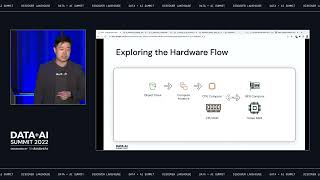
To reduce the cost of training a model, we need to ensure that we are making best use of our hardware resources. Typically, the GPUs that we rely on are memory constrained with much smaller amounts of VRAM being available relative to CPU RAM. As such we will need to leverage a variety of libraries to help ensure that we can keep our GPUs running.

Through the use of libraries like Petastorm to handle the data loading side, PyTorch Lightning and Horovod to handle the model distribution side we can accelerate can leverage commodity spark clusters to accelerate the training process for our Deep Learning Models.

Connect with us: Website: https://databricks.com Facebook: https://www.facebook.com/databricksinc Twitter: https://twitter.com/databricks LinkedIn: https://www.linkedin.com/company/data... Instagram: https://www.instagram.com/databricksinc/

Tackling Challenges of Distributed Deep Learning with Open Source Solutions

Deep learning has had an enormous impact in a variety of domains, however, with model and data size growing at a rapid pace, scaling out deep learning training has become essential for practical use.

In this talk, you will learn about the challenges and various solutions for distributed deep learning.

We will first cover some of the common patterns used to scale out deep learning training.

We will then describe some of the challenges with distributed deep learning in practice: Infrastructure and hardware management Spending too much time managing clusters, resources, and the scheduling/placement of jobs or processes. Developer iteration speed. Too much overhead to go from small-scale local ML development to large-scale training Hard to run distributed training jobs in a notebook/interactive environment. Difficulty integrating with open source software. Scale out training while still being able to leverage open source tools such as MLflow, Pytorch Lightning, and Huggingface Managing large-scale training data. Efficiently ingest large amounts of training data to my distributed machine learning model. Cloud compute costs. Leverage cheaper spot instances, without having to restart training in case of node pre-emption. Easily switch between cloud providers to reduce costs without rewriting all my code

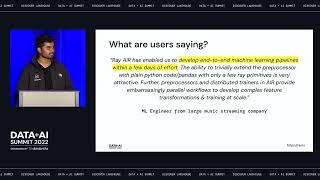
Then, we will share the merits of the ML open source ecosystem for distributed deep learning. In particular, we will introduce Ray Train, an open source library built on the Ray distributed execution framework, and show how it’s integrations with other open source libraries (PyTorch, Huggingface, MLflow, etc.) alleviate the pain points above.

We will conclude with a live demo showing large-scale distributed training using these open source tools.

Connect with us: Website: https://databricks.com Facebook: https://www.facebook.com/databricksinc Twitter: https://twitter.com/databricks LinkedIn: https://www.linkedin.com/company/data... Instagram: https://www.instagram.com/databricksinc/

Summary Machine learning has become a meaningful target for data applications, bringing with it an increase in the complexity of orchestrating the entire data flow. Flyte is a project that was started at Lyft to address their internal needs for machine learning and integrated closely with Kubernetes as the execution manager. In this episode Ketan Umare and Haytham Abuelfutuh share the story of the Flyte project and how their work at Union is focused on supporting and scaling the code and community that has made Flyte successful.

Announcements

Hello and welcome to the Data Engineering Podcast, the show about modern data management When you’re ready to build your next pipeline, or want to test out the projects you hear about on the show, you’ll need somewhere to deploy it, so check out our friends at Linode. With their managed Kubernetes platform it’s now even easier to deploy and scale your workflows, or try out the latest Helm charts from tools like Pulsar and Pachyderm. With simple pricing, fast networking, object storage, and worldwide data centers, you’ve got everything you need to run a bulletproof data platform. Go to dataengineeringpodcast.com/linode today and get a $100 credit to try out a Kubernetes cluster of your own. And don’t forget to thank them for their continued support of this show! This episode is brought to you by Acryl Data, the company behind DataHub, the leading developer-friendly data catalog for the modern data stack. Open Source DataHub is running in production at several companies like Peloton, Optum, Udemy, Zynga and others. Acryl Data provides DataHub as an easy to consume SaaS product which has been adopted by several companies. Signup for the SaaS product at dataengineeringpodcast.com/acryl RudderStack helps you build a customer data platform on your warehouse or data lake. Instead of trapping data in a black box, they enable you to easily collect customer data from the entire stack and build an identity graph on your warehouse, giving you full visibility and control. Their SDKs make event streaming from any app or website easy, and their state-of-the-art reverse ETL pipelines enable you to send enriched data to any cloud tool. Sign up free… or just get the free t-shirt for being a listener of the Data Engineering Podcast at dataengineeringpodcast.com/rudder. Data lake architectures provide the best combination of massive scalability and cost reduction, but they aren’t always the most performant option. That’s why Kyligence has built on top of the leading open source OLAP engine for data lakes, Apache Kylin. With their AI augmented engine they detect patterns from your critical queries, automatically build data marts with optimized table structures, and provide a unified SQL interface across your lake, cubes, and indexes. Their cost-based query router will give you interactive speeds across petabyte scale data sets for BI dashboards and ad-hoc data exploration. Stop struggling to speed up your data lake. Get started with Kyligence today at dataengineeringpodcast.com/kyligence Your host is Tobias Macey and today I’m interviewing Ketan Umare and Haytham Abuelfutuh about Flyte, the open source and kubernetes-native orchestration engine for your data systems

Interview

Introduction How did you get involved in the area of data management? Can you describe what Flyte is and the story behind it? What was missing in the ecosystem of available tools that made it necessary/worthwhile to create Flyte? Workflow orchestrators have been around for several years and have gone through a number of generational shifts. How would you characterize Flyte’s position in the ecosystem?

What do you see as the closest alternatives? What are the core differentiators that might lead someone to choose Flyte over e.g. Airflow/Prefect/Dagster?

What are the core primitives that Flyte exposes for building up complex workflows?

Machine learning use cases have been a core focus since the project’s inception. What are some of the ways that that manifests in the design and feature set?

Can you describe the architecture of Flyte?

How have the design and goals of the platform changed/evolved since you first started working on it?

What are the changes in the data ecosystem that have had the most substantial impact on the Flyte project? (e.g. roadmap, integrations, pushing people toward adoption, etc.) What is the process for setting up a Flyte deployment? What are the user personas that you prioritize in the design and feature development for Flyte? What is the workflow for someone building a new pipeline in Flyte?

What are the patterns that you and the community have established to encourage discovery and reuse of granular task definitions? Beyond code reuse, how can teams scale usage of Flyte at the company/organization level?

What are the affordances that you have created to facilitate local development and testing of workflows while ensuring a smooth transition to production?

What are the patterns that are available for CI/CD of workflows using Flyte?

How have you approached the design of data contracts/type definitions to provide a consistent/portable API for defining inter-task dependencies across languages? What are the available interfaces for extending Flyte and building integrations with other components across the data ecosystem? Data orchestration engines are a natural point for generating and taking advantage of rich metadata. How do you manage creation and propagation of metadata within and across the framework boundaries? Last year you founded Union to offer a managed version of Flyte. What are the features that you are offering beyond what is available in the open source?

What are the opportunities that you see for the Flyte ecosystem with a corporate entity to invest in expanding adoption?

What are the most interesting, innovative, or unexpected ways that you have seen Flyte used? What are the most interesting, unexpected, or challenging lessons that you have learned while working on Flyte? When is Flyte the wrong choice? What do you have planned for the future of Flyte?

Contact Info

Ketan Umare Haytham Abuelfutuh

Parting Question

From your perspective, what is the biggest gap in the tooling or technology for data management today?

Closing Announcements

Thank you for listening! Don’t forget to check out our other show, Podcast.init to learn about the Python language, its community, and the innovative ways it is being used. Visit the site to subscribe to the show, sign up for the mailing list, and read the show notes. If you’ve learned something or tried out a project from the show then tell us about it! Email [email protected]) with your story. To help other people find the show please leave a review on iTunes and tell your friends and co-workers

Links

Flyte

Slack Channel

Union.ai Kubeflow Airflow AWS Step Functions Protocol Buffers XGBoost MLFlow Dagster

Podcast Episode

Prefect

Podcast Episode

Arrow Parquet Metaflow Pytorch

Podcast.init Episode

dbt FastAPI

Podcast.init Interview

Python Type Annotations Modin

Podcast.init Interview

Monad Datahub

Podcast Episode

OpenMetadata

Podcast Episode

Hudi

Podcast Episode

Iceberg

Podcast Episode

Great Expectations

Podcast Episode

Pandera Union ML Weights and Biases Whylogs

Podcast Episode

The intro and outro music is from The Hug by The Freak Fandango Orchestra / CC BY-SA

Sponsored By: a…

Machine Learning with PyTorch and Scikit-Learn

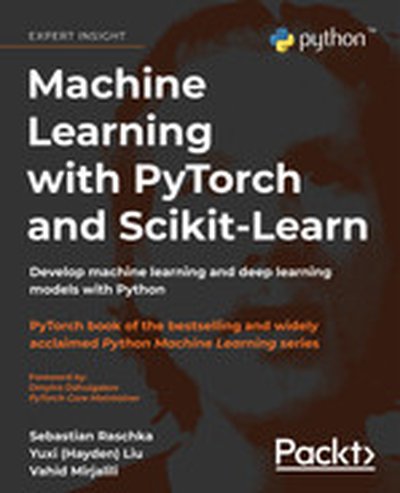
Machine Learning with PyTorch and Scikit-Learn is a comprehensive resource for developers looking to dive deep into the world of machine learning. It introduces foundational concepts alongside practical implementations using Python and leading libraries such as PyTorch and Scikit-Learn. With well-explained techniques and real-world examples, you'll gain the knowledge needed to design, build, and optimize machine learning systems. What this Book will help me do Understand and apply core concepts in machine learning using Scikit-Learn. Develop and deploy deep learning models using PyTorch efficiently. Configure and optimize neural networks, transformers, and GANs for various applications. Handle and preprocess data effectively for building robust models. Follow best practices for model evaluation, tuning, and deployment. Author(s) Sebastian Raschka, Yuxi (Hayden) Liu, and Vahid Mirjalili are experienced professionals in the field of machine learning with extensive teaching and writing backgrounds. They bring their expertise in Python and machine learning frameworks like PyTorch to provide both theoretical and practical insights helpful for learners. Their combined knowledge ensures a thorough and engaging learning experience suited for aspiring data scientists. Who is it for? This book is tailored for Python developers and data scientists eager to master machine learning and deep learning techniques. If you're familiar with Python programming and possess fundamental knowledge of calculus and linear algebra, you will find this book incredibly insightful. Whether you're entering the field or seeking to enhance your expertise, this resource caters to your professional growth in building advanced machine learning systems.

Summary The scale and complexity of the systems that we build to satisfy business requirements is increasing as the available tools become more sophisticated. In order to bridge the gap between legacy infrastructure and evolving use cases it is necessary to create a unifying set of components. In this episode Dipti Borkar explains how the emerging category of data orchestration tools fills this need, some of the existing projects that fit in this space, and some of the ways that they can work together to simplify projects such as cloud migration and hybrid cloud environments. It is always useful to get a broad view of new trends in the industry and this was a helpful perspective on the need to provide mechanisms to decouple physical storage from computing capacity.

Announcements

Hello and welcome to the Data Engineering Podcast, the show about modern data management When you’re ready to build your next pipeline, or want to test out the projects you hear about on the show, you’ll need somewhere to deploy it, so check out our friends at Linode. With 200Gbit private networking, scalable shared block storage, and a 40Gbit public network, you’ve got everything you need to run a fast, reliable, and bullet-proof data platform. If you need global distribution, they’ve got that covered too with world-wide datacenters including new ones in Toronto and Mumbai. And for your machine learning workloads, they just announced dedicated CPU instances. Go to dataengineeringpodcast.com/linode today to get a $20 credit and launch a new server in under a minute. And don’t forget to thank them for their continued support of this show! This week’s episode is also sponsored by Datacoral, an AWS-native, serverless, data infrastructure that installs in your VPC. Datacoral helps data engineers build and manage the flow of data pipelines without having to manage any infrastructure, meaning you can spend your time invested in data transformations and business needs, rather than pipeline maintenance. Raghu Murthy, founder and CEO of Datacoral built data infrastructures at Yahoo! and Facebook, scaling from terabytes to petabytes of analytic data. He started Datacoral with the goal to make SQL the universal data programming language. Visit dataengineeringpodcast.com/datacoral today to find out more. You listen to this show to learn and stay up to date with what’s happening in databases, streaming platforms, big data, and everything else you need to know about modern data management. For even more opportunities to meet, listen, and learn from your peers you don’t want to miss out on this year’s conference season. We have partnered with organizations such as O’Reilly Media, Dataversity, Corinium Global Intelligence, Alluxio, and Data Council. Upcoming events include the combined events of the Data Architecture Summit and Graphorum, the Data Orchestration Summit, and Data Council in NYC. Go to dataengineeringpodcast.com/conferences to learn more about these and other events, and take advantage of our partner discounts to save money when you register today. Your host is Tobias Macey and today I’m interviewing Dipti Borkark about data orchestration and how it helps in migrating data workloads to the cloud

Interview

Introduction How did you get involved in the area of data management? Can you start by describing what you mean by the term "Data Orchestration"?

How does it compare to the concept of "Data Virtualization"? What are some of the tools and platforms that fit under that umbrella?

What are some of the motivations for organizations to use the cloud for their data oriented workloads?

What are they giving up by using cloud resources in place of on-premises compute?

For businesses that have invested heavily in their own datacenters, what are some ways that they can begin to replicate some of the benefits of cloud environments? What are some of the common patterns for cloud migration projects and what challenges do they present?

Do you have advice on useful metrics to track for determining project completion or success criteria?

How do businesses approach employee education for designing and implementing effective systems for achieving their migration goals? Can you talk through some of the ways that different data orchestration tools can be composed together for a cloud migration effort?

What are some of the common pain points that organizations encounter when working on hybrid implementations?

What are some of the missing pieces in the data orchestration landscape?

Are there any efforts that you are aware of that are aiming to fill those gaps?

Where is the data orchestration market heading, and what are some industry trends that are driving it?

What projects are you most interested in or excited by?

For someone who wants to learn more about data orchestration and the benefits the technologies can provide, what are some resources that you would recommend?

Contact Info

LinkedIn @dborkar on Twitter

Parting Question

From your perspective, what is the biggest gap in the tooling or technology for data management today?

Closing Announcements

Thank you for listening! Don’t forget to check out our other show, Podcast.init to learn about the Python language, its community, and the innovative ways it is being used. Visit the site to subscribe to the show, sign up for the mailing list, and read the show notes. If you’ve learned something or tried out a project from the show then tell us about it! Email [email protected]) with your story. To help other people find the show please leave a review on iTunes and tell your friends and co-workers Join the community in the new Zulip chat workspace at dataengineeringpodcast.com/chat

Links

Alluxio

Podcast Episode

UC San Diego Couchbase Presto

Podcast Episode

Spark SQL Data Orchestration Data Virtualization PyTorch

Podcast.init Episode

Rook storage orchestration PySpark MinIO

Podcast Episode

Kubernetes Openstack Hadoop HDFS Parquet Files

Podcast Episode

ORC Files Hive Metastore Iceberg Table Format

Podcast Episode

Data Orchestration Summit Star Schema Snowflake Schema Data Warehouse Data Lake Teradata

The intro and outro music is from The Hug by The Freak Fandango Orchestra / CC BY-SA

Support Data Engineering Podcast

Summary Machine learning is a class of technologies that promise to revolutionize business. Unfortunately, it can be difficult to identify and execute on ways that it can be used in large companies. Kevin Dewalt founded Prolego to help Fortune 500 companies build, launch, and maintain their first machine learning projects so that they can remain competitive in our landscape of constant change. In this episode he discusses why machine learning projects require a new set of capabilities, how to build a team from internal and external candidates, and how an example project progressed through each phase of maturity. This was a great conversation for anyone who wants to understand the benefits and tradeoffs of machine learning for their own projects and how to put it into practice.

Introduction

Hello and welcome to the Data Engineering Podcast, the show about modern data management When you’re ready to build your next pipeline, or want to test out the projects you hear about on the show, you’ll need somewhere to deploy it, so check out Linode. With 200Gbit private networking, scalable shared block storage, and a 40Gbit public network, you’ve got everything you need to run a fast, reliable, and bullet-proof data platform. If you need global distribution, they’ve got that covered too with world-wide datacenters including new ones in Toronto and Mumbai. Go to dataengineeringpodcast.com/linode today to get a $20 credit and launch a new server in under a minute. Go to dataengineeringpodcast.com to subscribe to the show, sign up for the mailing list, read the show notes, and get in touch. To help other people find the show please leave a review on iTunes, or Google Play Music, tell your friends and co-workers, and share it on social media. Join the community in the new Zulip chat workspace at dataengineeringpodcast.com/chat Your host is Tobias Macey and today I’m interviewing Kevin Dewalt about his experiences at Prolego, building machine learning projects for Fortune 500 companies

Interview

Introduction How did you get involved in the area of data management? For the benefit of software engineers and team leaders who are new to machine learning, can you briefly describe what machine learning is and why is it relevant to them? What is your primary mission at Prolego and how did you identify, execute on, and establish a presence in your particular market?

How much of your sales process is spent on educating your clients about what AI or ML are and the benefits that these technologies can provide?

What have you found to be the technical skills and capacity necessary for being successful in building and deploying a machine learning project?

When engaging with a client, what have you found to be the most common areas of technical capacity or knowledge that are needed?

Everyone talks about a talent shortage in machine learning. Can you suggest a recruiting or skills development process for companies which need to build out their data engineering practice? What challenges will teams typically encounter when creating an efficient working relationship between data scientists and data engineers? Can you briefly describe a successful project of developing a first ML model and putting it into production?

What is the breakdown of how much time was spent on different activities such as data wrangling, model development, and data engineering pipeline development? When releasing to production, can you share the types of metrics that you track to ensure the health and proper functioning of the models? What does a deployable artifact for a machine learning/deep learning application look like?

What basic technology stack is necessary for putting the first ML models into production?

How does the build vs. buy debate break down in this space and what products do you typically recommend to your clients?

What are the major risks associated with deploying ML models and how can a team mitigate them? Suppose a software engineer wants to break into ML. What data engineering skills would you suggest they learn? How should they position themselves for the right opportunity?

Contact Info

Email: Kevin Dewalt [email protected] and Russ Rands [email protected] Connect on LinkedIn: Kevin Dewalt and Russ Rands Twitter: @kevindewalt

Parting Question

From your perspective, what is the biggest gap in the tooling or technology for data management today?

Links

Prolego Download our book: Become an AI Company in 90 Days Google Rules Of ML AI Winter Machine Learning Supervised Learning O’Reilly Strata Conference GE Rebranding Commercials Jez Humble: Stop Hiring Devops Experts (And Start Growing Them) SQL ORM Django RoR Tensorflow PyTorch Keras Data Engineering Podcast Episode About Data Teams DevOps For Data Teams – DevOps Days Boston Presentation by Tobias Jupyter Notebook Data Engineering Podcast: Notebooks at Netflix Pandas

Podcast Interview

Joel Grus

JupyterCon Presentation Data Science From Scratch

Expensify Airflow

James Meickle Interview

Git Jenkins Continuous Integration Practical Deep Learning For Coders Course by Jeremy Howard Data Carpentry

The intro and outro music is from The Hug by The Freak Fandango Orchestra / CC BY-SA

Support Data Engineering Podcast
Python Data Analytics: With Pandas, NumPy, and Matplotlib

Explore the latest Python tools and techniques to help you tackle the world of data acquisition and analysis. You'll review scientific computing with NumPy, visualization with matplotlib, and machine learning with scikit-learn. This revision is fully updated with new content on social media data analysis, image analysis with OpenCV, and deep learning libraries. Each chapter includes multiple examples demonstrating how to work with each library. At its heart lies the coverage of pandas, for high-performance, easy-to-use data structures and tools for data manipulation Author Fabio Nelli expertly demonstrates using Python for data processing, management, and information retrieval. Later chapters apply what you've learned to handwriting recognition and extending graphical capabilities with the JavaScript D3 library. Whether you are dealing with sales data, investment data, medical data, web page usage, or other data sets, Python Data Analytics, Second Edition is an invaluable reference with its examples of storing, accessing, and analyzing data. What You'll Learn Understand the core concepts of data analysis and the Python ecosystem Go in depth with pandas for reading, writing, and processing data Use tools and techniques for data visualization and image analysis Examine popular deep learning libraries Keras, Theano,TensorFlow, and PyTorch Who This Book Is For Experienced Python developers who need to learn about Pythonic tools for data analysis

Summary

The majority of the conversation around machine learning and big data pertains to well-structured and cleaned data sets. Unfortunately, that is just a small percentage of the information that is available, so the rest of the sources of knowledge in a company are housed in so-called “Dark Data” sets. In this episode Alex Ratner explains how the work that he and his fellow researchers are doing on Snorkel can be used to extract value by leveraging labeling functions written by domain experts to generate training sets for machine learning models. He also explains how this approach can be used to democratize machine learning by making it feasible for organizations with smaller data sets than those required by most tooling.

Preamble

Hello and welcome to the Data Engineering Podcast, the show about modern data infrastructure When you’re ready to launch your next project you’ll need somewhere to deploy it. Check out Linode at dataengineeringpodcast.com/linode and get a $20 credit to try out their fast and reliable Linux virtual servers for running your data pipelines or trying out the tools you hear about on the show. Go to dataengineeringpodcast.com to subscribe to the show, sign up for the newsletter, read the show notes, and get in touch. You can help support the show by checking out the Patreon page which is linked from the site. To help other people find the show you can leave a review on iTunes, or Google Play Music, and tell your friends and co-workers Your host is Tobias Macey and today I’m interviewing Alex Ratner about Snorkel and Dark Data

Interview

Introduction How did you get involved in the area of data management? Can you start by sharing your definition of dark data and how Snorkel helps to extract value from it? What are some of the most challenging aspects of building labelling functions and what tools or techniques are available to verify their validity and effectiveness in producing accurate outcomes? Can you provide some examples of how Snorkel can be used to build useful models in production contexts for companies or problem domains where data collection is difficult to do at large scale? For someone who wants to use Snorkel, what are the steps involved in processing the source data and what tooling or systems are necessary to analyse the outputs for generating usable insights? How is Snorkel architected and how has the design evolved over its lifetime? What are some situations where Snorkel would be poorly suited for use? What are some of the most interesting applications of Snorkel that you are aware of? What are some of the other projects that you and your group are working on that interact with Snorkel? What are some of the features or improvements that you have planned for future releases of Snorkel?

Contact Info

Website ajratner on Github @ajratner on Twitter

Parting Question

From your perspective, what is the biggest gap in the tooling or technology for data management today?

Links

Stanford DAWN HazyResearch Snorkel Christopher Ré Dark Data DARPA Memex Training Data FDA ImageNet National Library of Medicine Empirical Studies of Conflict Data Augmentation PyTorch Tensorflow Generative Model Discriminative Model Weak Supervision

The intro and outro music is from The Hug by The Freak Fandango Orchestra / CC BY-SA Support Data Engineering Podcast
In this session learn about performance optimizations for PyTorch on Google Cloud accelerators using OpenXLA. These models are powerful but can be disrupted by resource failures. This talk also explores strategies for achieving greater resiliency when running PyTorch on GPUs, focusing on fault tolerance, checkpointing, and distributed training. Learn how to leverage open source tools to minimize downtime and ensure your deep learning workloads run smoothly.