talk-data.com talk-data.com

Topic

Scala

programming_language functional_programming jvm

110

tagged

Activity Trend

12 peak/qtr
2020-Q1 2026-Q1

Activities

110 activities · Newest first

We talked about:

Summary of “Getting a Data Engineering Job” webinar Python and engineering skills  Interview process Behavioral interviews Technical interviews Learning Python and SQL from scratch Is having non-coding experience a disadvantage? Analyst or engineer? Do you need certificates? Do I need a master’s degree? Fully remote data engineering jobs Should I include teaching on my resume? Object-oriented programming for data engineering Python vs Java/Scala SQL and Python technical interview questions GCP certificates Is commercial experience really necessary? From sales to engineering Solution engineers Wrapping up

Links:

Getting a Data Engineering Job (webinar): https://www.youtube.com/watch?v=yvEWG-S1F_M The Flask Mega-Tutorial Part I - Hello, World! blog: https://blog.miguelgrinberg.com/post/the-flask-mega-tutorial-part-i-hello-world Mode SQL Tutorial: https://mode.com/sql-tutorial/

MLOps Zoomcamp: https://github.com/DataTalksClub/mlops-zoomcamp

Join DataTalks.Club: https://datatalks.club/slack.html

Our events: https://datatalks.club/events.html

Summary The best way to make sure that you don’t leak sensitive data is to never have it in the first place. The team at Skyflow decided that the second best way is to build a storage system dedicated to securely managing your sensitive information and making it easy to integrate with your applications and data systems. In this episode Sean Falconer explains the idea of a data privacy vault and how this new architectural element can drastically reduce the potential for making a mistake with how you manage regulated or personally identifiable information.

Announcements

Hello and welcome to the Data Engineering Podcast, the show about modern data management When you’re ready to build your next pipeline, or want to test out the projects you hear about on the show, you’ll need somewhere to deploy it, so check out our friends at Linode. With their new managed database service you can launch a production ready MySQL, Postgres, or MongoDB cluster in minutes, with automated backups, 40 Gbps connections from your application hosts, and high throughput SSDs. Go to dataengineeringpodcast.com/linode today and get a $100 credit to launch a database, create a Kubernetes cluster, or take advantage of all of their other services. And don’t forget to thank them for their continued support of this show! Atlan is the metadata hub for your data ecosystem. Instead of locking all of that information into a new silo, unleash its transformative potential with Atlan’s active metadata capabilities. Push information about data freshness and quality to your business intelligence, automatically scale up and down your warehouse based on usage patterns, and let the bots answer those questions in Slack so that the humans can focus on delivering real value. Go to dataengineeringpodcast.com/atlan today to learn more about how you can take advantage of active metadata and escape the chaos. Modern data teams are dealing with a lot of complexity in their data pipelines and analytical code. Monitoring data quality, tracing incidents, and testing changes can be daunting and often takes hours to days or even weeks. By the time errors have made their way into production, it’s often too late and damage is done. Datafold built automated regression testing to help data and analytics engineers deal with data quality in their pull requests. Datafold shows how a change in SQL code affects your data, both on a statistical level and down to individual rows and values before it gets merged to production. No more shipping and praying, you can now know exactly what will change in your database! Datafold integrates with all major data warehouses as well as frameworks such as Airflow & dbt and seamlessly plugs into CI workflows. Visit dataengineeringpodcast.com/datafold today to book a demo with Datafold. Data teams are increasingly under pressure to deliver. According to a recent survey by Ascend.io, 95% in fact reported being at or over capacity. With 72% of data experts reporting demands on their team going up faster than they can hire, it’s no surprise they are increasingly turning to automation. In fact, while only 3.5% report having current investments in automation, 85% of data teams plan on investing in automation in the next 12 months. 85%!!! That’s where our friends at Ascend.io come in. The Ascend Data Automation Cloud provides a unified platform for data ingestion, transformation, orchestration, and observability. Ascend users love its declarative pipelines, powerful SDK, elegant UI, and extensible plug-in architecture, as well as its support for Python, SQL, Scala, and Java. Ascend automates workloads on Snowflake, Databricks, BigQuery, and open source Spark, and can be deployed in AWS, Azure, or GCP. Go to dataengineeringpodcast.com/ascend and sign up for a free trial. If you’re a data engineering podcast listener, you get credits worth $5,000 when you become a customer. Your host is Tobias Macey and today I’m interviewing Sean Falconer about the idea of a data privacy vault and how the Skyflow team are working to make it turn-key

Interview

Introduction How did you get involved in the area of data management? Can you describe what Skyflow is and the story behind it? What is a "data privacy vault" and how does it differ from strategies such as privacy engineering or existing data governance patterns? What are the primary use cases and capabilities that you are focused on solving for with Skyflow?

Who is the target customer for Skyflow (e.g. how does it enter an organization)?

How is the Skyflow platform architected?

How have the design and goals of the system changed or evolved over time?

Can you describe the process of integrating with Skyflow at the application level? For organizations that are building analytical capabilities on top of the data managed in their applications, what are the interactions with Skyflow at each of the stages in the data lifecycle? One of the perennial problems with distributed systems is the challenge of joining data across machine boundaries. How do you mitigate that problem? On your website there are different "vaults" advertised in the form of healthcare, fintech, and PII. What are the different requirements across each of those problem domains?

What are the commonalities?

As a relatively new company in an emerging product category, what are some of the customer education challenges that you are facing? What are the most interesting, innovative, or unexpected ways that you have seen Skyflow used? What are the most interesting, unexpected, or challenging lessons that you have learned while working on Skyflow? When is Skyflow the wrong choice? What do you have planned for the future of Skyflow?

Contact Info

LinkedIn @seanfalconer on Twitter Website

Parting Question

From your perspective, what is the biggest gap in the tooling or technology for data management today?

Closing Announcements

Thank you for listening! Don’t forget to check out our other show, Podcast.init to learn about the Python language, its community, and the innovative ways it is being used. Visit the site to subscribe to the show, sign up for the mailing list, and read the show notes. If you’ve learned something or tried out a project from the show then tell us about it! Email [email protected]) with your story. To help other people find the show please leave a review on iTunes and tell your friends and co-workers

Links

Skyflow Privacy Engineering Data Governance Homomorphic Encryption Polymorphic Encryption

The intro and outro music is from The Hug by The Freak Fandango Orchestra / CC BY-SA

Support Data Engineering Podcast

Summary A large fraction of data engineering work involves moving data from one storage location to another in order to support different access and query patterns. Singlestore aims to cut down on the number of database engines that you need to run so that you can reduce the amount of copying that is required. By supporting fast, in-memory row-based queries and columnar on-disk representation, it lets your transactional and analytical workloads run in the same database. In this episode SVP of engineering Shireesh Thota describes the impact on your overall system architecture that Singlestore can have and the benefits of using a cloud-native database engine for your next application.

Announcements

Hello and welcome to the Data Engineering Podcast, the show about modern data management When you’re ready to build your next pipeline, or want to test out the projects you hear about on the show, you’ll need somewhere to deploy it, so check out our friends at Linode. With their managed Kubernetes platform it’s now even easier to deploy and scale your workflows, or try out the latest Helm charts from tools like Pulsar and Pachyderm. With simple pricing, fast networking, object storage, and worldwide data centers, you’ve got everything you need to run a bulletproof data platform. Go to dataengineeringpodcast.com/linode today and get a $100 credit to try out a Kubernetes cluster of your own. And don’t forget to thank them for their continued support of this show! Atlan is a collaborative workspace for data-driven teams, like Github for engineering or Figma for design teams. By acting as a virtual hub for data assets ranging from tables and dashboards to SQL snippets & code, Atlan enables teams to create a single source of truth for all their data assets, and collaborate across the modern data stack through deep integrations with tools like Snowflake, Slack, Looker and more. Go to dataengineeringpodcast.com/atlan today and sign up for a free trial. If you’re a data engineering podcast listener, you get credits worth $3000 on an annual subscription So now your modern data stack is set up. How is everyone going to find the data they need, and understand it? Select Star is a data discovery platform that automatically analyzes & documents your data. For every table in Select Star, you can find out where the data originated, which dashboards are built on top of it, who’s using it in the company, and how they’re using it, all the way down to the SQL queries. Best of all, it’s simple to set up, and easy for both engineering and operations teams to use. With Select Star’s data catalog, a single source of truth for your data is built in minutes, even across thousands of datasets. Try it out for free and double the length of your free trial today at dataengineeringpodcast.com/selectstar. You’ll also get a swag package when you continue on a paid plan. Data teams are increasingly under pressure to deliver. According to a recent survey by Ascend.io, 95% in fact reported being at or over capacity. With 72% of data experts reporting demands on their team going up faster than they can hire, it’s no surprise they are increasingly turning to automation. In fact, while only 3.5% report having current investments in automation, 85% of data teams plan on investing in automation in the next 12 months. 85%!!! That’s where our friends at Ascend.io come in. The Ascend Data Automation Cloud provides a unified platform for data ingestion, transformation, orchestration, and observability. Ascend users love its declarative pipelines, powerful SDK, elegant UI, and extensible plug-in architecture, as well as its support for Python, SQL, Scala, and Java. Ascend automates workloads on Snowflake, Databricks, BigQuery, and open source Spark, and can be deployed in AWS, Azure, or GCP. Go to dataengineeringpodcast.com/ascend and sign up for a free trial. If you’re a data engineering podcast listener, you get credits worth $5,000 when you becom

Elasticsearch 8.x Cookbook - Fifth Edition

"Elasticsearch 8.x Cookbook" is your go-to resource for harnessing the full potential of Elasticsearch 8. This book provides over 180 hands-on recipes to help you efficiently implement, customize, and scale Elasticsearch solutions in your enterprise. Whether you're handling complex queries, analytics, or cluster management, you'll find practical insights to enhance your capabilities. What this Book will help me do Understand the advanced features of Elasticsearch 8.x, including X-Pack, for improving functionality and security. Master advanced indexing and query techniques to perform efficient and scalable data operations. Implement and manage Elasticsearch clusters effectively including monitoring performance via Kibana. Integrate Elasticsearch seamlessly into Java, Scala, Python, and big data environments. Develop custom plugins and extend Elasticsearch to meet unique project requirements. Author(s) Alberto Paro is a seasoned Elasticsearch expert with years of experience in search technologies and enterprise solution development. As a professional developer and consultant, he has worked with numerous organizations to implement Elasticsearch at scale. Alberto brings his deep technical knowledge and hands-on approach to this book, ensuring readers gain practical insights and skills. Who is it for? This book is perfect for software engineers, data professionals, and developers working with Elasticsearch in enterprise environments. If you're seeking to advance your Elasticsearch knowledge, enhance your query-writing abilities, or seek to integrate it into big data workflows, this book will be invaluable. Regardless of whether you're deploying Elasticsearch in e-commerce, applications, or for analytics, you'll find the content purposeful and engaging.

Summary The interfaces and design cues that a tool offers can have a massive impact on who is able to use it and the tasks that they are able to perform. With an eye to making data workflows more accessible to everyone in an organization Raj Bains and his team at Prophecy designed a powerful and extensible low-code platform that lets technical and non-technical users scale data flows without forcing everyone into the same layers of abstraction. In this episode he explores the tension between code-first and no-code utilities and how he is working to balance the strengths without falling prey to their shortcomings.

Announcements

Hello and welcome to the Data Engineering Podcast, the show about modern data management When you’re ready to build your next pipeline, or want to test out the projects you hear about on the show, you’ll need somewhere to deploy it, so check out our friends at Linode. With their managed Kubernetes platform it’s now even easier to deploy and scale your workflows, or try out the latest Helm charts from tools like Pulsar and Pachyderm. With simple pricing, fast networking, object storage, and worldwide data centers, you’ve got everything you need to run a bulletproof data platform. Go to dataengineeringpodcast.com/linode today and get a $100 credit to try out a Kubernetes cluster of your own. And don’t forget to thank them for their continued support of this show! Atlan is a collaborative workspace for data-driven teams, like Github for engineering or Figma for design teams. By acting as a virtual hub for data assets ranging from tables and dashboards to SQL snippets & code, Atlan enables teams to create a single source of truth for all their data assets, and collaborate across the modern data stack through deep integrations with tools like Snowflake, Slack, Looker and more. Go to dataengineeringpodcast.com/atlan today and sign up for a free trial. If you’re a data engineering podcast listener, you get credits worth $3000 on an annual subscription So now your modern data stack is set up. How is everyone going to find the data they need, and understand it? Select Star is a data discovery platform that automatically analyzes & documents your data. For every table in Select Star, you can find out where the data originated, which dashboards are built on top of it, who’s using it in the company, and how they’re using it, all the way down to the SQL queries. Best of all, it’s simple to set up, and easy for both engineering and operations teams to use. With Select Star’s data catalog, a single source of truth for your data is built in minutes, even across thousands of datasets. Try it out for free and double the length of your free trial today at dataengineeringpodcast.com/selectstar. You’ll also get a swag package when you continue on a paid plan. Your host is Tobias Macey and today I’m interviewing Raj Bains about how improving the user experience for data tools can make your work as a data engineer better and easier

Interview

Introduction How did you get involved in the area of data management? What are the broad categories of data tool designs that are available currently and how does that impact what is possible with them?

What are the points of friction that are introduced by the tools? Can you share some of the types of workarounds or wasted effort that are made necessary by those design elements?

What are the core design principles that you have built into Prophecy to address these shortcomings?

How do those user experience changes improve the quality and speed of work for data engineers?

How has the Prophecy platform changed since we last spoke almost a year ago? What are the tradeoffs of low code systems for productivity vs. flexibility and creativity? What are the most interesting, innovative, or unexpected approaches to developer experience that you have seen for data tools? What are the most interesting, unexpected, or challenging lessons that you have learned while working on user experience optimization for data tooling at Prophecy? When is it more important to optimize for computational efficiency over developer productivity? What do you have planned for the future of Prophecy?

Contact Info

LinkedIn @_raj_bains on Twitter

Parting Question

From your perspective, what is the biggest gap in the tooling or technology for data management today?

Closing Announcements

Thank you for listening! Don’t forget to check out our other show, Podcast.init to learn about the Python language, its community, and the innovative ways it is being used. Visit the site to subscribe to the show, sign up for the mailing list, and read the show notes. If you’ve learned something or tried out a project from the show then tell us about it! Email [email protected]) with your story. To help other people find the show please leave a review on iTunes and tell your friends and co-workers

Links

Prophecy

Podcast Episode

CUDA Clustrix Hortonworks Apache Hive Compilerworks

Podcast Episode

Airflow Databricks Fivetran

Podcast Episode

Airbyte

Podcast Episode

Streamsets Change Data Capture Apache Pig Spark Scala Ab Initio Type 2 Slowly Changing Dimensions AWS Deequ Matillion

Podcast Episode

Prophecy SaaS

The intro and outro music is from The Hug by The Freak Fandango Orchestra / CC BY-SA

Support Data Engineering Podcast
In this episode, Bryce takes the programming language quiz! Twitter ADSP: The PodcastConor HoekstraBryce Adelstein LelbachShow Notes Date Recorded: 2022-03-19 Date Released: 2022-03-25 Guadalupe TrailBublyOOKLAEPOXYTony Van Eerd’s TweetmemtestProgramming Language Dependency GraphPython’s graphvizDOTThe Programming Language PodcastDavid Koontz on TwitterSmalltalkPharo-FunctionalErik Meijer on TwitterC# 3.0 LINQC++17 std::optionalC++23 std::expectedRust OptionRust ErrorOCamlJared Roesch on TwitterHaskell + C++ = Rust TweetSimula67AdaStepanovPapers.comSwiftObjective-CErlangElixirClojureScalaDavid TurnerKRCSASLMirandaAWKJavaScriptSelfIoSeven Languages in Seven Weeks: Ch 5 - Scala MeetupIntro Song Info Miss You by Sarah Jansen https://soundcloud.com/sarahjansenmusic Creative Commons — Attribution 3.0 Unported — CC BY 3.0 Free Download / Stream: http://bit.ly/l-miss-you Music promoted by Audio Library https://youtu.be/iYYxnasvfx8

Simplify Big Data Analytics with Amazon EMR

Simplify Big Data Analytics with Amazon EMR is a thorough guide to harnessing Amazon's EMR service for big data processing and analytics. From distributed computation pipelines to real-time streaming analytics, this book provides hands-on knowledge and actionable steps for implementing data solutions efficiently. What this Book will help me do Understand the architecture and key components of Amazon EMR and how to deploy it effectively. Learn to configure and manage distributed data processing pipelines using Amazon EMR. Implement security and data governance best practices within the Amazon EMR ecosystem. Master batch ETL and real-time analytics techniques using technologies like Apache Spark. Apply optimization and cost-saving strategies to scalable data solutions. Author(s) Sakti Mishra is a seasoned data professional with extensive expertise in deploying scalable analytics solutions on cloud platforms like AWS. With a background in big data technologies and a passion for teaching, Sakti ensures practical insights accompany every concept. Readers will find his approach thorough, hands-on, and highly informative. Who is it for? This book is perfect for data engineers, data scientists, and other professionals looking to leverage Amazon EMR for scalable analytics. If you are familiar with Python, Scala, or Java and have some exposure to Hadoop or AWS ecosystems, this book will empower you to design and implement robust data pipelines efficiently.

Introducing .NET for Apache Spark: Distributed Processing for Massive Datasets

Get started using Apache Spark via C# or F# and the .NET for Apache Spark bindings. This book is an introduction to both Apache Spark and the .NET bindings. Readers new to Apache Spark will get up to speed quickly using Spark for data processing tasks performed against large and very large datasets. You will learn how to combine your knowledge of .NET with Apache Spark to bring massive computing power to bear by distributed processing of extremely large datasets across multiple servers. This book covers how to get a local instance of Apache Spark running on your developer machine and shows you how to create your first .NET program that uses the Microsoft .NET bindings for Apache Spark. Techniques shown in the book allow you to use Apache Spark to distribute your data processing tasks over multiple compute nodes. You will learn to process data using both batch mode and streaming mode so you can make the right choice depending on whether you are processing an existing dataset or are working against new records in micro-batches as they arrive. The goal of the book is leave you comfortable in bringing the power of Apache Spark to your favorite .NET language. What You Will Learn Install and configure Spark .NET on Windows, Linux, and macOS Write Apache Spark programs in C# and F# using the .NET bindings Access and invoke the Apache Spark APIs from .NET with the same high performance as Python, Scala, and R Encapsulate functionality in user-defined functions Transform and aggregate large datasets Execute SQL queries against files through Apache Hive Distribute processing of large datasets across multiple servers Create your own batch, streaming, and machine learning programs Who This Book Is For .NETdevelopers who want to perform big data processing without having to migrate to Python, Scala, or R; and Apache Spark developers who want to run natively on .NET and take advantage of the C# and F# ecosystems

In this episode, Bryce and Conor talk about each of their favorite data structures. Date Recorded: 2020-11-28 Date Released: 2020-12-04 C++ | Containers OCaml | Containers Java | Collections Python | Collections Kotlin | Collections Scala | Collections Rust | Collections Go | Collections Haskell | Collections TS | Collections Ruby | Collections JS | Collections F# | Collection Types Racket | Data Structures Clojure | Data Structures What do you mean by “cache friendly”? - Björn Fahller - code::dive 2019Alan J. Perlis’ Epigrams on Programmingstd::vectorP1072 basic_string::resize_default_initstd::arraystd::unique_ptr (Array Specialization)P0316 allocate_unique and allocator_deletethurst::allocate_uniqueIntro Song Info Miss You by Sarah Jansen https://soundcloud.com/sarahjansenmusic Creative Commons — Attribution 3.0 Unported — CC BY 3.0 Free Download / Stream: http://bit.ly/l-miss-you Music promoted by Audio Library https://youtu.be/iYYxnasvfx8

Learning Spark, 2nd Edition

Data is bigger, arrives faster, and comes in a variety of formatsâ??and it all needs to be processed at scale for analytics or machine learning. But how can you process such varied workloads efficiently? Enter Apache Spark. Updated to include Spark 3.0, this second edition shows data engineers and data scientists why structure and unification in Spark matters. Specifically, this book explains how to perform simple and complex data analytics and employ machine learning algorithms. Through step-by-step walk-throughs, code snippets, and notebooks, youâ??ll be able to: Learn Python, SQL, Scala, or Java high-level Structured APIs Understand Spark operations and SQL Engine Inspect, tune, and debug Spark operations with Spark configurations and Spark UI Connect to data sources: JSON, Parquet, CSV, Avro, ORC, Hive, S3, or Kafka Perform analytics on batch and streaming data using Structured Streaming Build reliable data pipelines with open source Delta Lake and Spark Develop machine learning pipelines with MLlib and productionize models using MLflow

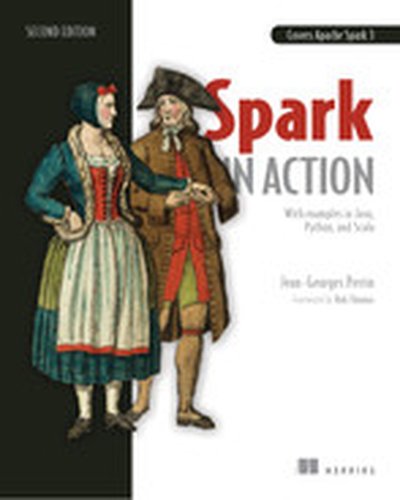
Spark in Action, Second Edition

The Spark distributed data processing platform provides an easy-to-implement tool for ingesting, streaming, and processing data from any source. In Spark in Action, Second Edition, you’ll learn to take advantage of Spark’s core features and incredible processing speed, with applications including real-time computation, delayed evaluation, and machine learning. Spark skills are a hot commodity in enterprises worldwide, and with Spark’s powerful and flexible Java APIs, you can reap all the benefits without first learning Scala or Hadoop. About the Technology Analyzing enterprise data starts by reading, filtering, and merging files and streams from many sources. The Spark data processing engine handles this varied volume like a champ, delivering speeds 100 times faster than Hadoop systems. Thanks to SQL support, an intuitive interface, and a straightforward multilanguage API, you can use Spark without learning a complex new ecosystem. About the Book Spark in Action, Second Edition, teaches you to create end-to-end analytics applications. In this entirely new book, you’ll learn from interesting Java-based examples, including a complete data pipeline for processing NASA satellite data. And you’ll discover Java, Python, and Scala code samples hosted on GitHub that you can explore and adapt, plus appendixes that give you a cheat sheet for installing tools and understanding Spark-specific terms. What's Inside Writing Spark applications in Java Spark application architecture Ingestion through files, databases, streaming, and Elasticsearch Querying distributed datasets with Spark SQL About the Reader This book does not assume previous experience with Spark, Scala, or Hadoop. About the Author Jean-Georges Perrin is an experienced data and software architect. He is France’s first IBM Champion and has been honored for 12 consecutive years. Quotes This book reveals the tools and secrets you need to drive innovation in your company or community. - Rob Thomas, IBM An indispensable, well-paced, and in-depth guide. A must-have for anyone into big data and real-time stream processing. - Anupam Sengupta, GuardHat Inc. This book will help spark a love affair with distributed processing. - Conor Redmond, InComm Product Control Currently the best book on the subject! - Markus Breuer, Materna IPS

Summary With the constant evolution of technology for data management it can seem impossible to make an informed decision about whether to build a data warehouse, or a data lake, or just leave your data wherever it currently rests. What’s worse is that any time you have to migrate to a new architecture, all of your analytical code has to change too. Thankfully it’s possible to add an abstraction layer to eliminate the churn in your client code, allowing you to evolve your data platform without disrupting your downstream data users. In this episode AtScale co-founder and CTO Matthew Baird describes how the data virtualization and data engineering automation capabilities that are built into the platform free up your engineers to focus on your business needs without having to waste cycles on premature optimization. This was a great conversation about the power of abstractions and appreciating the value of increasing the efficiency of your data team.

Announcements

Hello and welcome to the Data Engineering Podcast, the show about modern data management When you’re ready to build your next pipeline, or want to test out the projects you hear about on the show, you’ll need somewhere to deploy it, so check out our friends at Linode. With 200Gbit private networking, scalable shared block storage, and a 40Gbit public network, you’ve got everything you need to run a fast, reliable, and bullet-proof data platform. If you need global distribution, they’ve got that covered too with world-wide datacenters including new ones in Toronto and Mumbai. And for your machine learning workloads, they just announced dedicated CPU instances. Go to dataengineeringpodcast.com/linode today to get a $20 credit and launch a new server in under a minute. And don’t forget to thank them for their continued support of this show! This week’s episode is also sponsored by Datacoral, an AWS-native, serverless, data infrastructure that installs in your VPC. Datacoral helps data engineers build and manage the flow of data pipelines without having to manage any infrastructure, meaning you can spend your time invested in data transformations and business needs, rather than pipeline maintenance. Raghu Murthy, founder and CEO of Datacoral built data infrastructures at Yahoo! and Facebook, scaling from terabytes to petabytes of analytic data. He started Datacoral with the goal to make SQL the universal data programming language. Visit dataengineeringpodcast.com/datacoral today to find out more. Having all of your logs and event data in one place makes your life easier when something breaks, unless that something is your Elastic Search cluster because it’s storing too much data. CHAOSSEARCH frees you from having to worry about data retention, unexpected failures, and expanding operating costs. They give you a fully managed service to search and analyze all of your logs in S3, entirely under your control, all for half the cost of running your own Elastic Search cluster or using a hosted platform. Try it out for yourself at dataengineeringpodcast.com/chaossearch and don’t forget to thank them for supporting the show! You listen to this show to learn and stay up to date with what’s happening in databases, streaming platforms, big data, and everything else you need to know about modern data management. For even more opportunities to meet, listen, and learn from your peers you don’t want to miss out on this year’s conference season. We have partnered with organizations such as O’Reilly Media, Dataversity, Corinium Global Intelligence, Alluxio, and Data Council. Upcoming events include the combined events of the Data Architecture Summit and Graphorum, the Data Orchestration Summit, and Data Council in NYC. Go to dataengineeringpodcast.com/conferences to learn more about these and other events, and take advantage of our partner discounts to save money when you register today. Your host is Tobias Macey and today I’m interviewing Matt Baird about AtScale, a platform that

Interview

Introduction How did you get involved in the area of data management? Can you start by describing the AtScale platform and how it fits in the ecosystem of data tools? What was your motivation for building the platform and what were some of the early challenges that you faced in achieving your current level of success? How is the AtScale platform architected and what have been some of the main areas of evolution and change since you first began building it?

How has the surrounding data ecosystem changed since AtScale was founded? How are current industry trends influencing your product focus?

Can you talk through the workflow for someone implementing AtScale? What are some of the main use cases that benefit from data virtualization capabilities?

How does it influence the relevancy of data warehouses or data lakes?

What are some of the types of tools or patterns that AtScale replaces in a data platform? What are some of the most interesting or unexpected ways that you have seen AtScale used? What have been some of the most challenging aspects of building and growing the platform? When is AtScale the wrong choice? What do you have planned for the future of the platform and business?

Contact Info

LinkedIn @zetty on Twitter

Parting Question

From your perspective, what is the biggest gap in the tooling or technology for data management today?

Closing Announcements

Thank you for listening! Don’t forget to check out our other show, Podcast.init to learn about the Python language, its community, and the innovative ways it is being used. Visit the site to subscribe to the show, sign up for the mailing list, and read the show notes. If you’ve learned something or tried out a project from the show then tell us about it! Email [email protected]) with your story. To help other people find the show please leave a review on iTunes and tell your friends and co-workers Join the community in the new Zulip chat workspace at dataengineeringpodcast.com/chat

Links

AtScale PeopleSoft Oracle Hadoop PrestoDB Impala Apache Kylin Apache Druid Go Language Scala

The intro and outro music is from The Hug by The Freak Fandango Orchestra / CC BY-SA

Support Data Engineering Podcast
Summary One of the biggest challenges for any business trying to grow and reach customers globally is how to scale their data storage. FaunaDB is a cloud native database built by the engineers behind Twitter’s infrastructure and designed to serve the needs of modern systems. Evan Weaver is the co-founder and CEO of Fauna and in this episode he explains the unique capabilities of Fauna, compares the consensus and transaction algorithm to that used in other NewSQL systems, and describes the ways that it allows for new application design patterns. One of the unique aspects of Fauna that is worth drawing attention to is the first class support for temporality that simplifies querying of historical states of the data. It is definitely worth a good look for anyone building a platform that needs a simple to manage data layer that will scale with your business.

Announcements

Hello and welcome to the Data Engineering Podcast, the show about modern data management When you’re ready to build your next pipeline, or want to test out the projects you hear about on the show, you’ll need somewhere to deploy it, so check out our friends at Linode. With 200Gbit private networking, scalable shared block storage, and a 40Gbit public network, you’ve got everything you need to run a fast, reliable, and bullet-proof data platform. If you need global distribution, they’ve got that covered too with world-wide datacenters including new ones in Toronto and Mumbai. And for your machine learning workloads, they just announced dedicated CPU instances. Go to dataengineeringpodcast.com/linode today to get a $20 credit and launch a new server in under a minute. And don’t forget to thank them for their continued support of this show! Alluxio is an open source, distributed data orchestration layer that makes it easier to scale your compute and your storage independently. By transparently pulling data from underlying silos, Alluxio unlocks the value of your data and allows for modern computation-intensive workloads to become truly elastic and flexible for the cloud. With Alluxio, companies like Barclays, JD.com, Tencent, and Two Sigma can manage data efficiently, accelerate business analytics, and ease the adoption of any cloud. Go to dataengineeringpodcast.com/alluxio today to learn more and thank them for their support. Understanding how your customers are using your product is critical for businesses of any size. To make it easier for startups to focus on delivering useful features Segment offers a flexible and reliable data infrastructure for your customer analytics and custom events. You only need to maintain one integration to instrument your code and get a future-proof way to send data to over 250 services with the flip of a switch. Not only does it free up your engineers’ time, it lets your business users decide what data they want where. Go to dataengineeringpodcast.com/segmentio today to sign up for their startup plan and get $25,000 in Segment credits and $1 million in free software from marketing and analytics companies like AWS, Google, and Intercom. On top of that you’ll get access to Analytics Academy for the educational resources you need to become an expert in data analytics for measuring product-market fit. You listen to this show to learn and stay up to date with what’s happening in databases, streaming platforms, big data, and everything else you need to know about modern data management. For even more opportunities to meet, listen, and learn from your peers you don’t want to miss out on this year’s conference season. We have partnered with organizations such as O’Reilly Media, Dataversity, and the Open Data Science Conference. Go to dataengineeringpodcast.com/conferences to learn more and take advantage of our partner discounts when you register. Go to dataengineeringpodcast.com to subscribe to the show, sign up for the mailing list, read the show notes, and get in touch. To help other people find the show please leave a review on iTunes and tell your friends and co-workers Join the community in the new Zulip chat workspace at dataengineeringpodcast.com/chat Your host is Tobias Macey and today I’m interviewing Evan Weaver about FaunaDB, a modern operational data platform built for your cloud

Interview

Introduction How did you get involved in the area of data management? Can you start by explaining what FaunaDB is and how it got started? What are some of the main use cases that FaunaDB is targeting?

How does it compare to some of the other global scale databases that have been built in recent years such as CockroachDB?

Can you describe the architecture of FaunaDB and how it has evolved? The consensus and replication protocol in Fauna is intriguing. Can you talk through how it works?

What are some of the edge cases that users should be aware of? How are conflicts managed in Fauna?

What is the underlying storage layer?

How is the query layer designed to allow for different query patterns and model representations?

How does data modeling in Fauna compare to that of relational or document databases?

Can you describe the query format? What are some of the common difficulties or points of confusion around interacting with data in Fauna?

What are some application design patterns that are enabled by using Fauna as the storage layer? Given the ability to replicate globally, how do you mitigate latency when interacting with the database? What are some of the most interesting or unexpected ways that you have seen Fauna used? When is it the wrong choice? What have been some of the most interesting/unexpected/challenging aspects of building the Fauna database and company? What do you have in store for the future of Fauna?

Contact Info

@evan on Twitter LinkedIn

Parting Question

From your perspective, what is the biggest gap in the tooling or technology for data management today?

Links

Fauna Ruby on Rails CNET GitHub Twitter NoSQL Cassandra InnoDB Redis Memcached Timeseries Spanner Paper DynamoDB Paper Percolator ACID Calvin Protocol Daniel Abadi LINQ LSM Tree (Log-structured Merge-tree) Scala Change Data Capture GraphQL

Podcast.init Interview About Graphene

Fauna Query Language (FQL) CQL == Cassandra Query Language Object-Relational Databases LDAP == Lightweight Directory Access Protocol Auth0 OLAP == Online Analytical Processing Jepsen distributed systems safety research

The intro and outro music is from The Hug by The Freak Fandango Orchestra / CC BY-SA

Support Data Engineering Podcast
Apache Spark Quick Start Guide

Dive into the world of scalable data processing with the "Apache Spark Quick Start Guide." This book offers a foundational introduction to Spark, empowering readers to harness its capabilities for big data processing. With clear explanations and hands-on examples, you'll learn to implement Spark applications that handle complex data tasks efficiently. What this Book will help me do Understand and implement Spark's RDDs and DataFrame APIs to process large datasets effectively. Set up a local development environment for Spark-based projects. Develop skills to debug and optimize slow-performing Spark applications. Harness built-in modules of Spark for SQL, streaming, and machine learning applications. Adopt best practices and optimization techniques for high-performance Spark applications. Author(s) Shrey Mehrotra is a seasoned software developer with expertise in big data technologies, particularly Apache Spark. With years of hands-on industry experience, Shrey focuses on making complex technical concepts accessible to all. Through his writing, he aims to share clear, practical guidance for developers of all levels. Who is it for? This guide is perfect for big data enthusiasts and professionals looking to learn Apache Spark's capabilities from scratch. It's aimed at data engineers interested in optimizing application performance and data scientists wanting to integrate machine learning with Spark. A basic familiarity with either Scala, Python, or Java is recommended.

Hands-On Deep Learning with Apache Spark

"Hands-On Deep Learning with Apache Spark" is an essential resource for mastering distributed deep learning frameworks and applications on Apache Spark. Through practical examples and guided tutorials, this book teaches you to deploy scalable deep learning solutions for handling complex data challenges efficiently. What this Book will help me do Understand how to set up Apache Spark for deep learning workflows. Gain practical insight into implementing neural networks, including CNNs and RNNs, on distributed platforms. Learn to train and optimize models using popular frameworks like TensorFlow and Keras. Develop expertise in analyzing large datasets with textual and image-based deep learning methods. Acquire skills to deploy trained models for real-world applications in distributed environments. Author(s) None Iozzia is an accomplished software engineer and data scientist with a strong background in distributed computing and machine learning. With years of experience working with Apache Spark and deep learning technologies, None brings a wealth of practical knowledge to the table. Their passion for providing clear, hands-on guidance makes this book an approachable and valuable resource for learners of all levels. Who is it for? This book is aimed at Scala developers, data scientists, and data analysts who are looking to extend their skill set to include distributed deep learning on Apache Spark. It's ideally suited for readers familiar with machine learning basics and those with prior exposure to Apache Spark workflows. If you aim to create scalable machine learning solutions that handle complex data, this book offers precisely what you need.

Apache Spark 2: Data Processing and Real-Time Analytics

Build efficient data flow and machine learning programs with this flexible, multi-functional open-source cluster-computing framework Key Features Master the art of real-time big data processing and machine learning Explore a wide range of use-cases to analyze large data Discover ways to optimize your work by using many features of Spark 2.x and Scala Book Description Apache Spark is an in-memory, cluster-based data processing system that provides a wide range of functionalities such as big data processing, analytics, machine learning, and more. With this Learning Path, you can take your knowledge of Apache Spark to the next level by learning how to expand Spark's functionality and building your own data flow and machine learning programs on this platform. You will work with the different modules in Apache Spark, such as interactive querying with Spark SQL, using DataFrames and datasets, implementing streaming analytics with Spark Streaming, and applying machine learning and deep learning techniques on Spark using MLlib and various external tools. By the end of this elaborately designed Learning Path, you will have all the knowledge you need to master Apache Spark, and build your own big data processing and analytics pipeline quickly and without any hassle. This Learning Path includes content from the following Packt products: Mastering Apache Spark 2.x by Romeo Kienzler Scala and Spark for Big Data Analytics by Md. Rezaul Karim, Sridhar Alla Apache Spark 2.x Machine Learning Cookbook by Siamak Amirghodsi, Meenakshi Rajendran, Broderick Hall, Shuen MeiCookbook What you will learn Get to grips with all the features of Apache Spark 2.x Perform highly optimized real-time big data processing Use ML and DL techniques with Spark MLlib and third-party tools Analyze structured and unstructured data using SparkSQL and GraphX Understand tuning, debugging, and monitoring of big data applications Build scalable and fault-tolerant streaming applications Develop scalable recommendation engines Who this book is for If you are an intermediate-level Spark developer looking to master the advanced capabilities and use-cases of Apache Spark 2.x, this Learning Path is ideal for you. Big data professionals who want to learn how to integrate and use the features of Apache Spark and build a strong big data pipeline will also find this Learning Path useful. To grasp the concepts explained in this Learning Path, you must know the fundamentals of Apache Spark and Scala.

Practical Apache Spark: Using the Scala API

Work with Apache Spark using Scala to deploy and set up single-node, multi-node, and high-availability clusters. This book discusses various components of Spark such as Spark Core, DataFrames, Datasets and SQL, Spark Streaming, Spark MLib, and R on Spark with the help of practical code snippets for each topic. Practical Apache Spark also covers the integration of Apache Spark with Kafka with examples. You’ll follow a learn-to-do-by-yourself approach to learning – learn the concepts, practice the code snippets in Scala, and complete the assignments given to get an overall exposure. On completion, you’ll have knowledge of the functional programming aspects of Scala, and hands-on expertise in various Spark components. You’ll also become familiar with machine learning algorithms with real-time usage. What You Will Learn Discover the functional programming features of Scala Understand the completearchitecture of Spark and its components Integrate Apache Spark with Hive and Kafka Use Spark SQL, DataFrames, and Datasets to process data using traditional SQL queries Work with different machine learning concepts and libraries using Spark's MLlib packages Who This Book Is For Developers and professionals who deal with batch and stream data processing.

Summary

Modern applications and data platforms aspire to process events and data in real time at scale and with low latency. Apache Flink is a true stream processing engine with an impressive set of capabilities for stateful computation at scale. In this episode Fabian Hueske, one of the original authors, explains how Flink is architected, how it is being used to power some of the world’s largest businesses, where it sits in the lanscape of stream processing tools, and how you can start using it today.

Preamble

Hello and welcome to the Data Engineering Podcast, the show about modern data management When you’re ready to build your next pipeline, or want to test out the projects you hear about on the show, you’ll need somewhere to deploy it, so check out Linode. With 200Gbit private networking, scalable shared block storage, and a 40Gbit public network, you’ve got everything you need to run a fast, reliable, and bullet-proof data platform. If you need global distribution, they’ve got that covered too with world-wide datacenters including new ones in Toronto and Mumbai. Go to dataengineeringpodcast.com/linode today to get a $20 credit and launch a new server in under a minute. Go to dataengineeringpodcast.com to subscribe to the show, sign up for the mailing list, read the show notes, and get in touch. Join the community in the new Zulip chat workspace at dataengineeringpodcast.com/chat Your host is Tobias Macey and today I’m interviewing Fabian Hueske, co-author of the upcoming O’Reilly book Stream Processing With Apache Flink, about his work on Apache Flink, the stateful streaming engine

Interview

Introduction How did you get involved in the area of data management? Can you start by describing what Flink is and how the project got started? What are some of the primary ways that Flink is used? How does Flink compare to other streaming engines such as Spark, Kafka, Pulsar, and Storm?

What are some use cases that Flink is uniquely qualified to handle?

Where does Flink fit into the current data landscape? How is Flink architected?

How has that architecture evolved? Are there any aspects of the current design that you would do differently if you started over today?

How does scaling work in a Flink deployment?

What are the scaling limits? What are some of the failure modes that users should be aware of?

How is the statefulness of a cluster managed?

What are the mechanisms for managing conflicts? What are the limiting factors for the volume of state that can be practically handled in a cluster and for a given purpose? Can state be shared across processes or tasks within a Flink cluster?

What are the comparative challenges of working with bounded vs unbounded streams of data? How do you handle out of order events in Flink, especially as the delay for a given event increases? For someone who is using Flink in their environment, what are the primary means of interacting with and developing on top of it? What are some of the most challenging or complicated aspects of building and maintaining Flink? What are some of the most interesting or unexpected ways that you have seen Flink used? What are some of the improvements or new features that are planned for the future of Flink? What are some features or use cases that you are explicitly not planning to support? For people who participate in the training sessions that you offer through Data Artisans, what are some of the concepts that they are challenged by?

What do they find most interesting or exciting?

Contact Info

LinkedIn @fhueske on Twitter fhueske on GitHub

Parting Question

From your perspective, what is the biggest gap in the tooling or technology for data management today?

Links

Flink Data Artisans IBM DB2 Technische Universität Berlin Hadoop Relational Database Google Cloud Dataflow Spark Cascading Java RocksDB Flink Checkpoints Flink Savepoints Kafka Pulsar Storm Scala LINQ (Language INtegrated Query) SQL Backpressure

Summary

Jupyter notebooks have gained popularity among data scientists as an easy way to do exploratory analysis and build interactive reports. However, this can cause difficulties when trying to move the work of the data scientist into a more standard production environment, due to the translation efforts that are necessary. At Netflix they had the crazy idea that perhaps that last step isn’t necessary, and the production workflows can just run the notebooks directly. Matthew Seal is one of the primary engineers who has been tasked with building the tools and practices that allow the various data oriented roles to unify their work around notebooks. In this episode he explains the rationale for the effort, the challenges that it has posed, the development that has been done to make it work, and the benefits that it provides to the Netflix data platform teams.

Preamble

Hello and welcome to the Data Engineering Podcast, the show about modern data management When you’re ready to build your next pipeline you’ll need somewhere to deploy it, so check out Linode. With private networking, shared block storage, node balancers, and a 40Gbit network, all controlled by a brand new API you’ve got everything you need to run a bullet-proof data platform. Go to dataengineeringpodcast.com/linode to get a $20 credit and launch a new server in under a minute. Go to dataengineeringpodcast.com to subscribe to the show, sign up for the mailing list, read the show notes, and get in touch. Join the community in the new Zulip chat workspace at dataengineeringpodcast.com/chat Your host is Tobias Macey and today I’m interviewing Matthew Seal about the ways that Netflix is using Jupyter notebooks to bridge the gap between data roles

Interview

Introduction How did you get involved in the area of data management? Can you start by outlining the motivation for choosing Jupyter notebooks as the core interface for your data teams?

Where are you using notebooks and where are you not?

What is the technical infrastructure that you have built to suppport that design choice? Which team was driving the effort?

Was it difficult to get buy in across teams?

How much shared code have you been able to consolidate or reuse across teams/roles? Have you investigated the use of any of the other notebook platforms for similar workflows? What are some of the notebook anti-patterns that you have encountered and what conventions or tooling have you established to discourage them? What are some of the limitations of the notebook environment for the work that you are doing? What have been some of the most challenging aspects of building production workflows on top of Jupyter notebooks? What are some of the projects that are ongoing or planned for the future that you are most excited by?

Contact Info

Matthew Seal

Email LinkedIn @codeseal on Twitter MSeal on GitHub

Parting Question

From your perspective, what is the biggest gap in the tooling or technology for data management today?

Links

Netflix Notebook Blog Posts Nteract Tooling OpenGov Project Jupyter Zeppelin Notebooks Papermill Titus Commuter Scala Python R Emacs NBDime

The intro and outro music is from The Hug by The Freak Fandango Orchestra / CC BY-SA Support Data Engineering Podcast
Summary

Collaboration, distribution, and installation of software projects is largely a solved problem, but the same cannot be said of data. Every data team has a bespoke means of sharing data sets, versioning them, tracking related metadata and changes, and publishing them for use in the software systems that rely on them. The CEO and founder of Quilt Data, Kevin Moore, was sufficiently frustrated by this problem to create a platform that attempts to be the means by which data can be as collaborative and easy to work with as GitHub and your favorite programming language. In this episode he explains how the project came to be, how it works, and the many ways that you can start using it today.

Preamble

Hello and welcome to the Data Engineering Podcast, the show about modern data management When you’re ready to build your next pipeline you’ll need somewhere to deploy it, so check out Linode. With private networking, shared block storage, node balancers, and a 40Gbit network, all controlled by a brand new API you’ve got everything you need to run a bullet-proof data platform. Go to dataengineeringpodcast.com/linode to get a $20 credit and launch a new server in under a minute. Are you struggling to keep up with customer request and letting errors slip into production? Want to try some of the innovative ideas in this podcast but don’t have time? DataKitchen’s DataOps software allows your team to quickly iterate and deploy pipelines of code, models, and data sets while improving quality. Unlike a patchwork of manual operations, DataKitchen makes your team shine by providing an end to end DataOps solution with minimal programming that uses the tools you love. Join the DataOps movement and sign up for the newsletter at datakitchen.io/de today. After that learn more about why you should be doing DataOps by listening to the Head Chef in the Data Kitchen at dataengineeringpodcast.com/datakitchen Go to dataengineeringpodcast.com to subscribe to the show, sign up for the mailing list, read the show notes, and get in touch. Your host is Tobias Macey and today I’m interviewing Kevin Moore about Quilt Data, a platform and tooling for packaging, distributing, and versioning data

Interview

Introduction How did you get involved in the area of data management? What is the intended use case for Quilt and how did the project get started? Can you step through a typical workflow of someone using Quilt?

How does that change as you go from a single user to a team of data engineers and data scientists?

Can you describe the elements of what a data package consists of?

What was your criteria for the file formats that you chose?

How is Quilt architected and what have been the most significant changes or evolutions since you first started? How is the data registry implemented?

What are the limitations or edge cases that you have run into? What optimizations have you made to accelerate synchronization of the data to and from the repository?

What are the limitations in terms of data volume, format, or usage? What is your goal with the business that you have built around the project? What are your plans for the future of Quilt?

Contact Info

Email LinkedIn

Parting Question

From your perspective, what is the biggest gap in the tooling or technology for data management today?

Links

Quilt Data GitHub Jobs Reproducible Data Dependencies in Jupyter Reproducible Machine Learning with Jupyter and Quilt Allen Institute: Programmatic Data Access with Quilt Quilt Example: MissingNo Oracle Pandas Jupyter Ycombinator Data.World

Podcast Episode with CTO Bryon Jacob

Kaggle Parquet HDF5 Arrow PySpark Excel Scala Binder Merkle Tree Allen Institute for Cell Science Flask PostGreSQL Docker Airflow Quilt Teams Hive Hive Metastore PrestoDB

Podcast Episode

Netflix Iceberg Kubernetes Helm

The intro and outro music is from The Hug by The Freak Fandango Orchestra / CC BY-SA Support Data Engineering Podcast