talk-data.com talk-data.com

Topic

ELK

Elasticsearch/ELK Stack

search_engine log_analysis elk_stack

168

tagged

Activity Trend

10 peak/qtr
2020-Q1 2026-Q1

Activities

168 activities · Newest first

Summary

All software systems are in a constant state of evolution. This makes it impossible to select a truly future-proof technology stack for your data platform, making an eventual migration inevitable. In this episode Gleb Mezhanskiy and Rob Goretsky share their experiences leading various data platform migrations, and the hard-won lessons that they learned so that you don't have to.

Announcements

Hello and welcome to the Data Engineering Podcast, the show about modern data management Introducing RudderStack Profiles. RudderStack Profiles takes the SaaS guesswork and SQL grunt work out of building complete customer profiles so you can quickly ship actionable, enriched data to every downstream team. You specify the customer traits, then Profiles runs the joins and computations for you to create complete customer profiles. Get all of the details and try the new product today at dataengineeringpodcast.com/rudderstack Modern data teams are using Hex to 10x their data impact. Hex combines a notebook style UI with an interactive report builder. This allows data teams to both dive deep to find insights and then share their work in an easy-to-read format to the whole org. In Hex you can use SQL, Python, R, and no-code visualization together to explore, transform, and model data. Hex also has AI built directly into the workflow to help you generate, edit, explain and document your code. The best data teams in the world such as the ones at Notion, AngelList, and Anthropic use Hex for ad hoc investigations, creating machine learning models, and building operational dashboards for the rest of their company. Hex makes it easy for data analysts and data scientists to collaborate together and produce work that has an impact. Make your data team unstoppable with Hex. Sign up today at dataengineeringpodcast.com/hex to get a 30-day free trial for your team! Your host is Tobias Macey and today I'm interviewing Gleb Mezhanskiy and Rob Goretsky about when and how to think about migrating your data stack

Interview

Introduction How did you get involved in the area of data management? A migration can be anything from a minor task to a major undertaking. Can you start by describing what constitutes a migration for the purposes of this conversation? Is it possible to completely avoid having to invest in a migration? What are the signals that point to the need for a migration?

What are some of the sources of cost that need to be accounted for when considering a migration? (both in terms of doing one, and the costs of not doing one) What are some signals that a migration is not the right solution for a perceived problem?

Once the decision has been made that a migration is necessary, what are the questions that the team should be asking to determine the technologies to move to and the sequencing of execution? What are the preceding tasks that should be completed before starting the migration to ensure there is no breakage downstream of the changing component(s)? What are some of the ways that a migration effort might fail? What are the major pitfalls that teams need to be aware of as they work through a data platform migration? What are the opportunities for automation during the migration process? What are the most interesting, innovative, or unexpected ways that you have seen teams approach a platform migration? What are the most interesting, unexpected, or challenging lessons that you have learned while working on data platform migrations? What are some ways that the technologies and patterns that we use can be evolved to reduce the cost/impact/need for migraitons?

Contact Info

Gleb

LinkedIn @glebmm on Twitter

Rob

LinkedIn RobGoretsky on GitHub

Parting Question

From your perspective, what is the biggest gap in the tooling or technology for data management today?

Closing Announcements

Thank you for listening! Don't forget to check out our other shows. Podcast.init covers the Python language, its community, and the innovative ways it is being used. The Machine Learning Podcast helps you go from idea to production with machine learning. Visit the site to subscribe to the show, sign up for the mailing list, and read the show notes. If you've learned something or tried out a project from the show then tell us about it! Email [email protected]) with your story. To help other people find the show please leave a review on Apple Podcasts and tell your friends and co-workers

Links

Datafold

Podcast Episode

Informatica Airflow Snowflake

Podcast Episode

Redshift Eventbrite Teradata BigQuery Trino EMR == Elastic Map-Reduce Shadow IT

Podcast Episode

Mode Analytics Looker Sunk Cost Fallacy data-diff

Podcast Episode

SQLGlot Dagster dbt

The intro and outro music is from The Hug by The Freak Fandango Orchestra / CC BY-SA Sponsored By: Hex: Hex Tech Logo
Hex is a collaborative workspace for data science and analytics. A single place for teams to explore, transform, and visualize data into beautiful interactive reports. Use SQL, Python, R, no-code and AI to find and share insights across your organization. Empower everyone in an organization to make an impact with data. Sign up today at [dataengineeringpodcast.com/hex](https://www.dataengineeringpodcast.com/hex} and get 30 days free!Rudderstack: Rudderstack

Introducing RudderStack Profiles. RudderStack Profiles takes the SaaS guesswork and SQL grunt work out of building complete customer profiles so you can quickly ship actionable, enriched data to every downstream team. You specify the customer traits, then Profiles runs the joins and computations for you to create complete customer profiles. Get all of the details and try the new product today at dataengineeringpodcast.com/rudderstackSupport Data Engineering Podcast
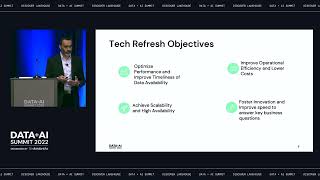
Databricks SQL: Why the Best Serverless Data Warehouse is a Lakehouse

Many organizations rely on complex cloud data architectures that create silos between applications, users and data. This fragmentation makes it difficult to access accurate, up-to-date information for analytics, often resulting in the use of outdated data. Enter the lakehouse, a modern data architecture that unifies data, AI, and analytics in a single location.

This session explores why the lakehouse is the best data warehouse, featuring success stories, use cases and best practices from industry experts. You'll discover how to unify and govern business-critical data at scale to build a curated data lake for data warehousing, SQL and BI. Additionally, you'll learn how Databricks SQL can help lower costs and get started in seconds with on-demand, elastic SQL serverless warehouses, and how to empower analytics engineers and analysts to quickly find and share new insights using their preferred BI and SQL tools such as Fivetran, dbt, Tableau, or Power BI.

Talk by: Miranda Luna and Cyrielle Simeone

Connect with us: Website: https://databricks.com Twitter: https://twitter.com/databricks LinkedIn: https://www.linkedin.com/company/databricks Instagram: https://www.instagram.com/databricksinc Facebook: https://www.facebook.com/databricksinc

Vector Data Lakes

Vector databases such as ElasticSearch and Pinecone offer fast ingestion and querying on vector embeddings with ANNs. However, they typically do not decouple compute and storage, making them hard to integrate in production data stacks. Because data storage in these databases is expensive and not easily accessible, data teams typically maintain ETL pipelines to offload historical embedding data to blob stores. When that data needs to be queried, they get loaded back into the vector database in another ETL process. This is reminiscent of loading data from OLTP database to cloud storage, then loading said data into an OLAP warehouse for offline analytics.

Recently, “lakehouse” offerings allow direct OLAP querying on cloud storage, removing the need for the second ETL step. The same could be done for embedding data. While embedding storage in blob stores cannot satisfy the high TPS requirements in online settings, we argue it’s sufficient for offline analytics use cases like slicing and dicing data based on embedding clusters. Instead of loading the embedding data back into the vector database for offline analytics, we propose direct processing on embeddings stored in Parquet files in Delta Lake. You will see that offline embedding workloads typically touch a large portion of the stored embeddings without the need for random access.

As a result, the workload is entirely bound by network throughput instead of latency, making it quite suitable for blob storage backends. On a test one billion vector dataset, ETL into cloud storage takes around one hour on a dedicated GPU instance, while batched nearest neighbor search can be done in under one minute with four CPU instances. We believe future “lakehouses” will ship with native support for these embedding workloads.

Talk by: Tony Wang and Chang She

Here’s more to explore: State of Data + AI Report: https://dbricks.co/44i2HBp Databricks named a Leader in 2022 Gartner® Magic QuadrantTM CDBMS: https://dbricks.co/3phw20d

Connect with us: Website: https://databricks.com Twitter: https://twitter.com/databricks LinkedIn: https://www.linkedin.com/company/databricks Instagram: https://www.instagram.com/databricksinc Facebook: https://www.facebook.com/databricksinc

High-scale orchestration of genomic algorithms using Airflow workflows, AWS Elastic Container Service (ECS), and Docker. Genomic algorithms are highly demanding of CPU, RAM, and storage. Our data science team requires a platform to facilitate the development and validation of proprietary algorithms. The Data engineering team develops a research data platform that enables Data Scientists to publish docker images to AWS ECR and run them using Airflow DAGS that provision AWS’s ECS compute power of EC2 and Fargate. We will describe a research platform that allows our data science team to check their algorithms on ~1000 cases in parallel using airflow UI and dynamic DAG generation to utilize EC2 machines, auto-scaling groups, and ECS clusters across multiple AWS regions.

Scaling Uber's Metric System from Elasticsearch to Pinot | Uber

ABOUT THE TALK: Uber has been using realtime system to support time-sensitive critical use cases for years, including Gairos, which was initiated in the Marketplace Org and then widely used across the company since 2014, and uMetric, which has emerged rapidly since 2020.

Continuous effort has been spent toward the reliability and performance of these realtime platforms, to cope with traffic growth, increasing number of users, different varieties of use cases, and following work such as operation cost, resource planning, and optimization feature development. This presentation shares the things done right to solve these challenges, including fully replace Elasticsearch with Apache Pinot as the realtime storage of our ecosystem.

ABOUT THE SPEAKERS: Yupeng Fu is a Principal Engineer at Uber and he leads the Real-time Data platform and Search platform at Uber. Yupeng Fu is also an Apache Pinot committer.

Nan Ding is a staff engineer at Uber, and leads data platform reliability and performance of Marketplace uMetric team.

ABOUT DATA COUNCIL: Data Council (https://www.datacouncil.ai/) is a community and conference series that provides data professionals with the learning and networking opportunities they need to grow their careers.

Make sure to subscribe to our channel for the most up-to-date talks from technical professionals on data related topics including data infrastructure, data engineering, ML systems, analytics and AI from top startups and tech companies.

FOLLOW DATA COUNCIL: Twitter: https://twitter.com/DataCouncilAI LinkedIn: https://www.linkedin.com/company/datacouncil-ai/

IBM Elastic Storage System Introduction Guide

This IBM® Redpaper Redbookspublication provides an overview of the IBM Elastic Storage® Server (IBM ESS) and IBM Elastic Storage System (also IBM ESS). These scalable, high-performance data and file management solution, are built on IBM Spectrum® Scale technology. Providing reliability, performance, and scalability, IBM ESS can be implemented for a range of diverse requirements. The latest IBM ESS 3500 is the most innovative system that provides investment protection to expand or build a new Global Data Platform and use current storage. The system allows enhanced, non-disruptive upgrades to grow from flash to hybrid or from hard disk drives (HDDs) to hybrid. IBM ESS can scale up or out with two different storage mediums in the environment, and it is ready for technologies like 200 Gb Ethernet or InfiniBand NDR-200 connectivity. This publication helps you to understand the solution and its architecture. It describes ordering the best solution for your environment, planning the installation and integration of the solution into your environment, and correctly maintaining your solution. The solution is created from the following combination of physical and logical components: Hardware Operating system Storage Network Applications Knowledge of the IBM Elastic Storage Server and IBM Elastic Storage System components is key for planning an environment. This paper is targeted toward technical professionals (consultants, technical support staff, IT Architects, and IT specialists) who are responsible for delivering cost-effective cloud services and big data solutions. The content of this paper can help you to uncover insights among client's data so that you can take appropriate actions to optimize business results, product development, and scientific discoveries.

Summary Data lineage is something that has grown from a convenient feature to a critical need as data systems have grown in scale, complexity, and centrality to business. Alvin is a platform that aims to provide a low effort solution for data lineage capabilities focused on simplifying the work of data engineers. In this episode co-founder Martin Sahlen explains the impact that easy access to lineage information can have on the work of data engineers and analysts, and how he and his team have designed their platform to offer that information to engineers and stakeholders in the places that they interact with data.

Announcements

Hello and welcome to the Data Engineering Podcast, the show about modern data management When you’re ready to build your next pipeline, or want to test out the projects you hear about on the show, you’ll need somewhere to deploy it, so check out our friends at Linode. With their new managed database service you can launch a production ready MySQL, Postgres, or MongoDB cluster in minutes, with automated backups, 40 Gbps connections from your application hosts, and high throughput SSDs. Go to dataengineeringpodcast.com/linode today and get a $100 credit to launch a database, create a Kubernetes cluster, or take advantage of all of their other services. And don’t forget to thank them for their continued support of this show! You wake up to a Slack message from your CEO, who’s upset because the company’s revenue dashboard is broken. You’re told to fix it before this morning’s board meeting, which is just minutes away. Enter Metaplane, the industry’s only self-serve data observability tool. In just a few clicks, you identify the issue’s root cause, conduct an impact analysis⁠—and save the day. Data leaders at Imperfect Foods, Drift, and Vendr love Metaplane because it helps them catch, investigate, and fix data quality issues before their stakeholders ever notice they exist. Setup takes 30 minutes. You can literally get up and running with Metaplane by the end of this podcast. Sign up for a free-forever plan at dataengineeringpodcast.com/metaplane, or try out their most advanced features with a 14-day free trial. Mention the podcast to get a free "In Data We Trust World Tour" t-shirt. RudderStack helps you build a customer data platform on your warehouse or data lake. Instead of trapping data in a black box, they enable you to easily collect customer data from the entire stack and build an identity graph on your warehouse, giving you full visibility and control. Their SDKs make event streaming from any app or website easy, and their state-of-the-art reverse ETL pipelines enable you to send enriched data to any cloud tool. Sign up free… or just get the free t-shirt for being a listener of the Data Engineering Podcast at dataengineeringpodcast.com/rudder. Data teams are increasingly under pressure to deliver. According to a recent survey by Ascend.io, 95% in fact reported being at or over capacity. With 72% of data experts reporting demands on their team going up faster than they can hire, it’s no surprise they are increasingly turning to automation. In fact, while only 3.5% report having current investments in automation, 85% of data teams plan on investing in automation in the next 12 months. 85%!!! That’s where our friends at Ascend.io come in. The Ascend Data Automation Cloud provides a unified platform for data ingestion, transformation, orchestration, and observability. Ascend users love its declarative pipelines, powerful SDK, elegant UI, and extensible plug-in architecture, as well as its support for Python, SQL, Scala, and Java. Ascend automates workloads on Snowflake, Databricks, BigQuery, and open source Spark, and can be deployed in AWS, Azure, or GCP. Go to dataengineeringpodcast.com/ascend and sign up for a free trial. If you’re a data engineering podcast listener, you get credits worth $5,000 when you become a customer. Your host is Tobias Macey and today I’m interviewing Martin Sahlen about his work on data lineage at Alvin and how it factors into the day-to-day work of data engineers

Interview

Introduction How did you get involved in the area of data management? Can you describe what Alvin is and the story behind it? What is the core problem that you are trying to solve at Alvin? Data lineage has quickly become an overloaded term. What are the elements of lineage that you are focused on addressing?

What are some of the other sources/pieces of information that you integrate into the lineage graph?

How does data lineage show up in the work of data engineers?

In what ways does your focus on data engineers inform the way that you model the lineage information?

As with every data asset/product, the lineage graph is only as useful as the data that it stores. What are some of the ways that you focus on establishing and ensuring a complete view of lineage?

How do you account for assets (e.g. tables, dashboards, exports, etc.) that are created outside of the "officially supported" methods? (e.g. someone manually runs a SQL create statement, etc.)

Can you describe how you have implemented the Alvin platform?

How have the design and goals shifted from when you first started exploring the problem?

What are the types of data systems/assets that you are focused on supporting? (e.g. data warehouses vs. lakes, structured vs. unstructured, which BI tools, etc.) How does Alvin fit into the workflow of data engineers and their downstream customers/collaborators?

What are some of the design choices (both visual and functional) that you focused on to avoid friction in the data engineer’s workflow?

What are some of the open questions/areas for investigation/improvement in the space of data lineage?

What are the factors that contribute to the difficulty of a truly holistic and complete view of lineage across an organization?

What are the most interesting, innovative, or unexpected ways that you have seen Alvin used? What are the most interesting, unexpected, or challenging lessons that you have learned while working on Alvin? When is Alvin the wrong choice? What do you have planned for the future of Alvin?

Contact Info

LinkedIn @martinsahlen on Twitter

Parting Question

From your perspective, what is the biggest gap in the tooling or technology for data management today?

Closing Announcements

Thank you for listening! Don’t forget to check out our other shows. Podcast.init covers the Python language, its community, and the innovative ways it is being used. The Machine Learning Podcast helps you go from idea to production with machine learning. Visit the site to subscribe to the show, sign up for the mailing list, and read the show notes. If you’ve learned something or tried out a project from the show then tell us about it! Email [email protected]) with your story. To help other people find the show please leave a review on Apple Podcasts and tell your friends and co-workers

Links

Alvin Unacast sqlparse Python library Cython

Podcast.init Episode

Antlr Kotlin programming language PostgreSQL

Podcast Episode

OpenSearch ElasticSearch Redis Kubernetes Airflow BigQuery Spark Looker Mode

The intro and outro music is from The Hug by The Freak Fandango Orchestra / CC BY-SA

Support Data Engineering Podcast
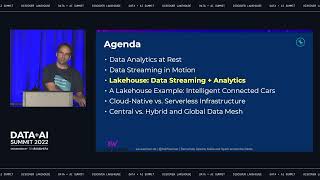
Serverless Kafka and Apache Spark in a Multi-Cloud Data Lakehouse Architecture

Apache Kafka in conjunction with Apache Spark became the de facto standard for processing and analyzing data. Both frameworks are open, flexible, and scalable. Unfortunately, the latter makes operations a challenge for many teams. Ideally, teams can use serverless SaaS offerings to focus on business logic. However, hybrid and multi-cloud scenarios require a cloud-native platform that provides automated and elastic tooling to reduce the operations burden.

This post explores different architecture to build serverless Kafka and Spark multi-cloud architectures across regions and continents. We start from the analytics perspective of a data lake and explore its relation to a fully integrated data streaming layer with Kafka to build a modern data lakehouse. Real-world use cases show the joint value and explore the benefit of the "delta lake" integration.

Connect with us: Website: https://databricks.com Facebook: https://www.facebook.com/databricksinc Twitter: https://twitter.com/databricks LinkedIn: https://www.linkedin.com/company/data... Instagram: https://www.instagram.com/databricksinc/

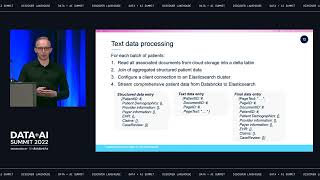
Comprehensive Patient Data Self-Serve Environment and Executive Dashboards Leveraging Databricks

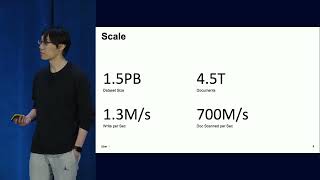
In this talk, we will outline our data pipelines and demo dashboards developed on top of the resulting elasticsearch index. This tool enables queries for terms or phrases in the raw documents to be executed together with any associated EMR patient data filters within 1-2 second for a data set containing millions of records/documents. Finally, the dashboards are simple to use and enable Real World Evidence data stakeholders to gain real-time statistical insight into the comprehensive patient information available.

Connect with us: Website: https://databricks.com Facebook: https://www.facebook.com/databricksinc Twitter: https://twitter.com/databricks LinkedIn: https://www.linkedin.com/company/data... Instagram: https://www.instagram.com/databricksinc/

Data Lake for State Health Exchange Analytics using Databricks

One of the largest State based health exchanges in the country was looking to modernize their data warehouse (DWH) environment to support the vision that every decision to design, implement and evaluate their state-based health exchange portal is informed by timely and rigorous evidence about its consumers’ experiences. The scope of the project was to replace existing Oracle-based DWH with an analytics platform that could support a much broader range of requirements with an ability to provide unified analytics capabilities including machine learning. The modernized analytics platform comprises a cloud native data lake and DWH solution using Databricks. The solution provides significantly higher performance and elastic scalability to better handle larger and varying data volumes with a much lower cost of ownership compared to the existing solution. In this session, we will walk through the rationale behind tool selection, solution architecture, project timeline and benefits expected.

Connect with us: Website: https://databricks.com Facebook: https://www.facebook.com/databricksinc Twitter: https://twitter.com/databricks LinkedIn: https://www.linkedin.com/company/data... Instagram: https://www.instagram.com/databricksinc/

Data Warehousing on the Lakehouse

Most organizations routinely operate their business with complex cloud data architectures that silo applications, users and data. As a result, there is no single source of truth of data for analytics, and most analysis is performed with stale data. To solve these challenges, the lakehouse has emerged as the new standard for data architecture, with the promise to unify data, AI and analytic workloads in one place. In this session, we will cover why the data lakehouse is the next best data warehouse. You will hear from the experts success stories, use cases, and best practices learned from the field and discover how the data lakehouse ingests, stores and governs business-critical data at scale to build a curated data lake for data warehousing, SQL and BI workloads. You will also learn how Databricks SQL can help you lower costs and get started in seconds with instant, elastic SQL serverless compute, and how to empower every analytics engineers and analysts to quickly find and share new insights using their favorite BI and SQL tools, like Fivetran, dbt, Tableau or PowerBI.

Connect with us: Website: https://databricks.com Facebook: https://www.facebook.com/databricksinc Twitter: https://twitter.com/databricks LinkedIn: https://www.linkedin.com/company/data... Instagram: https://www.instagram.com/databricksinc/

Elasticsearch 8.x Cookbook - Fifth Edition

"Elasticsearch 8.x Cookbook" is your go-to resource for harnessing the full potential of Elasticsearch 8. This book provides over 180 hands-on recipes to help you efficiently implement, customize, and scale Elasticsearch solutions in your enterprise. Whether you're handling complex queries, analytics, or cluster management, you'll find practical insights to enhance your capabilities. What this Book will help me do Understand the advanced features of Elasticsearch 8.x, including X-Pack, for improving functionality and security. Master advanced indexing and query techniques to perform efficient and scalable data operations. Implement and manage Elasticsearch clusters effectively including monitoring performance via Kibana. Integrate Elasticsearch seamlessly into Java, Scala, Python, and big data environments. Develop custom plugins and extend Elasticsearch to meet unique project requirements. Author(s) Alberto Paro is a seasoned Elasticsearch expert with years of experience in search technologies and enterprise solution development. As a professional developer and consultant, he has worked with numerous organizations to implement Elasticsearch at scale. Alberto brings his deep technical knowledge and hands-on approach to this book, ensuring readers gain practical insights and skills. Who is it for? This book is perfect for software engineers, data professionals, and developers working with Elasticsearch in enterprise environments. If you're seeking to advance your Elasticsearch knowledge, enhance your query-writing abilities, or seek to integrate it into big data workflows, this book will be invaluable. Regardless of whether you're deploying Elasticsearch in e-commerce, applications, or for analytics, you'll find the content purposeful and engaging.

Getting Started with Elastic Stack 8.0

Discover how to harness the power of the Elastic Stack 8.0 to manage, analyze, and secure complex data environments. You will learn to combine components such as Elasticsearch, Kibana, Logstash, and more to build scalable and effective solutions for your organization. By focusing on hands-on implementations, this book ensures you can apply your knowledge to real-world use cases. What this Book will help me do Set up and manage Elasticsearch clusters tailored to various architecture scenarios. Utilize Logstash and Elastic Agent to ingest and process diverse data sources efficiently. Create interactive dashboards and data models in Kibana, enabling business intelligence insights. Implement secure and effective search infrastructures for enterprise applications. Deploy Elastic SIEM to fortify your organization's security against modern cybersecurity threats. Author(s) Asjad Athick is a seasoned technologist and author with expertise in developing scalable data solutions. With years of experience working with the Elastic Stack, Asjad brings a pragmatic approach to teaching complex architectures. His dedication to explaining technical concepts in an accessible manner makes this book a valuable resource for learners. Who is it for? This book is ideal for developers seeking practical knowledge in search, observability, and security solutions using Elastic Stack. Solutions architects who aim to design scalable data platforms will also benefit greatly. Even tech leads or managers keen to understand the Elastic Stack's impact on their operations will find the insights valuable. No prior experience with Elastic Stack is needed.

IBM TS4500 R8 Tape Library Guide

The IBM® TS4500 (TS4500) tape library is a next-generation tape solution that offers higher storage density and better integrated management than previous solutions. This IBM Redbooks® publication gives you a close-up view of the new IBM TS4500 tape library. In the TS4500, IBM delivers the density that today's and tomorrow's data growth requires. It has the cost-effectiveness and the manageability to grow with business data needs, while you preserve investments in IBM tape library products. Now, you can achieve a low per-terabyte cost and high density, with up to 13 PB of data (up to 39 PB compressed) in a single 10 square-foot library by using LTO Ultrium 9 cartridges or 11 PB with 3592 cartridges. The TS4500 offers the following benefits: Support of the IBM Linear Tape-Open (LTO) Ultrium 9 tape drive: Store up to 1.04 EB 2.5:1 compressed per library with IBM LTO 9 cartridges. High availability: Dual active accessors with integrated service bays reduce inactive service space by 40%. The Elastic Capacity option can be used to eliminate inactive service space. Flexibility to grow: The TS4500 library can grow from the right side and the left side of the first L frame because models can be placed in any active position. Increased capacity: The TS4500 can grow from a single L frame up to another 17 expansion frames with a capacity of over 23,000 cartridges. High-density (HD) generation 1 frames from the TS3500 library can be redeployed in a TS4500. Capacity on demand (CoD): CoD is supported through entry-level, intermediate, and base-capacity configurations. Advanced Library Management System (ALMS): ALMS supports dynamic storage management, which enables users to create and change logical libraries and configure any drive for any logical library. Support for IBM TS1160 while also supporting TS1155, TS1150, and TS1140 tape drive. The TS1160 gives organizations an easy way to deliver fast access to data, improve security, and provide long-term retention, all at a lower cost than disk solutions. The TS1160 offers high-performance, flexible data storage with support for data encryption. Also, this enhanced fifth-generation drive can help protect investments in tape automation by offering compatibility with existing automation. Store up to 1.05 EB 3:1 compressed per library with IBM 3592 cartridges Integrated TS7700 back-end Fibre Channel (FC) switches are available. Up to four library-managed encryption (LME) key paths per logical library are available. This book describes the TS4500 components, feature codes, specifications, supported tape drives, encryption, new integrated management console (IMC), command-line interface (CLI), and REST over SCSI (RoS) to obtain status information about library components. You learn how to accomplish the following tasks: Improve storage density with increased expansion frame capacity up to 2.4 times, and support 33% more tape drives per frame

What Is Distributed SQL?

Globally available resources have become the status quo. They're accessible, distributed, and resilient. Our traditional SQL database options haven't kept up. Centralized SQL databases, even those with read replicas in the cloud, put all the transactional load on a central system. The further away that a transaction happens from the user, the more the user experience suffers. If the transactional data powering the application is greatly slowed down, fast-loading web pages mean nothing. In this report, Paul Modderman, Jim Walker, and Charles Custer explain how distributed SQL fits all applications and eliminates complex challenges like sharding from traditional RDBMS systems. You'll learn how distributed SQL databases can reach global scale without introducing the consistency trade-offs found in NoSQL solutions. These databases come to life through cloud computing, while legacy databases simply can't rise to meet the elastic and ubiquitous new paradigm. You'll learn: Key concepts driving this new technology, including the CAP theorem, the Raft consensus algorithm, multiversion concurrency control, and Google Spanner How distributed SQL databases meet enterprise requirements, including management, security, integration, and Everything as a Service (XaaS) The impact that distributed SQL has already made in the telecom, retail, and gaming industries Why serverless computing is an ideal fit for distributed SQL How distributed SQL can help you expand your company's strategic plan

Highly Efficient Data Access with RoCE on IBM Elastic Storage Systems and IBM Spectrum Scale

With Remote Direct Memory Access (RDMA), you can make a subset of a host's memory directly available to a remote host. RDMA is available on standard Ethernet-based networks by using the RDMA over Converged Ethernet (RoCE) interface. The RoCE network protocol is an industry-standard initiative by the InfiniBand Trade Association. This IBM® Redpaper publication describes how to set up RoCE to use within an IBM Spectrum® Scale cluster and IBM Elastic Storage® Systems (ESSs). This book is targeted at technical professionals (consultants, technical support staff, IT Architects, and IT Specialists) who are responsible for delivering cost-effective storage solutions with IBM Spectrum Scale and IBM ESSs.

Cassandra: The Definitive Guide, (Revised) Third Edition, 3rd Edition

Imagine what you could do if scalability wasn't a problem. With this hands-on guide, you'll learn how the Cassandra database management system handles hundreds of terabytes of data while remaining highly available across multiple data centers. This revised third edition--updated for Cassandra 4.0 and new developments in the Cassandra ecosystem, including deployments in Kubernetes with K8ssandra--provides technical details and practical examples to help you put this database to work in a production environment. Authors Jeff Carpenter and Eben Hewitt demonstrate the advantages of Cassandra's nonrelational design, with special attention to data modeling. Developers, DBAs, and application architects looking to solve a database scaling issue or future-proof an application will learn how to harness Cassandra's speed and flexibility. Understand Cassandra's distributed and decentralized structure Use the Cassandra Query Language (CQL) and cqlsh (the CQL shell) Create a working data model and compare it with an equivalent relational model Design and develop applications using client drivers Explore cluster topology and learn how nodes exchange data Maintain a high level of performance in your cluster Deploy Cassandra onsite, in the cloud, or with Docker and Kubernetes Integrate Cassandra with Spark, Kafka, Elasticsearch, Solr, and Lucene

We talked about:

Natalie’s background Airbyte What is ETL? Why ELT instead of ETL? Transformations How does ELT help analysts be more independent? Data marts and Data warehouses Ingestion DB ETL vs ELT Data lakes Data swamps Data governance Ingestion layer vs Data lake Do you need both a Data warehouse and a Data lake? Airbyte and ELT Modern data stack Reverse ETL Is drag-and-drop killing data engineering jobs? Who is responsible for managing unused data? CDC – Change Data Capture Slowly changing dimension Are there cases where ETL is preferable over ELT? Why is Airbyte open source? The case of Elasticsearch and AWS

Links:

Natalie's LinkedIn: https://www.linkedin.com/in/nataliekwong/ https://airbyte.io/blog/why-the-future-of-etl-is-not-elt-but-el

Join DataTalks.Club: https://datatalks.club/slack.html

Our events: https://datatalks.club/events.html

IBM TS4500 R7 Tape Library Guide

The IBM® TS4500 (TS4500) tape library is a next-generation tape solution that offers higher storage density and better integrated management than previous solutions. This IBM Redbooks® publication gives you a close-up view of the new IBM TS4500 tape library. In the TS4500, IBM delivers the density that today's and tomorrow's data growth requires. It has the cost-effectiveness and the manageability to grow with business data needs, while you preserve investments in IBM tape library products. Now, you can achieve a low cost per terabyte (TB) and a high TB density per square foot because the TS4500 can store up to 11 petabytes (PB) of uncompressed data in a single frame library or scale up to 2 PB per square foot to over 350 PB. The TS4500 offers the following benefits: High availability: Dual active accessors with integrated service bays reduce inactive service space by 40%. The Elastic Capacity option can be used to eliminate inactive service space. Flexibility to grow: The TS4500 library can grow from the right side and the left side of the first L frame because models can be placed in any active position. Increased capacity: The TS4500 can grow from a single L frame up to another 17 expansion frames with a capacity of over 23,000 cartridges. High-density (HD) generation 1 frames from the TS3500 library can be redeployed in a TS4500. Capacity on demand (CoD): CoD is supported through entry-level, intermediate, and base-capacity configurations. Advanced Library Management System (ALMS): ALMS supports dynamic storage management, which enables users to create and change logical libraries and configure any drive for any logical library. Support for IBM TS1160 while also supporting TS1155, TS1150, and TS1140 tape drive: The TS1160 gives organizations an easy way to deliver fast access to data, improve security, and provide long-term retention, all at a lower cost than disk solutions. The TS1160 offers high-performance, flexible data storage with support for data encryption. Also, this enhanced fifth-generation drive can help protect investments in tape automation by offering compatibility with existing automation. The TS1160 Tape Drive Model 60E delivers a dual 10 Gb or 25 Gb Ethernet host attachment interface that is optimized for cloud-based and hyperscale environments. The TS1160 Tape Drive Model 60F delivers a native data rate of 400 MBps, the same load/ready, locate speeds, and access times as the TS1155, and includes dual-port 16 Gb Fibre Channel support. Support of the IBM Linear Tape-Open (LTO) Ultrium 8 tape drive: The LTO Ultrium 8 offering represents significant improvements in capacity, performance, and reliability over the previous generation, LTO Ultrium 7, while still protecting your investment in the previous technology. Support of LTO 8 Type M cartridge (m8): The LTO Program introduced a new capability with LTO-8 drives. The ability of the LTO-8 drive to write 9 TB on a brand new LTO-7 cartridge instead of 6 TB as specified by the LTO-7 format. Such a cartridge is called an LTO-7 initialized LTO-8 Type M cartridge. Integrated TS7700 back-end Fibre Channel (FC) switches are available. Up to four library-managed encryption (LME) key paths per logical library are available. This book describes the TS4500 components, feature codes, specifications, supported tape drives, encryption, new integrated management console (IMC), command-line interface (CLI), and REST over SCSI (RoS) to obtain status information about library components. October 2020 - Added support for the 3592 model 60S tape drive that provides a dual-port 12 Gb SAS (Serial Attached SCSI) interface for host attachment.

At QuintoAndar we seek automation and scalability in our data pipelines and believe that Airflow is the right tool for giving us exactly what we need. However, having all concerns mapped and tooling defined doesn’t necessarily mean success. For months we had struggled with a misconception that Airflow should act as an orchestrator and executor within a monolithic strategy. That could not be further from the truth because of the rise of scalability and performance issues, infrastructure and maintainability costs, and multi-directional impact throughout development teams. Employing Airflow, though, as an orchestration-only solution may help teams deliver value to end users in a more efficient, reliable and performant manner, where data pipelines can be executed anywhere with proper resources and optimizations. Those are the reasons we have shifted from an orchestrate-execute strategy to an orchestrate-only one, in order to leverage the full power of data pipeline management in Airflow. Straightaway the separation of data processing and pipeline coordination brought not only a finer resource tuning and better maintainability, but also a tremendous scalability on both ends.