talk-data.com talk-data.com

Topic

HDFS

Hadoop Distributed File System (HDFS)

distributed_storage big_data hadoop

57

tagged

Activity Trend

1 peak/qtr
2020-Q1 2026-Q1

Activities

57 activities · Newest first

Optimizing Speed and Scale of User-Facing Analytics Using Apache Kafka and Pinot

Apache Kafka is the de facto standard for real-time event streaming, but what do you do if you want to perform user-facing, ad-hoc, real-time analytics too? That's where Apache Pinot comes in.

Apache Pinot is a realtime distributed OLAP datastore, which is used to deliver scalable real time analytics with low latency. It can ingest data from batch data sources (S3, HDFS, Azure Data Lake, Google Cloud Storage) as well as streaming sources such as Kafka. Pinot is used extensively at LinkedIn and Uber to power many analytical applications such as Who Viewed My Profile, Ad Analytics, Talent Analytics, Uber Eats and many more serving 100k+ queries per second while ingesting 1Million+ events per second.

Apache Kafka's highly performant, distributed, fault-tolerant, real-time publish-subscribe messaging platform powers big data solutions at Airbnb, LinkedIn, MailChimp, Netflix, the New York Times, Oracle, PayPal, Pinterest, Spotify, Twitter, Uber, Wikimedia Foundation, and countless other businesses.

Come hear from Neha Power, Founding Engineer at a StarTree and PMC and committer of Apache Pinot, and Karin Wolok, Head of Developer Community at StarTree, on an introduction to both systems and a view of how they work together.

Connect with us: Website: https://databricks.com Facebook: https://www.facebook.com/databricksinc Twitter: https://twitter.com/databricks LinkedIn: https://www.linkedin.com/company/data... Instagram: https://www.instagram.com/databricksinc/

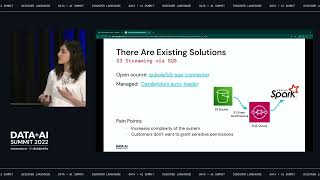
An Advanced S3 Connector for Spark to Hunt for Cyber Attacks

Working with S3 is different from doing so with HDFS: The architecture of the Object store makes the standard Spark file connector inefficient to work with S3.

There is a way to tackle this problem with a message queue for listening to changes in a bucket. What if an additional message queue is not an option and you need to use Spark-streaming? You can use a standard file connector, but you quickly face performance degradation with a number of files in the source path.

We have seen this happen at Hunters, a security operations platform that works with a wide range of data sources.

We want to share a description of the problem and the solution we will open-source. The audience will learn how to configure it and make the best use of it. We will also discuss how to use metadata to boost the performance of discovering new files in the stream and show the use case of utilizing time metadata of CloudTrail to efficiently collect logs for hunting cyber attacks.

Connect with us: Website: https://databricks.com Facebook: https://www.facebook.com/databricksinc Twitter: https://twitter.com/databricks LinkedIn: https://www.linkedin.com/company/data... Instagram: https://www.instagram.com/databricksinc/

Summary There is a lot of attention on the database market and cloud data warehouses. While they provide a measure of convenience, they also require you to sacrifice a certain amount of control over your data. If you want to build a warehouse that gives you both control and flexibility then you might consider building on top of the venerable PostgreSQL project. In this episode Thomas Richter and Joshua Drake share their advice on how to build a production ready data warehouse with Postgres.

Announcements

Hello and welcome to the Data Engineering Podcast, the show about modern data management When you’re ready to build your next pipeline, or want to test out the projects you hear about on the show, you’ll need somewhere to deploy it, so check out our friends at Linode. With their managed Kubernetes platform it’s now even easier to deploy and scale your workflows, or try out the latest Helm charts from tools like Pulsar and Pachyderm. With simple pricing, fast networking, object storage, and worldwide data centers, you’ve got everything you need to run a bulletproof data platform. Go to dataengineeringpodcast.com/linode today and get a $100 credit to try out a Kubernetes cluster of your own. And don’t forget to thank them for their continued support of this show! Firebolt is the fastest cloud data warehouse. Visit dataengineeringpodcast.com/firebolt to get started. The first 25 visitors will receive a Firebolt t-shirt. Atlan is a collaborative workspace for data-driven teams, like Github for engineering or Figma for design teams. By acting as a virtual hub for data assets ranging from tables and dashboards to SQL snippets & code, Atlan enables teams to create a single source of truth for all their data assets, and collaborate across the modern data stack through deep integrations with tools like Snowflake, Slack, Looker and more. Go to dataengineeringpodcast.com/atlan today and sign up for a free trial. If you’re a data engineering podcast listener, you get credits worth $3000 on an annual subscription Your host is Tobias Macey and today I’m interviewing Thomas Richter and Joshua Drake about using Postgres as your data warehouse

Interview

Introduction How did you get involved in the area of data management? Can you start by establishing a working definition of what constitutes a data warehouse for the purpose of this discussion?

What are the limitations for out-of-the-box Postgres when trying to use it for these workloads?

There are a large and growing number of options for data warehouse style workloads. How would you categorize the different systems and what is PostgreSQL’s position in that ecosystem?

What do you see as the motivating factors for a team or organization to select from among those categories?

Why would someone want to use Postgres as their data warehouse platform rather than using a purpose-built engine? What is the cost/performance equation for Postgres as compared to other data warehouse solutions? For someone who wants to turn Postgres into a data warehouse engine, what are their options?

What are the relative tradeoffs of the different open source and commercial offerings? (e.g. Citus, cstore_fdw, zedstore, Swarm64, Greenplum, etc.)

One of the biggest areas of growth right now is in the "cloud data warehouse" market where storage and compute are decoupled. What are the options for making that possible with Postgres? (e.g. using foreign data wrappers for interacting with data lake storage (S3, HDFS, Alluxio, etc.)) What areas of work are happening in the Postgres community for upcoming releases to make it more easily suited to data warehouse/analytical workloads? What are some of the most interesting, innovative, or unexpected ways that you have seen Postgres used in analytical contexts? What are the most interesting, unexpected, or challenging lessons that you have learned from your own experiences of building analytical systems with Postgres? When is Postgres the wrong choice fo

SQL Server Big Data Clusters: Data Virtualization, Data Lake, and AI Platform

Use this guide to one of SQL Server 2019’s most impactful features—Big Data Clusters. You will learn about data virtualization and data lakes for this complete artificial intelligence (AI) and machine learning (ML) platform within the SQL Server database engine. You will know how to use Big Data Clusters to combine large volumes of streaming data for analysis along with data stored in a traditional database. For example, you can stream large volumes of data from Apache Spark in real time while executing Transact-SQL queries to bring in relevant additional data from your corporate, SQL Server database. Filled with clear examples and use cases, this book provides everything necessary to get started working with Big Data Clusters in SQL Server 2019. You will learn about the architectural foundations that are made up from Kubernetes, Spark, HDFS, and SQL Server on Linux. You then are shown how to configure and deploy Big Data Clusters in on-premises environments or in the cloud. Next, you are taught about querying. You will learn to write queries in Transact-SQL—taking advantage of skills you have honed for years—and with those queries you will be able to examine and analyze data from a wide variety of sources such as Apache Spark. Through the theoretical foundation provided in this book and easy-to-follow example scripts and notebooks, you will be ready to use and unveil the full potential of SQL Server 2019: combining different types of data spread across widely disparate sources into a single view that is useful for business intelligence and machine learning analysis. What You Will Learn Install, manage, and troubleshoot Big Data Clusters in cloud or on-premise environments Analyze large volumes of data directly from SQL Server and/or Apache Spark Manage data stored in HDFS from SQL Server as if it wererelational data Implement advanced analytics solutions through machine learning and AI Expose different data sources as a single logical source using data virtualization Who This Book Is For Data engineers, data scientists, data architects, and database administrators who want to employ data virtualization and big data analytics in their environments

Introducing Microsoft SQL Server 2019

Introducing Microsoft SQL Server 2019 is the must-have guide for database professionals eager to leverage the latest advancements in SQL Server 2019. This book covers the features and capabilities that make SQL Server 2019 a powerful tool for managing and analyzing data both on-premises and in the cloud. What this Book will help me do Understand the new features introduced in SQL Server 2019 and their practical applications. Confidently manage and analyze relational, NoSQL, and big data within SQL Server 2019. Implement containerization for SQL Server using Docker and Kubernetes. Migrate and integrate your databases effectively to use Power BI Report Server. Query data from Hadoop Distributed File System with Azure Data Studio. Author(s) The authors of 'Introducing Microsoft SQL Server 2019' are subject matter experts including Kellyn Gorman, Allan Hirt, and others. With years of professional experience in database management and SQL Server, they bring a wealth of practical insight and knowledge to the book. Their experience spans roles as administrators, architects, and educators in the field. Who is it for? This book is aimed at database professionals such as DBAs, architects, and big data engineers who are currently using earlier versions of SQL Server or other database platforms. It is particularly well-suited for professionals aiming to understand and implement SQL Server 2019's new features. Readers should have basic familiarity with SQL Server and RDBMS concepts. If you're looking to explore SQL Server 2019 to improve data management and analytics in your organization, this book is for you.

IBM Spectrum Scale CSI Driver for Container Persistent Storage

IBM® Spectrum Scale is a proven, scalable, high-performance data and file management solution. It provides world-class storage management with extreme scalability, flash accelerated performance, automatic policy-based storage that has tiers of flash through disk to tape. It also provides support for various protocols, such as NFS, SMB, Object, HDFS, and iSCSI. Containers can leverage the performance, information lifecycle management (ILM), scalability, and multisite data management to give the full flexibility on storage as they experience on the runtime. Container adoption is increasing in all industries, and they sprawl across multiple nodes on a cluster. The effective management of containers is necessary because their number will probably reach a far greater number than virtual machines today. Kubernetes is the standard container management platform currently being used. Data management is of ultimate importance, and often is forgotten because the first workloads containerized are ephemeral. For data management, many drivers with different specifications were available. A specification named Container Storage Interface (CSI) was created and is now adopted by all major Container Orchestrator Systems available. Although other container orchestration systems exist, Kubernetes became the standard framework for container management. It is a very flexible open source platform used as the base for most cloud providers and software companies' container orchestration systems. Red Hat OpenShift is one of the most reliable enterprise-grade container orchestration systems based on Kubernetes, designed and optimized to easily deploy web applications and services. OpenShift enables developers to focus on the code, while the platform takes care of all of the complex IT operations and processes. This IBM Redbooks® publication describes how the CSI Driver for IBM file storage enables IBM Spectrum® Scale to be used as persistent storage for stateful applications running in Kubernetes clusters. Through the Container Storage Interface Driver for IBM file storage, Kubernetes persistent volumes (PVs) can be provisioned from IBM Spectrum Scale. Therefore, the containers can be used with stateful microservices, such as database applications (MongoDB, PostgreSQL, and so on).

SQL Server Big Data Clusters: Early First Edition Based on Release Candidate 1

Get a head-start on learning one of SQL Server 2019’s latest and most impactful features—Big Data Clusters—that combines large volumes of non-relational data for analysis along with data stored relationally inside a SQL Server database. This book provides a first look at Big Data Clusters based upon SQL Server 2019 Release Candidate 1. Start now and get a jump on your competition in learning this important new feature. Big Data Clusters is a feature set covering data virtualization, distributed computing, and relational databases and provides a complete AI platform across the entire cluster environment. This book shows you how to deploy, manage, and use Big Data Clusters. For example, you will learn how to combine data stored on the HDFS file system together with data stored inside the SQL Server instances that make up the Big Data Cluster. Filled with clear examples and use cases, this book provides everything necessary to get started working with Big Data Clusters in SQL Server 2019 using Release Candidate 1. You will learn about the architectural foundations that are made up from Kubernetes, Spark, HDFS, and SQL Server on Linux. You then are shown how to configure and deploy Big Data Clusters in on-premises environments or in the cloud. Next, you are taught about querying. You will learn to write queries in Transact-SQL—taking advantage of skills you have honed for years—and with those queries you will be able to examine and analyze data from a wide variety of sources such as Apache Spark. Through the theoretical foundation provided in this book and easy-to-follow example scripts and notebooks, you will be ready to use and unveil the full potential of SQL Server 2019: combining different types of data spread across widely disparate sources into a single view that is useful for business intelligence and machine learning analysis. What You Will Learn Install, manage, and troubleshoot Big Data Clusters in cloud or on-premise environments Analyze large volumes of data directly from SQL Server and/or Apache Spark Manage data stored in HDFS from SQL Server as if it were relational data Implement advanced analytics solutions through machine learning and AI Expose different data sources as a single logical source using data virtualization Who This Book Is For For data engineers, data scientists, data architects, and database administrators who want to employ data virtualization and big data analytics in their environment

Summary The scale and complexity of the systems that we build to satisfy business requirements is increasing as the available tools become more sophisticated. In order to bridge the gap between legacy infrastructure and evolving use cases it is necessary to create a unifying set of components. In this episode Dipti Borkar explains how the emerging category of data orchestration tools fills this need, some of the existing projects that fit in this space, and some of the ways that they can work together to simplify projects such as cloud migration and hybrid cloud environments. It is always useful to get a broad view of new trends in the industry and this was a helpful perspective on the need to provide mechanisms to decouple physical storage from computing capacity.

Announcements

Hello and welcome to the Data Engineering Podcast, the show about modern data management When you’re ready to build your next pipeline, or want to test out the projects you hear about on the show, you’ll need somewhere to deploy it, so check out our friends at Linode. With 200Gbit private networking, scalable shared block storage, and a 40Gbit public network, you’ve got everything you need to run a fast, reliable, and bullet-proof data platform. If you need global distribution, they’ve got that covered too with world-wide datacenters including new ones in Toronto and Mumbai. And for your machine learning workloads, they just announced dedicated CPU instances. Go to dataengineeringpodcast.com/linode today to get a $20 credit and launch a new server in under a minute. And don’t forget to thank them for their continued support of this show! This week’s episode is also sponsored by Datacoral, an AWS-native, serverless, data infrastructure that installs in your VPC. Datacoral helps data engineers build and manage the flow of data pipelines without having to manage any infrastructure, meaning you can spend your time invested in data transformations and business needs, rather than pipeline maintenance. Raghu Murthy, founder and CEO of Datacoral built data infrastructures at Yahoo! and Facebook, scaling from terabytes to petabytes of analytic data. He started Datacoral with the goal to make SQL the universal data programming language. Visit dataengineeringpodcast.com/datacoral today to find out more. You listen to this show to learn and stay up to date with what’s happening in databases, streaming platforms, big data, and everything else you need to know about modern data management. For even more opportunities to meet, listen, and learn from your peers you don’t want to miss out on this year’s conference season. We have partnered with organizations such as O’Reilly Media, Dataversity, Corinium Global Intelligence, Alluxio, and Data Council. Upcoming events include the combined events of the Data Architecture Summit and Graphorum, the Data Orchestration Summit, and Data Council in NYC. Go to dataengineeringpodcast.com/conferences to learn more about these and other events, and take advantage of our partner discounts to save money when you register today. Your host is Tobias Macey and today I’m interviewing Dipti Borkark about data orchestration and how it helps in migrating data workloads to the cloud

Interview

Introduction How did you get involved in the area of data management? Can you start by describing what you mean by the term "Data Orchestration"?

How does it compare to the concept of "Data Virtualization"? What are some of the tools and platforms that fit under that umbrella?

What are some of the motivations for organizations to use the cloud for their data oriented workloads?

What are they giving up by using cloud resources in place of on-premises compute?

For businesses that have invested heavily in their own datacenters, what are some ways that they can begin to replicate some of the benefits of cloud environments? What are some of the common patterns for cloud migration projects and what challenges do they present?

Do you have advice on useful metrics to track for determining project completion or success criteria?

How do businesses approach employee education for designing and implementing effective systems for achieving their migration goals? Can you talk through some of the ways that different data orchestration tools can be composed together for a cloud migration effort?

What are some of the common pain points that organizations encounter when working on hybrid implementations?

What are some of the missing pieces in the data orchestration landscape?

Are there any efforts that you are aware of that are aiming to fill those gaps?

Where is the data orchestration market heading, and what are some industry trends that are driving it?

What projects are you most interested in or excited by?

For someone who wants to learn more about data orchestration and the benefits the technologies can provide, what are some resources that you would recommend?

Contact Info

LinkedIn @dborkar on Twitter

Parting Question

From your perspective, what is the biggest gap in the tooling or technology for data management today?

Closing Announcements

Thank you for listening! Don’t forget to check out our other show, Podcast.init to learn about the Python language, its community, and the innovative ways it is being used. Visit the site to subscribe to the show, sign up for the mailing list, and read the show notes. If you’ve learned something or tried out a project from the show then tell us about it! Email [email protected]) with your story. To help other people find the show please leave a review on iTunes and tell your friends and co-workers Join the community in the new Zulip chat workspace at dataengineeringpodcast.com/chat

Links

Alluxio

Podcast Episode

UC San Diego Couchbase Presto

Podcast Episode

Spark SQL Data Orchestration Data Virtualization PyTorch

Podcast.init Episode

Rook storage orchestration PySpark MinIO

Podcast Episode

Kubernetes Openstack Hadoop HDFS Parquet Files

Podcast Episode

ORC Files Hive Metastore Iceberg Table Format

Podcast Episode

Data Orchestration Summit Star Schema Snowflake Schema Data Warehouse Data Lake Teradata

The intro and outro music is from The Hug by The Freak Fandango Orchestra / CC BY-SA

Support Data Engineering Podcast

SQL Server 2019 Revealed: Including Big Data Clusters and Machine Learning

Get up to speed on the game-changing developments in SQL Server 2019. No longer just a database engine, SQL Server 2019 is cutting edge with support for machine learning (ML), big data analytics, Linux, containers, Kubernetes, Java, and data virtualization to Azure. This is not a book on traditional database administration for SQL Server. It focuses on all that is new for one of the most successful modernized data platforms in the industry. It is a book for data professionals who already know the fundamentals of SQL Server and want to up their game by building their skills in some of the hottest new areas in technology. SQL Server 2019 Revealed begins with a look at the project's team goal to integrate the world of big data with SQL Server into a major product release. The book then dives into the details of key new capabilities in SQL Server 2019 using a “learn by example” approach for Intelligent Performance, security, mission-criticalavailability, and features for the modern developer. Also covered are enhancements to SQL Server 2019 for Linux and gain a comprehensive look at SQL Server using containers and Kubernetes clusters. The book concludes by showing you how to virtualize your data access with Polybase to Oracle, MongoDB, Hadoop, and Azure, allowing you to reduce the need for expensive extract, transform, and load (ETL) applications. You will then learn how to take your knowledge of containers, Kubernetes, and Polybase to build a comprehensive solution called Big Data Clusters, which is a marquee feature of 2019. You will also learn how to gain access to Spark, SQL Server, and HDFS to build intelligence over your own data lake and deploy end-to-end machine learning applications. What You Will Learn Implement Big Data Clusters with SQL Server, Spark, and HDFS Create a Data Hub with connections to Oracle, Azure, Hadoop, and other sources Combine SQL and Spark to build a machine learning platform for AI applications Boost your performance with no application changes using Intelligent Performance Increase security of your SQL Server through Secure Enclaves and Data Classification Maximize database uptime through online indexing and Accelerated Database Recovery Build new modern applications with Graph, ML Services, and T-SQL Extensibility with Java Improve your ability to deploy SQL Server on Linux Gain in-depth knowledge to run SQL Server with containers and Kubernetes Know all the new database engine features for performance, usability, and diagnostics Use the latest tools and methods to migrate your database to SQL Server 2019 Apply your knowledge of SQL Server 2019 to Azure Who This Book Is For IT professionals and developers who understand the fundamentals of SQL Server and wish to focus on learning about the new, modern capabilities of SQL Server 2019. The book is for those who want to learn about SQL Server 2019 and the new Big Data Clusters and AI feature set, support for machine learning and Java, how to run SQL Server with containers and Kubernetes, and increased capabilities around Intelligent Performance, advanced security, and high availability.

Summary Object storage is quickly becoming the unifying layer for data intensive applications and analytics. Modern, cloud oriented data warehouses and data lakes both rely on the durability and ease of use that it provides. S3 from Amazon has quickly become the de-facto API for interacting with this service, so the team at MinIO have built a production grade, easy to manage storage engine that replicates that interface. In this episode Anand Babu Periasamy shares the origin story for the MinIO platform, the myriad use cases that it supports, and the challenges that they have faced in replicating the functionality of S3. He also explains the technical implementation, innovative design, and broad vision for the project.

Announcements

Hello and welcome to the Data Engineering Podcast, the show about modern data management When you’re ready to build your next pipeline, or want to test out the projects you hear about on the show, you’ll need somewhere to deploy it, so check out our friends at Linode. With 200Gbit private networking, scalable shared block storage, and a 40Gbit public network, you’ve got everything you need to run a fast, reliable, and bullet-proof data platform. If you need global distribution, they’ve got that covered too with world-wide datacenters including new ones in Toronto and Mumbai. And for your machine learning workloads, they just announced dedicated CPU instances. Go to dataengineeringpodcast.com/linode today to get a $20 credit and launch a new server in under a minute. And don’t forget to thank them for their continued support of this show! You listen to this show to learn and stay up to date with what’s happening in databases, streaming platforms, big data, and everything else you need to know about modern data management.For even more opportunities to meet, listen, and learn from your peers you don’t want to miss out on this year’s conference season. We have partnered with organizations such as O’Reilly Media, Dataversity, Corinium Global Intelligence, and Data Council. Upcoming events include the O’Reilly AI conference, the Strata Data conference, the combined events of the Data Architecture Summit and Graphorum, and Data Council in Barcelona. Go to dataengineeringpodcast.com/conferences to learn more about these and other events, and take advantage of our partner discounts to save money when you register today. Your host is Tobias Macey and today I’m interviewing Anand Babu Periasamy about MinIO, the neutral, open source, enterprise grade object storage system.

Interview

Introduction How did you get involved in the area of data management? Can you explain what MinIO is and its origin story? What are some of the main use cases that MinIO enables? How does MinIO compare to other object storage options and what benefits does it provide over other open source platforms?

Your marketing focuses on the utility of MinIO for ML and AI workloads. What benefits does object storage provide as compared to distributed file systems? (e.g. HDFS, GlusterFS, Ceph)

What are some of the challenges that you face in terms of maintaining compatibility with the S3 interface?

What are the constraints and opportunities that are provided by adhering to that API?

Can you describe how MinIO is implemented and the overall system design?

How has that design evolved since you first began working on it?

What assumptions did you have at the outset and how have they been challenged or updated?

What are the axes for scaling that MinIO provides and how does it handle clustering?

Where does it fall on the axes of availability and consistency in the CAP theorem?

One of the useful features that you provide is efficient erasure coding, as well as protection against data corruption. How much overhead do those capabilties incur, in terms of computational efficiency and, in a clustered scenario, storage volume? For someone who is interested in running MinIO, what is involved in deploying and maintain

IBM Spectrum Scale: Big Data and Analytics Solution Brief

This IBM® Redguide™ publication describes big data and analytics deployments that are built on IBM Spectrum Scale™. IBM Spectrum Scale is a proven enterprise-level distributed file system that is a high-performance and cost-effective alternative to Hadoop Distributed File System (HDFS) for Hadoop analytics services. IBM Spectrum Scale includes NFS, SMB, and Object services and meets the performance that is required by many industry workloads, such as technical computing, big data, analytics, and content management. IBM Spectrum Scale provides world-class, web-based storage management with extreme scalability, flash accelerated performance, and automatic policy-based storage tiering from flash through disk to the cloud, which reduces storage costs up to 90% while improving security and management efficiency in cloud, big data, and analytics environments. This Redguide publication is intended for technical professionals (analytics consultants, technical support staff, IT Architects, and IT Specialists) who are responsible for providing Hadoop analytics services and are interested in learning about the benefits of the use of IBM Spectrum Scale as an alternative to HDFS.

Hands-On Big Data Analytics with PySpark

Dive into the exciting world of big data analytics with 'Hands-On Big Data Analytics with PySpark'. This practical guide offers you the tools and knowledge to tackle massive datasets using PySpark. By exploring real-world examples, you'll learn to unleash the power of distributed systems to analyze and manipulate data at scale. What this Book will help me do Master using PySpark to handle large and complex datasets efficiently and effectively. Develop skills to optimize Spark programs using best practices like reducing shuffle operations. Learn to set up a PySpark environment, process data from platforms like HDFS, Hive, and S3. Enhance your data analytics capabilities by implementing powerful SQL queries and data visualizations. Understand testing and debugging techniques to build reliable, production-quality data pipelines. Author(s) Authored by Rudy Lai and Bartłomiej Potaczek, both seasoned data engineers and authors in the big data field. Rudy and Bartłomiej bring their extensive experience working with distributed systems and scalable data architectures into this book. Their approach is hands-on, focusing on real-world applications and best practices. Who is it for? This book is tailored for data scientists, engineers, and developers eager to advance their big data analytics capabilities. Whether you're new to big data or experienced with other analytics frameworks, this book will equip you with practical knowledge to utilize PySpark for scalable data solutions.

Integration of IBM Aspera Sync with IBM Spectrum Scale: Protecting and Sharing Files Globally

Economic globalization requires data to be available globally. With most data stored in file systems, solutions to make this data globally available become more important. Files that are in file systems can be protected or shared by replicating these files to another file system that is in a remote location. The remote location might be just around the corner or in a different country. Therefore, the techniques that are used to protect and share files must account for long distances and slow and unreliable wide area network (WAN) connections. IBM® Spectrum Scale is a scalable clustered file system that can be used to store all kinds of unstructured data. It provides open data access by way of Network File System (NFS); Server Message Block (SMB); POSIX Object Storage APIs, such as S3 and OpenStack Swift; and the Hadoop Distributed File System (HDFS) for accessing and sharing data. The IBM Aspera® file transfer solution (IBM Aspera Sync) provides predictable and reliable data transfer across large distance for small and large files. The combination of both can be used for global sharing and protection of data. This IBM Redpaper™ publication describes how IBM Aspera Sync can be used to protect and share data that is stored in IBM Spectrum™ Scale file systems across large distances of several hundred to thousands of miles. We also explain the integration of IBM Aspera Sync with IBM Spectrum Scale™ and differentiate it from solutions that are built into IBM Spectrum Scale for protection and sharing. We also describe different use cases for IBM Aspera Sync with IBM Spectrum Scale.

Mastering Hadoop 3

"Mastering Hadoop 3" is your in-depth guide to understanding and mastering the advanced features of the Hadoop ecosystem. With a focus on distributed computing and data processing, this book covers essential tools such as YARN, MapReduce, and Apache Spark to help you build scalable, efficient data pipelines. What this Book will help me do Gain a comprehensive understanding of Hadoop Distributed File System (HDFS) and YARN for effective resource management. Master data processing with MapReduce and learn to integrate with real-time processing engines like Spark and Flink. Develop and secure enterprise-grade Hadoop-based data pipelines by implementing robust security and governance measures. Explore techniques for batch data processing, data modeling, and designing applications tailored for Hadoop environments. Understand best practices for optimizing and troubleshooting Hadoop clusters for enhanced performance and reliability. Author(s) The authors, including None Wong, None Singh, and None Kumar, bring together years of experience in big data engineering, distributed systems, and enterprise application development. They aim to provide a clear pathway to mastering Hadoop ecosystem tools. Who is it for? This book is ideal for budding big data professionals who have some familiarity with Java and basic Hadoop concepts and wish to elevate their expertise. If you're a Hadoop career practitioner keen to expand your understanding of the ecosystem's advanced capabilities or a professional looking to implement Hadoop in organizational workflows, this book is well-suited for you.

Summary

The Hadoop platform is purpose built for processing large, slow moving data in long-running batch jobs. As the ecosystem around it has grown, so has the need for fast data analytics on fast moving data. To fill this need the Kudu project was created with a column oriented table format that was tuned for high volumes of writes and rapid query execution across those tables. For a perfect pairing, they made it easy to connect to the Impala SQL engine. In this episode Brock Noland and Jordan Birdsell from PhData explain how Kudu is architected, how it compares to other storage systems in the Hadoop orbit, and how to start integrating it into you analytics pipeline.

Preamble

Hello and welcome to the Data Engineering Podcast, the show about modern data management When you’re ready to build your next pipeline, or want to test out the projects you hear about on the show, you’ll need somewhere to deploy it, so check out Linode. With 200Gbit private networking, scalable shared block storage, and a 40Gbit public network, you’ve got everything you need to run a fast, reliable, and bullet-proof data platform. If you need global distribution, they’ve got that covered too with world-wide datacenters including new ones in Toronto and Mumbai. Go to dataengineeringpodcast.com/linode today to get a $20 credit and launch a new server in under a minute. Go to dataengineeringpodcast.com to subscribe to the show, sign up for the mailing list, read the show notes, and get in touch. To help other people find the show please leave a review on iTunes, or Google Play Music, tell your friends and co-workers, and share it on social media. Join the community in the new Zulip chat workspace at dataengineeringpodcast.com/chat Your host is Tobias Macey and today I’m interviewing Brock Noland and Jordan Birdsell about Apache Kudu and how it is able to provide fast analytics on fast data in the Hadoop ecosystem

Interview

Introduction How did you get involved in the area of data management? Can you start by explaining what Kudu is and the motivation for building it?

How does it fit into the Hadoop ecosystem? How does it compare to the work being done on the Iceberg table format?

What are some of the common application and system design patterns that Kudu supports? How is Kudu architected and how has it evolved over the life of the project? There are many projects in and around the Hadoop ecosystem that rely on Zookeeper as a building block for consensus. What was the reasoning for using Raft in Kudu? How does the storage layer in Kudu differ from what would be found in systems like Hive or HBase?

What are the implementation details in the Kudu storage interface that have had the greatest impact on its overall speed and performance?

A number of the projects built for large scale data processing were not initially built with a focus on operational simplicity. What are the features of Kudu that simplify deployment and management of production infrastructure? What was the motivation for using C++ as the language target for Kudu?

If you were to start the project over today what would you do differently?

What are some situations where you would advise against using Kudu? What have you found to be the most interesting/unexpected/challenging lessons learned in the process of building and maintaining Kudu? What are you most excited about for the future of Kudu?

Contact Info

Brock

LinkedIn @brocknoland on Twitter

Jordan

LinkedIn @jordanbirdsell jbirdsell on GitHub

PhData

Website phdata on GitHub @phdatainc on Twitter

Parting Question

From your perspective, what is the biggest gap in the tooling or technology for data management today?

Links

Kudu PhData Getting Started with Apache Kudu Thomson Reuters Hadoop Oracle Exadata Slowly Changing Dimensions HDFS S3 Azure Blob Storage State Farm Stanly Black & Decker ETL (Extract, Transform, Load) Parquet

Podcast Episode

ORC HBase Spark

Podcast Episode

Learning Apache Drill

Get up to speed with Apache Drill, an extensible distributed SQL query engine that reads massive datasets in many popular file formats such as Parquet, JSON, and CSV. Drill reads data in HDFS or in cloud-native storage such as S3 and works with Hive metastores along with distributed databases such as HBase, MongoDB, and relational databases. Drill works everywhere: on your laptop or in your largest cluster. In this practical book, Drill committers Charles Givre and Paul Rogers show analysts and data scientists how to query and analyze raw data using this powerful tool. Data scientists today spend about 80% of their time just gathering and cleaning data. With this book, you’ll learn how Drill helps you analyze data more effectively to drive down time to insight. Use Drill to clean, prepare, and summarize delimited data for further analysis Query file types including logfiles, Parquet, JSON, and other complex formats Query Hadoop, relational databases, MongoDB, and Kafka with standard SQL Connect to Drill programmatically using a variety of languages Use Drill even with challenging or ambiguous file formats Perform sophisticated analysis by extending Drill’s functionality with user-defined functions Facilitate data analysis for network security, image metadata, and machine learning

Apache Hadoop 3 Quick Start Guide

Dive into the world of distributed data processing with the 'Apache Hadoop 3 Quick Start Guide.' This comprehensive resource equips you with the knowledge needed to handle large datasets effectively using Apache Hadoop. Learn how to set up and configure Hadoop, work with its core components, and explore its powerful ecosystem tools. What this Book will help me do Understand the fundamental concepts of Apache Hadoop, including HDFS, MapReduce, and YARN, and use them to store and process large datasets. Set up and configure Hadoop 3 in both developer and production environments to suit various deployment needs. Gain hands-on experience with Hadoop ecosystem tools like Hive, Kafka, and Spark to enhance your big data processing capabilities. Learn to manage, monitor, and troubleshoot Hadoop clusters efficiently to ensure smooth operations. Analyze real-time streaming data with tools like Apache Storm and perform advanced data analytics using Apache Spark. Author(s) The author of this guide, Vijay Karambelkar, brings years of experience working with big data technologies and Apache Hadoop in real-world applications. With a passion for teaching and simplifying complex topics, Vijay has compiled his expertise to help learners confidently approach Hadoop 3. His detailed, example-driven approach makes this book a practical resource for aspiring data professionals. Who is it for? This book is ideal for software developers, data engineers, and IT professionals who aspire to dive into the field of big data. If you're new to Apache Hadoop or looking to upgrade your skills to include version 3, this guide is for you. A basic understanding of Java programming is recommended to make the most of the topics covered. Embark on this journey to enhance your career in data-intensive industries.

Summary

With the growth of the Hadoop ecosystem came a proliferation of implementations for the Hive table format. Unfortunately, with no formal specification, each project works slightly different which increases the difficulty of integration across systems. The Hive format is also built with the assumptions of a local filesystem which results in painful edge cases when leveraging cloud object storage for a data lake. In this episode Ryan Blue explains how his work on the Iceberg table format specification and reference implementation has allowed Netflix to improve the performance and simplify operations for their S3 data lake. This is a highly detailed and technical exploration of how a well-engineered metadata layer can improve the speed, accuracy, and utility of large scale, multi-tenant, cloud-native data platforms.

Preamble

Hello and welcome to the Data Engineering Podcast, the show about modern data management When you’re ready to build your next pipeline you’ll need somewhere to deploy it, so check out Linode. With private networking, shared block storage, node balancers, and a 40Gbit network, all controlled by a brand new API you’ve got everything you need to run a bullet-proof data platform. Go to dataengineeringpodcast.com/linode to get a $20 credit and launch a new server in under a minute. Go to dataengineeringpodcast.com to subscribe to the show, sign up for the mailing list, read the show notes, and get in touch. Join the community in the new Zulip chat workspace at dataengineeringpodcast.com/chat Your host is Tobias Macey and today I’m interviewing Ryan Blue about Iceberg, a Netflix project to implement a high performance table format for batch workloads

Interview

Introduction How did you get involved in the area of data management? Can you start by explaining what Iceberg is and the motivation for creating it?

Was the project built with open-source in mind or was it necessary to refactor it from an internal project for public use?

How has the use of Iceberg simplified your work at Netflix? How is the reference implementation architected and how has it evolved since you first began work on it?

What is involved in deploying it to a user’s environment?

For someone who is interested in using Iceberg within their own environments, what is involved in integrating it with their existing query engine?

Is there a migration path for pre-existing tables into the Iceberg format?

How is schema evolution managed at the file level?

How do you handle files on disk that don’t contain all of the fields specified in a table definition?

One of the complicated problems in data modeling is managing table partitions. How does Iceberg help in that regard? What are the unique challenges posed by using S3 as the basis for a data lake?

What are the benefits that outweigh the difficulties?

What have been some of the most challenging or contentious details of the specification to define?

What are some things that you have explicitly left out of the specification?

What are your long-term goals for the Iceberg specification?

Do you anticipate the reference implementation continuing to be used and maintained?

Contact Info

rdblue on GitHub LinkedIn

Parting Question

From your perspective, what is the biggest gap in the tooling or technology for data management today?

Links

Iceberg Reference Implementation Iceberg Table Specification Netflix Hadoop Cloudera Avro Parquet Spark S3 HDFS Hive ORC S3mper Git Metacat Presto Pig DDL (Data Definition Language) Cost-Based Optimization

The intro and outro music is from The Hug by The Freak Fandango Orchestra / CC BY-SA Support Data Engineering Podcast

Summary

When working with large volumes of data that you need to access in parallel across multiple instances you need a distributed filesystem that will scale with your workload. Even better is when that same system provides multiple paradigms for interacting with the underlying storage. Ceph is a highly available, highly scalable, and performant system that has support for object storage, block storage, and native filesystem access. In this episode Sage Weil, the creator and lead maintainer of the project, discusses how it got started, how it works, and how you can start using it on your infrastructure today. He also explains where it fits in the current landscape of distributed storage and the plans for future improvements.

Preamble

Hello and welcome to the Data Engineering Podcast, the show about modern data management When you’re ready to build your next pipeline you’ll need somewhere to deploy it, so check out Linode. With private networking, shared block storage, node balancers, and a 40Gbit network, all controlled by a brand new API you’ve got everything you need to run a bullet-proof data platform. Go to dataengineeringpodcast.com/linode to get a $20 credit and launch a new server in under a minute. Are you struggling to keep up with customer request and letting errors slip into production? Want to try some of the innovative ideas in this podcast but don’t have time? DataKitchen’s DataOps software allows your team to quickly iterate and deploy pipelines of code, models, and data sets while improving quality. Unlike a patchwork of manual operations, DataKitchen makes your team shine by providing an end to end DataOps solution with minimal programming that uses the tools you love. Join the DataOps movement and sign up for the newsletter at datakitchen.io/de today. After that learn more about why you should be doing DataOps by listening to the Head Chef in the Data Kitchen at dataengineeringpodcast.com/datakitchen Go to dataengineeringpodcast.com to subscribe to the show, sign up for the mailing list, read the show notes, and get in touch. Join the community in the new Zulip chat workspace at dataengineeringpodcast.com/chat Your host is Tobias Macey and today I’m interviewing Sage Weil about Ceph, an open source distributed file system that supports block storage, object storage, and a file system interface.

Interview

Introduction How did you get involved in the area of data management? Can you start with an overview of what Ceph is?

What was the motivation for starting the project? What are some of the most common use cases for Ceph?

There are a large variety of distributed file systems. How would you characterize Ceph as it compares to other options (e.g. HDFS, GlusterFS, LionFS, SeaweedFS, etc.)? Given that there is no single point of failure, what mechanisms do you use to mitigate the impact of network partitions?

What mechanisms are available to ensure data integrity across the cluster?

How is Ceph implemented and how has the design evolved over time? What is required to deploy and manage a Ceph cluster?

What are the scaling factors for a cluster? What are the limitations?

How does Ceph handle mixed write workloads with either a high volume of small files or a smaller volume of larger files? In services such as S3 the data is segregated from block storage options like EBS or EFS. Since Ceph provides all of those interfaces in one project is it possible to use each of those interfaces to the same data objects in a Ceph cluster? In what situations would you advise someone against using Ceph? What are some of the most interested, unexpected, or challenging aspects of working with Ceph and the community? What are some of the plans that you have for the future of Ceph?

Contact Info

Email @liewegas on Twitter liewegas on GitHub

Parting Question

From your perspective, what is the biggest gap in the tooling or technology for data management today?

Links

Ceph Red Hat DreamHo

Next-Generation Big Data: A Practical Guide to Apache Kudu, Impala, and Spark

Utilize this practical and easy-to-follow guide to modernize traditional enterprise data warehouse and business intelligence environments with next-generation big data technologies. Next-Generation Big Data takes a holistic approach, covering the most important aspects of modern enterprise big data. The book covers not only the main technology stack but also the next-generation tools and applications used for big data warehousing, data warehouse optimization, real-time and batch data ingestion and processing, real-time data visualization, big data governance, data wrangling, big data cloud deployments, and distributed in-memory big data computing. Finally, the book has an extensive and detailed coverage of big data case studies from Navistar, Cerner, British Telecom, Shopzilla, Thomson Reuters, and Mastercard. What You’ll Learn Install Apache Kudu, Impala, and Spark to modernize enterprise data warehouse and business intelligence environments, complete with real-world, easy-to-follow examples, and practical advice Integrate HBase, Solr, Oracle, SQL Server, MySQL, Flume, Kafka, HDFS, and Amazon S3 with Apache Kudu, Impala, and Spark Use StreamSets, Talend, Pentaho, and CDAP for real-time and batch data ingestion and processing Utilize Trifacta, Alteryx, and Datameer for data wrangling and interactive data processing Turbocharge Spark with Alluxio, a distributed in-memory storage platform Deploy big data in the cloud using Cloudera Director Perform real-time data visualization and time series analysis using Zoomdata, Apache Kudu, Impala, and Spark Understand enterprise big data topics such as big data governance, metadata management, data lineage, impact analysis, and policy enforcement, and how to use Cloudera Navigator to perform common data governance tasks Implement big data use cases such as big data warehousing, data warehouse optimization, Internet of Things, real-time data ingestion and analytics, complex event processing, and scalable predictive modeling Study real-world big data case studies from innovative companies, including Navistar, Cerner, British Telecom, Shopzilla, Thomson Reuters, and Mastercard Who This Book Is For BI and big data warehouse professionals interested in gaining practical and real-world insight into next-generation big data processing and analytics using Apache Kudu, Impala, and Spark; and those who want to learn more about other advanced enterprise topics