talk-data.com talk-data.com

Topic

data

5765

tagged

Activity Trend

3 peak/qtr
2020-Q1 2026-Q1

Activities

5765 activities · Newest first

Essential Data Analytics, Data Science, and AI: A Practical Guide for a Data-Driven World

In today’s world, understanding data analytics, data science, and artificial intelligence is not just an advantage but a necessity. This book is your thorough guide to learning these innovative fields, designed to make the learning practical and engaging. The book starts by introducing data analytics, data science, and artificial intelligence. It illustrates real-world applications, and, it addresses the ethical considerations tied to AI. It also explores ways to gain data for practice and real-world scenarios, including the concept of synthetic data. Next, it uncovers Extract, Transform, Load (ETL) processes and explains how to implement them using Python. Further, it covers artificial intelligence and the pivotal role played by machine learning models. It explains feature engineering, the distinction between algorithms and models, and how to harness their power to make predictions. Moving forward, it discusses how to assess machine learning models after their creation, with insights into various evaluation techniques. It emphasizes the crucial aspects of model deployment, including the pros and cons of on-device versus cloud-based solutions. It concludes with real-world examples and encourages embracing AI while dispelling fears, and fostering an appreciation for the transformative potential of these technologies. Whether you’re a beginner or an experienced professional, this book offers valuable insights that will expand your horizons in the world of data and AI. What you will learn: What are Synthetic data and Telemetry data How to analyze data using programming languages like Python and Tableau. What is feature engineering What are the practical Implications of Artificial Intelligence Who this book is for: Data analysts, scientists, and engineers seeking to enhance their skills, explore advanced concepts, and stay up-to-date with ethics. Business leaders and decision-makers across industries are interested in understanding the transformative potential and ethical implications of data analytics and AI in their organizations.
Modern Business Analytics

Deriving business value from analytics is a challenging process. Turning data into information requires a business analyst who is adept at multiple technologies including databases, programming tools, and commercial analytics tools. This practical guide shows programmers who understand analysis concepts how to build the skills necessary to achieve business value. Author Deanne Larson, data science practitioner and academic, helps you bridge the technical and business worlds to meet these requirements. You'll focus on developing these skills with R and Python using real-world examples. You'll also learn how to leverage methodologies for successful delivery. Learning methodology combined with open source tools is key to delivering successful business analytics and value. This book shows you how to: Apply business analytics methodologies to achieve successful results Cleanse and transform data using R and Python Use R and Python to complete exploratory data analysis Create predictive models to solve business problems in R and Python Use Python, R, and business analytics tools to handle large volumes of data Commit code to GitHub to collaborate with data engineers and data scientists Measure success in business analytics

DuckDB: Up and Running

DuckDB, an open source in-process database created for OLAP workloads, provides key advantages over more mainstream OLAP solutions: It's embeddable and optimized for analytics. It also integrates well with Python and is compatible with SQL, giving you the performance and flexibility of SQL right within your Python environment. This handy guide shows you how to get started with this versatile and powerful tool. Author Wei-Meng Lee takes developers and data professionals through DuckDB's primary features and functions, best practices, and practical examples of how you can use DuckDB for a variety of data analytics tasks. You'll also dive into specific topics, including how to import data into DuckDB, work with tables, perform exploratory data analysis, visualize data, perform spatial analysis, and use DuckDB with JSON files, Polars, and JupySQL. Understand the purpose of DuckDB and its main functions Conduct data analytics tasks using DuckDB Integrate DuckDB with pandas, Polars, and JupySQL Use DuckDB to query your data Perform spatial analytics using DuckDB's spatial extension Work with a diverse range of data including Parquet, CSV, and JSON

Snowflake Data Engineering

A practical introduction to data engineering on the powerful Snowflake cloud data platform. Data engineers create the pipelines that ingest raw data, transform it, and funnel it to the analysts and professionals who need it. The Snowflake cloud data platform provides a suite of productivity-focused tools and features that simplify building and maintaining data pipelines. In Snowflake Data Engineering, Snowflake Data Superhero Maja Ferle shows you how to get started. In Snowflake Data Engineering you will learn how to: Ingest data into Snowflake from both cloud and local file systems Transform data using functions, stored procedures, and SQL Orchestrate data pipelines with streams and tasks, and monitor their execution Use Snowpark to run Python code in your pipelines Deploy Snowflake objects and code using continuous integration principles Optimize performance and costs when ingesting data into Snowflake Snowflake Data Engineering reveals how Snowflake makes it easy to work with unstructured data, set up continuous ingestion with Snowpipe, and keep your data safe and secure with best-in-class data governance features. Along the way, you’ll practice the most important data engineering tasks as you work through relevant hands-on examples. Throughout, author Maja Ferle shares design tips drawn from her years of experience to ensure your pipeline follows the best practices of software engineering, security, and data governance. About the Technology Pipelines that ingest and transform raw data are the lifeblood of business analytics, and data engineers rely on Snowflake to help them deliver those pipelines efficiently. Snowflake is a full-service cloud-based platform that handles everything from near-infinite storage, fast elastic compute services, inbuilt AI/ML capabilities like vector search, text-to-SQL, code generation, and more. This book gives you what you need to create effective data pipelines on the Snowflake platform. About the Book Snowflake Data Engineering guides you skill-by-skill through accomplishing on-the-job data engineering tasks using Snowflake. You’ll start by building your first simple pipeline and then expand it by adding increasingly powerful features, including data governance and security, adding CI/CD into your pipelines, and even augmenting data with generative AI. You’ll be amazed how far you can go in just a few short chapters! What's Inside Ingest data from the cloud, APIs, or Snowflake Marketplace Orchestrate data pipelines with streams and tasks Optimize performance and cost About the Reader For software developers and data analysts. Readers should know the basics of SQL and the Cloud. About the Author Maja Ferle is a Snowflake Subject Matter Expert and a Snowflake Data Superhero who holds the SnowPro Advanced Data Engineer and the SnowPro Advanced Data Analyst certifications. Quotes An incredible guide for going from zero to production with Snowflake. - Doyle Turner, Microsoft A must-have if you’re looking to excel in the field of data engineering. - Isabella Renzetti, Data Analytics Consultant & Trainer Masterful! Unlocks the true potential of Snowflake for modern data engineers. - Shankar Narayanan, Microsoft Valuable insights will enhance your data engineering skills and lead to cost-effective solutions. A must read! - Frédéric L’Anglais, Maxa Comprehensive, up-to-date and packed with real-life code examples. - Albert Nogués, Danone

Just Enough Data Science and Machine Learning: Essential Tools and Techniques

An accessible introduction to applied data science and machine learning, with minimal math and code required to master the foundational and technical aspects of data science. In Just Enough Data Science and Machine Learning, authors Mark Levene and Martyn Harris present a comprehensive and accessible introduction to data science. It allows the readers to develop an intuition behind the methods adopted in both data science and machine learning, which is the algorithmic component of data science involving the discovery of patterns from input data. This book looks at data science from an applied perspective, where emphasis is placed on the algorithmic aspects of data science and on the fundamental statistical concepts necessary to understand the subject. The book begins by exploring the nature of data science and its origins in basic statistics. The authors then guide readers through the essential steps of data science, starting with exploratory data analysis using visualisation tools. They explain the process of forming hypotheses, building statistical models, and utilising algorithmic methods to discover patterns in the data. Finally, the authors discuss general issues and preliminary concepts that are needed to understand machine learning, which is central to the discipline of data science. The book is packed with practical examples and real-world data sets throughout to reinforce the concepts. All examples are supported by Python code external to the reading material to keep the book timeless. Notable features of this book: Clear explanations of fundamental statistical notions and concepts Coverage of various types of data and techniques for analysis In-depth exploration of popular machine learning tools and methods Insight into specific data science topics, such as social networks and sentiment analysis Practical examples and case studies for real-world application Recommended further reading for deeper exploration of specific topics. ....

PostgreSQL Skills Development on Cloud: A Practical Guide to Database Management with AWS and Azure

This book provides a comprehensive approach to manage PostgreSQL cluster databases on Amazon Web Services and Azure Web Services on the cloud, as well as in Docker and container environments on a Red Hat operating system. Furthermore, detailed references for managing PostgreSQL on both Windows and Mac are provided. This book condenses all the fundamental and essential concepts you need to manage a PostgreSQL cluster into a one-stop guide that is perfect for newcomers to Postgres database administration. Each chapter of the book provides historical context and documents version changes of the PostgreSQL cluster, elucidates practical "how-to" methods, and includes illustrations and key word definitions, practices for application, a summary of key learnings, and questions to reinforce understanding. The book also outlines a clear study objective with a weekly learning schedule and hundreds of practice exercises, along with questions and answers. With its comprehensive and practical approach, this book will help you gain the confidence to manage all aspects of a PostgreSQL cluster in critical production environments so you can better support your organization's database infrastructure on the cloud and in containers. What You Will Learn Install and configure Postgres clusters on the cloud and in containers, monitor database logs, start and stop databases, troubleshoot, tune performance, backup and recover, and integrate with Amazon S3 and Azure Data Blob Manage Postgres databases on Amazon Web Services and Azure Web Services on the cloud, as well as in Docker and container environments on a Red Hat operating system Access sample references to scripting solutions and database management tools for working with Postgres, Redshift (based on Postgres 8.2), and Docker Create Amazon Machine Images (AMI) and Azure Images for managing a fleet of Postgres clusters on the cloud Reinforce knowledge with a weekly learning schedule and hundreds of practice exercises, along with questions and answers Progress from simple concepts, such as how to choose the correct instance type, to creating complex machine images Gain access to an Amazon AMI with a DBA admin tool, allowing you to learn Postgres, Redshift, and Docker in a cloud environment Refer to a comprehensive summary of documentations of Postgres, Amazon Web services, Azure Web services, and Red Hat Linux for managing all aspects of Postgres cluster management on the cloud Who This Book Is For Newcomers to PostgreSQL database administration and cross-platform support DBAs looking to master PostgreSQL on the cloud.

The Data Science Handbook, 2nd Edition

Practical, accessible guide to becoming a data scientist, updated to include the latest advances in data science and related fields. Becoming a data scientist is hard. The job focuses on mathematical tools, but also demands fluency with software engineering, understanding of a business situation, and deep understanding of the data itself. This book provides a crash course in data science, combining all the necessary skills into a unified discipline. The focus of The Data Science Handbook is on practical applications and the ability to solve real problems, rather than theoretical formalisms that are rarely needed in practice. Among its key points are: An emphasis on software engineering and coding skills, which play a significant role in most real data science problems. Extensive sample code, detailed discussions of important libraries, and a solid grounding in core concepts from computer science (computer architecture, runtime complexity, and programming paradigms). A broad overview of important mathematical tools, including classical techniques in statistics, stochastic modeling, regression, numerical optimization, and more. Extensive tips about the practical realities of working as a data scientist, including understanding related jobs functions, project life cycles, and the varying roles of data science in an organization. Exactly the right amount of theory. A solid conceptual foundation is required for fitting the right model to a business problem, understanding a tool’s limitations, and reasoning about discoveries. Data science is a quickly evolving field, and this 2nd edition has been updated to reflect the latest developments, including the revolution in AI that has come from Large Language Models and the growth of ML Engineering as its own discipline. Much of data science has become a skillset that anybody can have, making this book not only for aspiring data scientists, but also for professionals in other fields who want to use analytics as a force multiplier in their organization.

AI Engineering

Recent breakthroughs in AI have not only increased demand for AI products, they've also lowered the barriers to entry for those who want to build AI products. The model-as-a-service approach has transformed AI from an esoteric discipline into a powerful development tool that anyone can use. Everyone, including those with minimal or no prior AI experience, can now leverage AI models to build applications. In this book, author Chip Huyen discusses AI engineering: the process of building applications with readily available foundation models. The book starts with an overview of AI engineering, explaining how it differs from traditional ML engineering and discussing the new AI stack. The more AI is used, the more opportunities there are for catastrophic failures, and therefore, the more important evaluation becomes. This book discusses different approaches to evaluating open-ended models, including the rapidly growing AI-as-a-judge approach. AI application developers will discover how to navigate the AI landscape, including models, datasets, evaluation benchmarks, and the seemingly infinite number of use cases and application patterns. You'll learn a framework for developing an AI application, starting with simple techniques and progressing toward more sophisticated methods, and discover how to efficiently deploy these applications. Understand what AI engineering is and how it differs from traditional machine learning engineering Learn the process for developing an AI application, the challenges at each step, and approaches to address them Explore various model adaptation techniques, including prompt engineering, RAG, fine-tuning, agents, and dataset engineering, and understand how and why they work Examine the bottlenecks for latency and cost when serving foundation models and learn how to overcome them Choose the right model, dataset, evaluation benchmarks, and metrics for your needs Chip Huyen works to accelerate data analytics on GPUs at Voltron Data. Previously, she was with Snorkel AI and NVIDIA, founded an AI infrastructure startup, and taught Machine Learning Systems Design at Stanford. She's the author of the book Designing Machine Learning Systems, an Amazon bestseller in AI. AI Engineering builds upon and is complementary to Designing Machine Learning Systems (O'Reilly).

Hacking MySQL: Breaking, Optimizing, and Securing MySQL for Your Use Case

Your MySQL instances are probably broken. Many developers face slow-running queries, issues related to database architecture, replication, or database security—and that’s only the beginning. This book will deliver answers to your most pressing MySQL database questions related to performance, availability, or security by uncovering what causes databases to break in the first place. At its core, this book provides you with the knowledge necessary for you to break your database instances so you can better optimize it for performance and secure it from data breaches. In other words, you’ll discover the sorts of actions, minor and major, that degrade databases so you can fix and ultimately preempt them. MySQL sometimes acts according to its own rules, and this book will help you keep it working on your terms. At the same time, you will learn to optimize your backup and recovery procedures, determine when and which data to index to achieve maximum performance, and choose the best MySQL configurations, among other essential skills. Most MySQL books focus exclusively on optimization, but this book argues that it’s just as important to pay attention to the ways databases break. Indeed, after reading this book, you will be able to safely break your database instances to expose and overcome the nuanced issues that affect performance, availability, and security. What You Will Learn Know the basics of MySQL and the storage engines innoDB and MyISAM Spot the ways you are harming your database’s performance, availability and security without even realizing it Fix minor bugs and issues that have surprisingly serious impact Optimize schema, data types, queries, indexes, and partitions to head off issues Understand key MySQL security strategies Who This Book Is For Database administrators, web developers, systems administrators, and security professionals with an intermediary knowledge of database management systems and building applications in MySQL

Applied Data Science Using PySpark: Learn the End-to-End Predictive Model-Building Cycle

This comprehensive guide, featuring hand-picked examples of daily use cases, will walk you through the end-to-end predictive model-building cycle using the latest techniques and industry tricks. In Chapters 1, 2, and 3, we will begin by setting up the environment and covering the basics of PySpark, focusing on data manipulation. Chapter 4 delves into the art of variable selection, demonstrating various techniques available in PySpark. In Chapters 5, 6, and 7, we explore machine learning algorithms, their implementations, and fine-tuning techniques. Chapters 8 and 9 will guide you through machine learning pipelines and various methods to operationalize and serve models using Docker/API. Chapter 10 will demonstrate how to unlock the power of predictive models to create a meaningful impact on your business. Chapter 11 introduces some of the most widely used and powerful modeling frameworks to unlock real value from data. In this new edition, you will learn predictive modeling frameworks that can quantify customer lifetime values and estimate the return on your predictive modeling investments. This edition also includes methods to measure engagement and identify actionable populations for effective churn treatments. Additionally, a dedicated chapter on experimentation design has been added, covering steps to efficiently design, conduct, test, and measure the results of your models. All code examples have been updated to reflect the latest stable version of Spark. You will: Gain an overview of end-to-end predictive model building Understand multiple variable selection techniques and their implementations Learn how to operationalize models Perform data science experiments and learn useful tips

Causal Inference in R

Causal Inference in R is a comprehensive guide that introduces you to the methods and practices of determining causality in data through the lens of R programming. By navigating its pages and examples, you'll master the application of causal models and statistical approaches to real-world problems, enabling more informed data-driven decisions. What this Book will help me do Understand the principles and foundations of causal inference to identify causality in data. Apply methods like propensity score matching and instrumental variables using R. Leverage real-world case studies to analyze and resolve confounding factors and make better data claims. Harness statistical methods and R tools to address real-world data challenges innovatively. Develop a strategy for integrating causal models into decision-making workflows with confidence. Author(s) Subhajit Das, the author of Causal Inference in R, is an accomplished applied scientist with over a decade of experience in causal inference methodologies and data analysis. Subhajit is passionate about empowering learners by breaking down complex concepts into manageable, clear explanations. His expertise ensures that readers not only understand the theory behind causal inference but are also able to apply it effectively using R. Who is it for? This book is ideal for data analysts, statisticians, and researchers looking to deepen their understanding of causal inference techniques using R. Whether you're a practitioner aiming to enhance your data-driven decision-making skills or a student aspiring to tackle advanced causal analysis, this book provides pathbreaking insights. It's suitable for individuals at beginner to intermediate skill levels in data analysis, especially those in public policy, economics, and the social sciences who utilize R regularly.

Data Engineering with AWS Cookbook

Data Engineering with AWS Cookbook serves as a comprehensive practical guide for building scalable and efficient data engineering solutions using AWS. With this book, you will master implementing data lakes, orchestrating data pipelines, and creating serving layers using AWS's robust services, such as Glue, EMR, Redshift, and Athena. With hands-on exercises and practical recipes, you will enhance your AWS-based data engineering projects. What this Book will help me do Gain the skills to design centralized data lake solutions and manage them securely at scale. Develop expertise in crafting data pipelines with AWS's ETL technologies like Glue and EMR. Learn to implement and automate governance, orchestration, and monitoring for data platforms. Build high-performance data serving layers using AWS analytics tools like Redshift and QuickSight. Effectively plan and execute data migrations to AWS from on-premises infrastructure. Author(s) Trâm Ngọc Phạm, Gonzalo Herreros González, Viquar Khan, and Huda Nofal bring together years of collective experience in data engineering and AWS cloud solutions. Each author's deep knowledge and passion for cloud technology have shaped this book into a valuable resource, geared towards practical learning and real-world application. Their approach ensures readers are not just learning but building tangible, impactful solutions. Who is it for? This book is geared towards data engineers and big data professionals engaged in or transitioning to cloud-based environments, specifically on AWS. Ideal readers are those looking to optimize workflows and master AWS tools to create scalable, efficient solutions. The content assumes a basic familiarity with AWS concepts like IAM roles and a command-line interface, ensuring all examples are accessible yet meaningful for those seeking advancement in AWS data engineering.

Managing Data as a Product

Discover how to transform your data architecture with the insights and techniques presented in Managing Data as a Product by Andrea Gioia. In this comprehensive guide, you'll explore how to design, implement, and maintain data-product-centered systems to meet modern demands, achieving scalable and sustainable data management tailored to your organization's needs. What this Book will help me do Understand the principles of data-product-centered architectures and their advantages. Learn to design, develop, and operate data products in production settings. Explore strategies to manage the lifecycle of data products efficiently. Gain insights into team topologies and data ownership for distributed systems. Discover data modeling techniques for AI-ready architectures. Author(s) Andrea Gioia is a renowned data architect and the creator of the Open Data Mesh Initiative. With over 20 years of experience, Andrea has successfully led complex data projects and is passionate about sharing his expertise. His writing is practical and driven by real-world challenges, aiming to equip engineers with actionable knowledge. Who is it for? This book is ideal for data engineers, software architects, and engineering leaders involved in shaping innovative data architectures. If you have foundational knowledge of data engineering and are eager to advance your expertise by adopting data-product principles, this book will suit your needs. It is for professionals aiming to modernize and optimize their approach to organizational data management.

Evolve from Infrastructure to Innovation with SAP on AWS: Strategize Beyond Infrastructure for Extending your SAP applications, Data Management, IoT & AI/ML integration and IT Operations using AWS Services

The world of SAP is undergoing a major transformation, with many customers either planning or actively modernizing their SAP landscapes as part of the S/4HANA digital transformation. Given the extensive SAP transformation efforts adopted by nearly all SAP customers in recent years and the profound impact these digital changes have had on their business models and IT organizations, the authors decided to write this book. As customers embark on their SAP on AWS journey, they face three main challenges: deciding on the overall strategy, selecting the right business use cases and implementing them effectively. This book aims to address these challenges by guiding readers through the process of identifying and executing the appropriate use cases. It will highlight how customers can harness AWS services beyond merely hosting their SAP systems on AWS, demonstrating the potential of these services to drive innovation. This book covers the entire journey, from defining strategy and identifying business use cases to their implementation, providing practical tips, strategies, and insights. It serves as an essential guide for customers planning to migrate or those who have already migrated their SAP workloads to AWS, helping them explore beyond just the infrastructure aspects of their journey. You Will : Discover how to go beyond just hosting SAP systems on AWS, using the full range of AWS services to innovate and extend your SAP applications. Learn how to identify the right business use cases and implement them effectively, with practical examples and real-world scenarios. Develop the mindset and skills needed to architect modern, cloud-native, event-driven architectures, balancing trade-offs between simplicity, efficiency, and cost. This book is for: Business leaders, IT professionals, and SAP specialists who are looking to modernize their SAP landscapes by leveraging AWS services

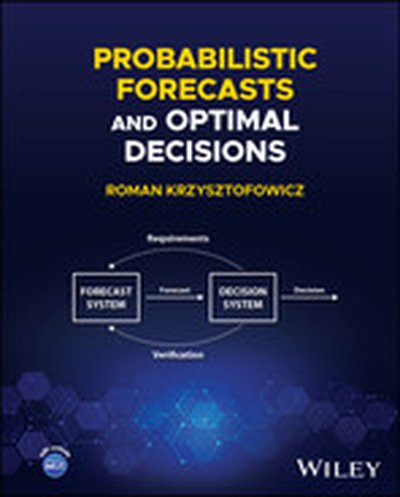
Probabilistic Forecasts and Optimal Decisions

Account for uncertainties and optimize decision-making with this thorough exposition Decision theory is a body of thought and research seeking to apply a mathematical-logical framework to assessing probability and optimizing decision-making. It has developed robust tools for addressing all major challenges to decision making. Yet the number of variables and uncertainties affecting each decision outcome, many of them beyond the decider’s control, mean that decision-making is far from a ‘solved problem’. The tools created by decision theory remain to be refined and applied to decisions in which uncertainties are prominent. Probabilistic Forecasts and Optimal Decisions introduces a theoretically-grounded methodology for optimizing decision-making under conditions of uncertainty. Beginning with an overview of the basic elements of probability theory and methods for modeling continuous variates, it proceeds to survey the mathematics of both continuous and discrete models, supporting each with key examples. The result is a crucial window into the complex but enormously rewarding world of decision theory. Readers of Probablistic Forecasts and Optimal Decisions will also find: Extended case studies supported with real-world data Mini-projects running through multiple chapters to illustrate different stages of the decision-making process End of chapter exercises designed to facilitate student learning Probabilistic Forecasts and Optimal Decisions is ideal for advanced undergraduate and graduate students in the sciences and engineering, as well as predictive analytics and decision analytics professionals.

Prompt Engineering for LLMs

Large language models (LLMs) are revolutionizing the world, promising to automate tasks and solve complex problems. A new generation of software applications are using these models as building blocks to unlock new potential in almost every domain, but reliably accessing these capabilities requires new skills. This book will teach you the art and science of prompt engineering-the key to unlocking the true potential of LLMs. Industry experts John Berryman and Albert Ziegler share how to communicate effectively with AI, transforming your ideas into a language model-friendly format. By learning both the philosophical foundation and practical techniques, you'll be equipped with the knowledge and confidence to build the next generation of LLM-powered applications. Understand LLM architecture and learn how to best interact with it Design a complete prompt-crafting strategy for an application Gather, triage, and present context elements to make an efficient prompt Master specific prompt-crafting techniques like few-shot learning, chain-of-thought prompting, and RAG

Collect, Combine, and Transform Data Using Power Query in Power BI and Excel, 2nd Edition

Transform your data analysis experience with Power Query, the ultimate tool for importing, reshaping, and cleansing data through a user-friendly interface. Whether youre using Power BI, Excel, or other Microsoft products, Power Querys capabilities are at your fingertips. Renowned Power Query experts Daniil Maslyuk and Gil Raviv guide you through mastering this indispensable tool, helping you eliminate tedious manual data preparation, tackle common issues, and avoid potential pitfalls. In this updated edition, youll delve into comprehensive analytics challenges, seamlessly integrating your skills into a realistic, final project. By the end, youll possess the expertise to handle any data and convert it into actionable insights. You will learn how to: Effortlessly prepare data by utilizing Power Query in Power BI and Excel to transform your data quickly and efficiently Overcome common data preparation problems with intuitive mouse clicks and straightforward formula edits Combine data from various sources, multiple queries, and mismatched tables with ease Reshape tables to suit your analysis needs Use the Power Query M formula language to create flexible data mashups and tailor transformations to your requirements Address and overcome collaboration challenges by using Power Querys powerful features Gain crucial insights from text feeds by enhancing your data analysis capabilities Profile data, diagnose queries, improve query performance, and more! About This Book For everyone who wants to get more done with Power Query in less time For business and financial professionals, developers, entrepreneurs, students, and others who need to efficiently manage and analyze data .

Learn FileMaker Pro 2024: The Comprehensive Guide to Building Custom Databases

FileMaker Pro is a development platform from Claris International Inc., a subsidiary of Apple Inc. The software makes it easy for everyone to create powerful, multi-user, cross-platform, relational database applications. This book navigates the reader through the software in a clear and logical manner, with each chapter building on the previous one. After an initial review of the user environment and application basics, the book delves into a deep exploration of the integrated development environment, which seamlessly combines the full stack of schema, business logic, and interface layers into a unified visual programming experience. Everything beginners need to get started is covered, along with advanced material that seasoned professionals will appreciate. Written by a professional developer with decades of real-world experience, "Learn FileMaker Pro 2024" is a comprehensive learning and reference guide. Join millions of users and developers worldwide in achieving a new level of workflow efficiency with FileMaker. For This New Edition This third edition includes clearer lessons and more examples, making it easier than ever to start planning, building, and deploying a custom database solution. It covers dozens of new and modified features introduced in versions 19.1 to 19.6, as well as the more recent 2023 (v20) and 2024 (v21) releases. Whatever your level of experience, this book has something new for you! What You’ll Learn · Plan and create custom tables, fields, and relationships · Write calculations using built-in and custom functions · Build layouts with dynamic objects, themes, and custom menus · Automate tasks with scripts and link them to objects and interface events · Keep database files secure and healthy · Integrate with external systems using ODBC, cURL, and the FM API · Deploy solutions to share with desktop, iOS, and web clients · Learn about summary reports, dynamic object references, and transactions · Delve into artificial intelligence with CoreML, OpenAI, and Semantic Finds Who This Book Is For Hobbyist developers, professional consultants, IT staff